





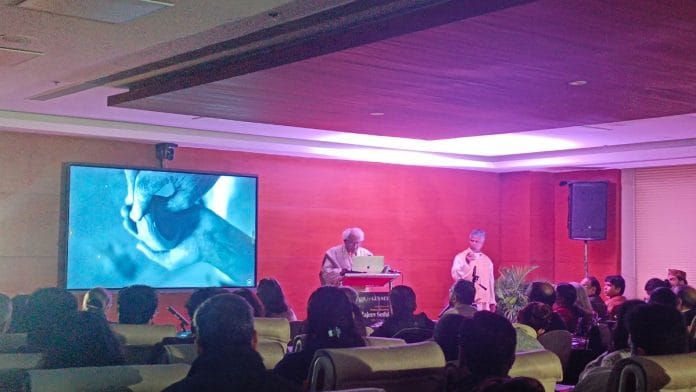



New Delhi: Art curator and designer Rajeev Sethi started with a question for a full-room audience as he began his lecture on “Handmade for Gen-Next” on Sunday.
“What do you remember as the first thing or moment you heard the word handmade?” he asked the audience in Delhi.
Several people raised their hands, sharing their memories of handmade. Someone said it was the quilts her grandmother made using her old sarees, which carried her smell and love. For another, the first thing that came to their mind was the handmade cards and gifts they received on various occasions. For some, handmade meant food and for a six-year-old in the audience, it was the woollen sweater his grandmother made for him.
“Handmade is not just a thing. It is a philosophy, and a way of being and seeing. It is a touch of human intuition. The quiet dialogue between skill and soul. Something no machine can ever replicate,” said Sethi.
The Padma Bhushan awardee reflected on critical questions that define handmade today—whether it can endure in an era of rapid technological change and how its age-old strengths can respond to contemporary challenges such as migration and cultural homogenisation.
The lecture was part of the handicraft series organised by the Office of the Development Commissioner (Handicrafts), Ministry of Textiles, with the support of the Export Promotion Council for Handicrafts. The inaugural edition of the Kamaladevi Chattopadhyay Craft Lecture Series was launched at the International Craft Complex (The Kunj) in New Delhi on 14 December.
The series is a tribute to the visionary legacy of Kamaladevi Chattopadhyay, widely regarded as the mother of India’s craft renaissance, who played a pioneering role in reviving India’s handicraft and handloom traditions.
“Her lifelong work helped empower artisans, promote indigenous crafts, and position Indian handicrafts on the global stage,” said Sethi.
Sethi also underlined the enduring power of the human hand—its intuition, skill, and sensitivity—as a creative force that no machine can fully replicate, and highlighted how handmade craft aligns closely with sustainability through less mechanised production, localised livelihoods, and the empowerment of women and marginalised communities across India.
Handmade vs machines
Inviting the audience to an exercise, he asked them to raise their hands and look at their palms. For Sethi, understanding handmade starts with self-awareness of the hand.
“Notice your palms; they have millions of neurons, and at the end of each fingertip are connections to your brain,” he said, raising his hand and showing his palm.
He explained that the equilibrium of the eye, the mind, and the spirit is managed by the tips of the fingers, adding that touch is not secondary to thought—it is integral to it. He said that hands connect the human body. Machines separate seeing, thinking, and doing, but handmade unites eye, mind, and spirit simultaneously.
“Fingers help us think and never get old,” he said, adding that the disappearance of tactile engagement in the digital age threatens this deep human connection. “Sixteen aspects—like skill, memory, emotions, culture, and identity—reside in the hand, all of which cannot be replicated by machines.”
Also read: India is growing, but not developing, says author Santosh Desai
The next generation
India occupies a vital place at the global level through its handicrafts, architecture, and living traditions. Sethi said that it is crucial to preserve these practices, speak about them, and actively introduce them to the new generation. By outlining the contrast between handmade processes and machinery, he discussed how a balance between the two can be achieved.
To illustrate this tension, Sethi played a clip from the 1959 film Paigam, starring Dilip Kumar and Rajendra Kumar, which addresses the conflict between industrialisation, labour, and human values—closely aligning with the question of whether the future should be “mass produced or produced by the masses.”
The debate between machines and human effort is not new. Rather, the future must allow for coexistence—between handmade and machine-made, personal and virtual, slow and fast—rather than forcing a choice between them. Sethi added that individuals and communities must continue to fight for their rights, values, and cultural identity.
“India is the only country left where people are still using their hands. We should show this to the whole world,” said Sethi.
Sethi also urged the younger generation to take Indian artisanship and craft to the next level by giving it renewed recognition rather than confining it to museums. He added that the next generation must reimagine Indian skills before they disappear or before their credit is entirely claimed by others.
“India is perhaps the only country left in the world that has a vast reservoir of design resources and skilled craftsmen in every medium, whose creative energies can be tapped to restore to the Western world what it has lost in the last century during its drive toward mechanisation and industrialisation,” he said.
(Edited by Ratan Priya)