








New Delhi: People like to talk about sexuality, but they don’t like to talk about sex, writer and filmmaker Paromita Vohra said during a recent conversation on her new anthology, Love, Sex and India. She sought to change this through her digital media project, Agents of Ishq. The website hosts stories, poems, and nonfiction pieces on sex, relationships, and mental health.
“We wanted to talk about sex as it is without any boringness, with a lot of mercy, and even vulgarity,” she said.
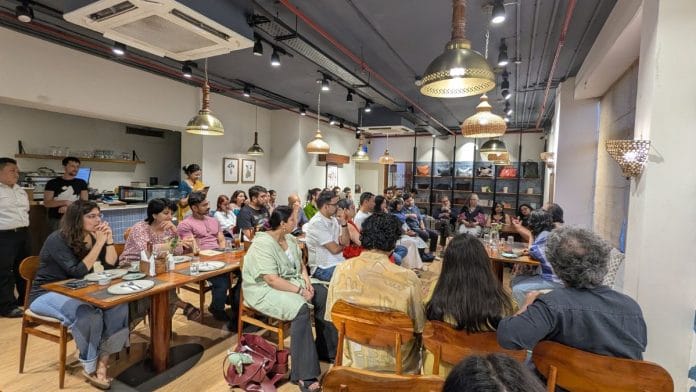
Vohra was in conversation with journalist Manisha Pande at The Bookshop Inc in Vasant Kunj, New Delhi, on 13 March. About 50-odd people turned up for an evening of witty, naughty discussions on topics ranging from yearning and vulnerability to privacy and AI.
According to Vohra, the problem with sexuality influencers is that they try to tell their audiences what is right and wrong—what is good sex, what is bad sex, and how to navigate it.
“People think about their own sex lives in terms of jargon now. They slot themselves, like, ‘Mine is a story of body positivity.’ You are not saying, ‘This happened to me. This is my experience, my self-discovery, my self-acceptance’,” she said.
In a world that offers modern lovers with ever-increasing terms and definitions, Vohra views Agents of Ishq as a much-needed space for confusion.
Also read: Love, lies, laundry & UCC—inside India’s live-in relationships
Inviting the new
When Vohra started Agents of Ishq, she made a conscious effort to centre women and queer people. Over time, men did enter the space, she said, but on the terms of the platform.
“A lot of women wrote in, and a lot of gay men wrote in, but we didn’t get submissions from lesbian women and straight men. And though that has changed over time with respect to queer women, straight men really find it very difficult,” she said.
Even when men write sex scenes, Vohra finds an overuse of metaphor and description. “It’s too much like an action scene,” she said to nods and laughter.
According to Writer and critical thinking professor Aditya Vikram, who read out a section from his chapter in Love, Sex and India at the event, Agents of Ishq is significant because it furthers the conversation on pleasure and desire instead of repeating it.
“We’re constantly criticising how regressive, problematic older conversations have been. But what Agents of Ishq did was to move the focus from being these hoity-toity critics of what’s wrong with the conversations on sex to inviting the new,” they told ThePrint.
The website welcomes pieces from people who aren’t experienced in writing and are unaware of the popular categories with which the social media age understands sexuality and sex.
“Editing a story on something new that couldn’t be said earlier and spending five months on it, instead of hiring some posh writer to write the same old critical piece—that’s the most powerful thing the platform has done,” Vikram added.
Also read: Everyone’s ‘damaged’ in modern dating. Love will soon be called a mental illness
What shapes love?
In her conversations with the younger generations, Vohra has found a fear of vulnerability. Falling in love is not ideal because relationships are a game one can’t afford to lose. She wondered if Devdas was made again, whether it would be a hit. The character of Devdas, after all, is a loser in love.
“The degree to which capitalism is shaping our emotions is really this: You want relationships to be emotionally efficient. If a young kid falls in love, he may not be able to be with the person he falls in love with. So, the idea of yearning, waiting—those things are made unavailable to him,” Vohra said.
She speculated whether this fear of vulnerability was connected to class. In a conversation with a group of women erotic dancers, she’d found that they thought of village boys as “nice and simple”, as opposed to city boys, who were seen as “clever”. Men who write Hindi poetry, she added, reveal a kind of comfort in the body that English male writers can’t access.
For Dalit queer activist and poet Dhiren Borissa, this came close to discussing caste in dating, but fell short of it. “The conversation missed something central to what falling in love in India means. Caste functions as a structure of love,” he said.
Pande ended the evening on a naughty note as she read out a poem by Nisha Susan from the anthology, titled Ahem:
“Smart women
My grandmother says,
Smart women
can hold their men
in the palm of their hands.
I’m beginning to wonder
what exactly she’s talking about.”
(Edited by Theres Sudeep)