





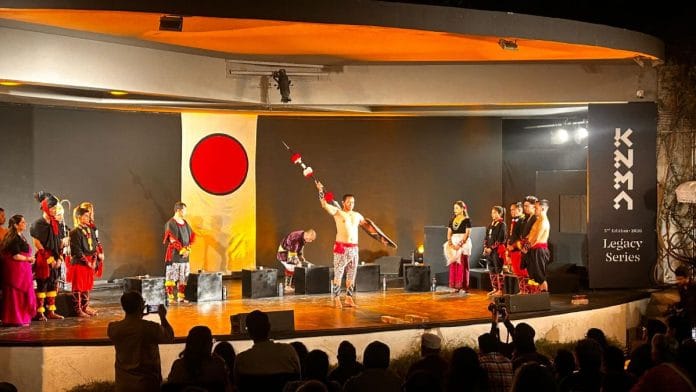



New Delhi: First came the ritual invocation, as Manipuri men dressed in traditional Meitei attire moved to the strains of meditative music, setting the tone for the two performances to follow.
The audience had gathered at the Triveni Kala Sangam on 20 February to witness Thang-Ta, a Manipuri martial art form that blends sword and spear combat with ritual, philosophy, and movement. The name ‘Thang-Ta’ translates to ‘sword and spear’.
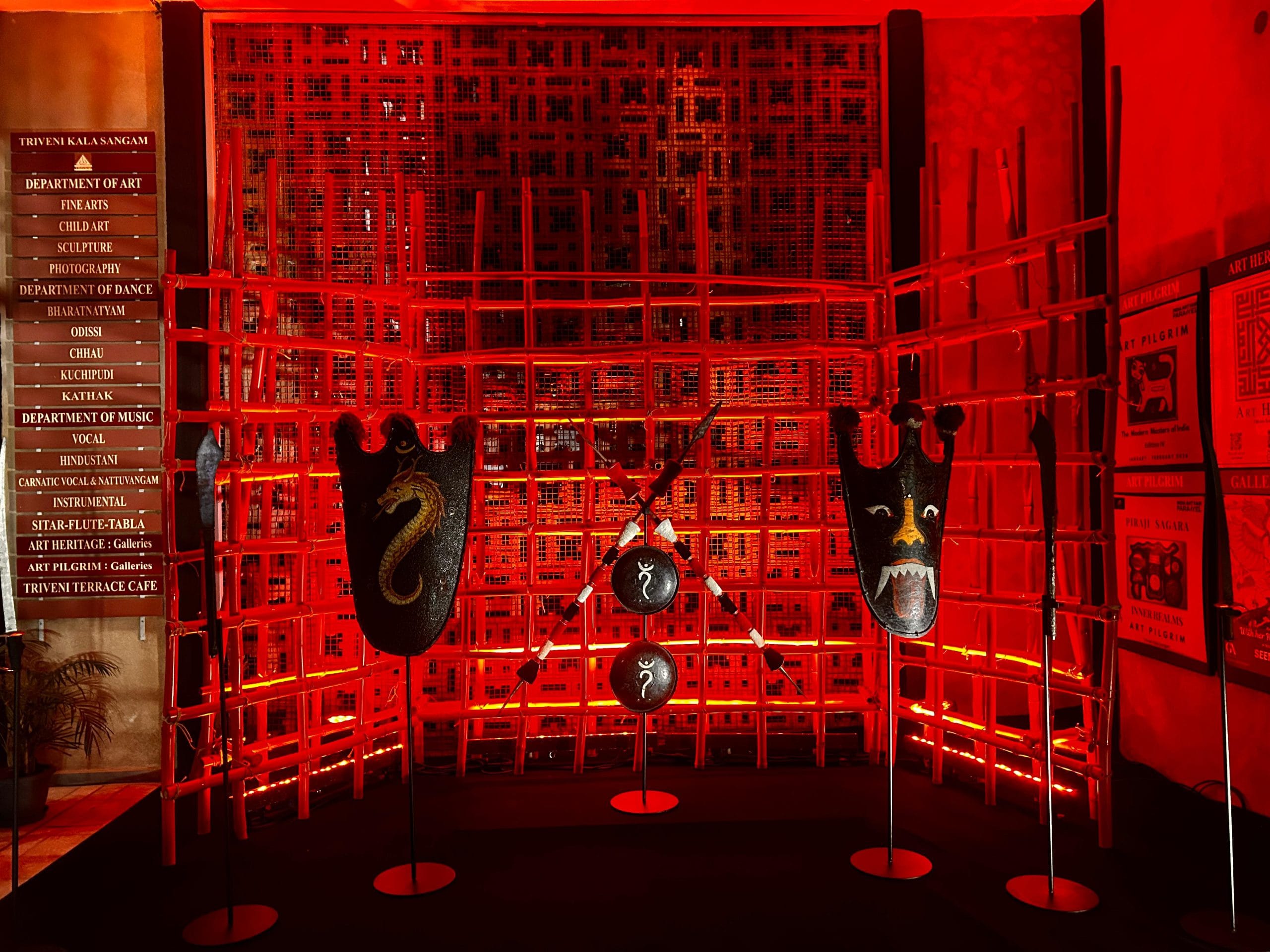
The welcome was grand, complete with a dance performance and musicians at the gates. A large bamboo art installation featured ritualistic spears and shields under glowing red light.
The performances were preceded by a panel discussion on the dance form and its long history.
“For Manipuris, Thang-Ta is not just a martial art—it is mother, father, god, and fear, woven into everyday life,” said Priti Patel, acclaimed Manipuri dancer who choreographed one of the performances.
She was joined on the panel by cultural gurus Gurumayun Biseshwor Sharma, Ojha Ranjeet Chingtham, Ojha Thokchom Imocha Singh, and performer Surjit Nongmeikapam.
The Thang-Ta showcase was a part of the third edition of the Legacy series by the Kiran Nadar Museum of Art. It honours generations of dancers and performers who have devoted their lives to the ‘intergenerational transfer of artistic disciplines’.
The myth behind the form
Thang-Ta wasn’t always performed on the stage.
“Thang-Ta was originally a warfare art, later suppressed under British rule, and preserved by our gurus as a performing form. Though banned under British rule, it was preserved by our gurus as a performing form, even as its core training remains martial,” said Patel.
The Manusmriti describes Thang-Ta as an integral part in the creation of heaven and earth. When the serpentine Meitei god Pakhangba stomped and levelled the soil, the movements of the form were born. According to the story, the deity’s limbs and bones turned into a sword and a spear, while his teeth and fingers turned into an iron axe and arrows, respectively.
The martial art form helped Meteis survive conflicts inside Manipur as well as fight invaders and colonial rule.
“It is fundamentally a warfare art. We continue to teach it as that,” Patel added.
Sharma, Chingtham, and Singh have learned Thang-Ta from experts. Chingtham was learning Chinese kung fu when he was introduced to Thang-Ta by his friends. He was impressed.
“Once I began training, I realised our art is no less than any other martial tradition, and that gave me the conviction to develop and nurture my own style,” he said. Chingthem teaches at the Huyen Lallong Manipur Thang-Ta Cultural Association.
Nongneikapam, who identifies as a Manipuri performer—not a martial artist—brings Thang-Ta to wider audiences through contemporary dance.
“Through contemporary dance, I try to create a bridge for those unfamiliar with martial arts, offering them a glimpse into the philosophy and culture of Manipur,” he said.
Also read: 100 Ways to See India: Stats, Stories, and Surprises captures the country’s diversity
Yangshak and Agni
Before the performances began in earnest, Singh introduced the audience to the martial form as he guided his disciples through some warm-up exercises.
The first performance, ‘Yangshak’, featured dancers Senjam Hemjit and Yanglem Luckyson, and was choreographed by Nongmeikapam. Yangshak is an expression of inner awareness to gain a deeper understanding of the body. ‘Yang’ means ‘spine (internal)’ and ‘shak’ means ‘image (external)’.
While the first performance was about externalising emotions, the second one, ‘Agni’, featured Vedic Meitei chants and rituals, invoking the fire deity to purify all evil. Presented by the Centre for Manipuri Dance and Movement Therapy and choreographed by Patel, the piece began with a ritualistic ‘Agni Manthan’ or the lightning of fire.
(Edited by Prasanna Bachchhav)