





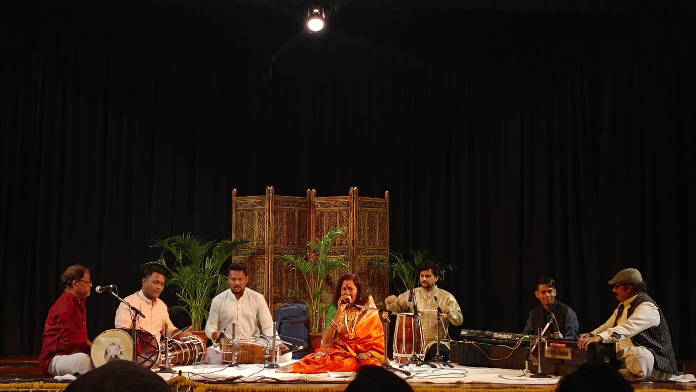



New Delhi: In an orange silk saree and seated amid her team of instrumentalists, Shailesh Srivastava took the audience on a musical journey, unfolding the beauty of folk traditions from Maharashtra, Uttar Pradesh and Punjab through her evocative singing.
The Ministry of Culture’s North Central Zone Cultural Centre (NCZCC), Prayagraj, organised the event — a celebration of folk music — at the India International Centre in New Delhi on Wednesday. The event, titled ‘Maati Ki Boli: Essence of Land’, was an evening dedicated to traditional folk music and its deep-rooted cultural stories.
Srivastava presented the lyrical soul of Maharashtra’s folk traditions and, after popular demand, concluded the evening with folk songs from Uttar Pradesh and Punjab.
“Folk is so beautiful, raw and powerful that it doesn’t need extra beats or music to make it reach another person or to convince someone to move with the song,” Srivastava said as she began her performance with ‘Ganraya Taraya Yave Dhauni,’ a popular Marathi devotional song dedicated to the Hindu deity Ganesh. In Hindu tradition, every auspicious beginning starts with invoking Ganesha.
“Here we asked Ganesha to come to us and remove our problems,” she said. “Only folk can allow this kind of intimacy — where one can call out to God and ask Him to come running to take away our sorrows.”
Srivastava then moved to a song centred on Krishna, whose playful and mischievous childhood stories have been celebrated in folk traditions across India — from stealing makhan (butter) to teasing the gopis (milkmaids).
“Folk is the only art form that never grows old; even many of Bollywood’s most popular songs are rooted in folk music,” she added, before beginning ‘Yamunechya Tiri Kal Pahila Hari, Kanha Vajavi Basuri.’ It is another Marathi folk song that narrates the gopis’ playful complaints to Krishna’s mother, Yashoda, about his flute-playing by the banks of the River Yamuna.
Padma Bhushan awardees, brothers Pandit Rajan Mishra and Pandit Sajan Mishra of the Banaras gharana, trained Srivastava. She has gone on to be celebrated for her mastery across regions, languages, and folk traditions. She holds a doctorate in folk and media from Shreemati Nathibai Damodar Thackersey Women’s University, Mumbai, and can sing in over 11 languages, including Sanskrit, Hindi, Urdu, Bhojpuri, Awadhi, Punjabi, Sindhi, Himachali, Dogri, and Marathi.
‘Once more’
“Once more! Once more!” “One last song from Uttar Pradesh, please!” “No Punjabi songs, please!” — the audience shouted as soon as Srivastava finished the scheduled performances of the day, including Marathi folk songs, ‘Gan–Gondhal’, ‘Vagya-Murli’, ‘Jagran’ (Khandoba), ‘Gaulang’ (Gopi–Krishna dialogue), and ‘Baithakicha Lavani’.
Not wanting to disappoint her audience, she seamlessly transitioned from Maharashtra and Marathi folk to Uttar Pradesh, performing ‘Mundra Kaga Kahe Bole’ and ‘Kotha Ke Uper Kothariya’.
“Folk has songs about everything — from a nose pin to a crow making noise signalling that guests will soon arrive at the house,” she said, highlighting the versatility of folk music and the richness of India’s languages.
Srivastava has performed at international platforms such as the World Hindi Conference in Mauritius, the Asian Music Festival in Indonesia, the Shah Tarana Lohri Festival in Russia, and also in the United States, Trinidad and Tobago, Guyana, and Amsterdam. She is also an empanelled artist at the Indian Council for Cultural Relations (ICCR), New Delhi.
As the beats of the tabla, bodhran, harmonium, synthesiser, dholki, naal, sambal, and chipani rose, the energy in the room shifted. From clapping and singing along, the audience soon stood on their feet, dancing to the next folk performance — the Punjabi song ‘Mera Laung Gawacha’.
Fifty-six-year-old Anupriya Joshi, who sat in the middle of the auditorium and clapped along to the beats.
“The event went beyond a performance, I felt like I just attended a one-hour concert of tabla and Marathi folk music,” she said.
(Edited by Insha Jalil Waziri)