








New Delhi: While elderly attendees and young participants in the back rows of the Jawahar Bhawan hall yawned or sat half-asleep, urban planner and architect Mukta Naik delivered a remark that jolted the room awake. India’s cities are heading toward a future that is “hotter, flooded, congested and increasingly unlivable” unless the country fundamentally rethinks how it plans and governs urban spaces, Naik warned Monday at the launch of City Limits: The Crisis of Urbanisation.
Published by Penguin Random House and edited by urban planner Tikender Panwar, the anthology argues that India’s urban growth, once imagined as the engine of development, is instead producing climate vulnerability and social segregation.
“We’re going to be hotter. We’re going to be unlivable. We’re going to be flooded. We’re going to be congested. It doesn’t matter how rich you are. The middle class will be as sad and as frustrated as the poor are now. Is that the future that we want?” Naik, who contributed to the book, said.
Naik joined urban planners, practitioners, and experts in expressing concern about the lack of policies and schemes for urban development, the rise of Hindutva urbanism, changing urban landscapes, distress migration, segregation, and the emergence of non-livable, unsustainable urbanisation in ‘New India’.
The panel included Congress Rajya Sabha MP Manish Tewari, CPI(M) Rajya Sabha MP John Brittas, Congress spokesperson Gurdeep Sappal, former Deputy Mayor of Shimla and urban planner Tikender Panwar, Samajwadi Party spokesperson Abhishek Mishra, senior journalist Sangeeta Barooah Pisharoty, Executive Director of ActionAid Association India Sandeep Chachra, and Urban practitioner Aravind Unni.
Aravind Unni, a contributor to the anthology, claimed that the government introduced policies and schemes for urban development until 2015, but has not announced any major new scheme since then. He highlighted that the Smart Cities Mission, the flagship programme of the Indian Government, ended in March 2025, and added that no new urban development initiative has followed its conclusion.
He explained that schemes such as the Deendayal Antyodaya Yojana—National Urban Livelihoods Mission (DAY-NULM) have stalled, and several other initiatives exist only on paper without direct links to urban development. Although the 2026 Budget announced the Urban Challenge Fund program, there is no blueprint for it.
“Right now, there is no national policy or scheme, even a big scheme for urban development,” claimed Unni. “The Smart Cities Mission has ended. What is the next plan? Where is DAY-NULM? It is such a large scheme, yet no work has been done for the past two years. That reflects a larger problem. There is a clear lack of vision and clarity in the urbanisation. It is absolutely not there.”
Also read: Mumbai to Bengaluru—Indian cities are unlivable despite economic growth, says report
Helix of Urbanisation
The country’s helix of urbanisation is closely tied to capital accumulation. Cities function as centres of production where surplus is generated and should ideally return to society through democratic distribution.
Former Deputy Mayor Tikendra Panwar explained that while this forms one part of the urbanisation helix, the country has failed to capture another important dimension of urban economic activity.
Panwar referred to an Intergovernmental Panel on Climate Change report and said the second helix of urbanisation reflects a new climate crisis in which children born after 1996 have experienced disasters once every six months.
According to him, urban planning increasingly prioritised capital investment over everyday needs, with infrastructure often designed inefficiently. He explained that during the 1970s and 1980s, cities had space that could have supported social housing, ecological planning, and geography-led development, but the 1990s shifted the focus toward making cities engines of growth.
He described the shift as cities going from managers to entrepreneurs.
“Real estate was one of the principal drivers. Unfortunately, that starts the first process of massive segregation, and profound human inequality begins. The whole capacity of the cities was giving way from production houses to being centres of service, where 90 to 92 per cent of the people are now employed informally,” he said.
Panwar also highlighted the third helix of urbanisation, which deepens existing social stratification and pushes marginalised communities further to the margins.
Also read: Bengaluru and its inspired incompetence in running things
Hindutva Urbanism
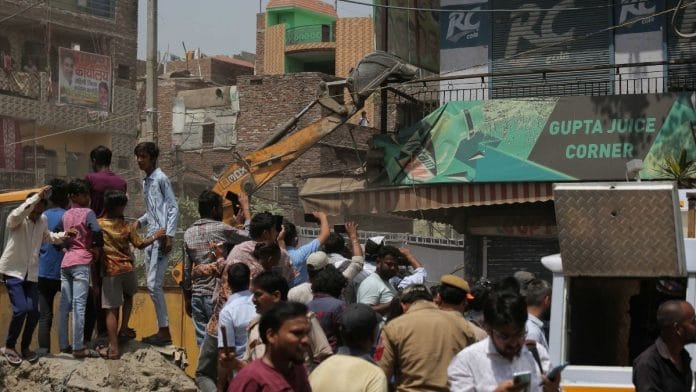
Unni called the new urban model a ‘demolition city’. He said the government has increasingly weaponised urban policies and schemes for displacement. He explained that programmes such as the Smart Cities Mission, Pradhan Mantri Awas Yojana, and heritage redevelopment projects in Varanasi have often been used to reshape cities through demolition.
According to him, this trend became especially clear after 2014 and became even more visible after the Covid-19 pandemic, marking a distinct shift from earlier demolition patterns.
“Demolitions now had become weaponised, targeted at communities and households, without even looking at the master plans or giving any reasons. They have become a policy,” he said.
Unni directed attention toward how urban demolition is a modern form of social segregation, referring to historical patterns in which Dalits were pushed out of villages.
He described this as the weaponisation of demolition and linked it to what he called ‘Hindutva Urbanism,’ saying ideology now increasingly shapes how cities are planned, who belongs in them, and who stays outside the periphery.
Manish Tewari, Congress Rajya Sabha MP, said that people are angry because they already understand what is failing.
Tewari alleged that the governments and officials were failing to understand the concept of a smart city, as a substantial portion of the allocated funds was spent on routine municipal works.
“I’m still waiting for somebody to give me the answer on what makes the city smart,” Tewari says with a wry smile.
(Edited by Theres Sudeep)