





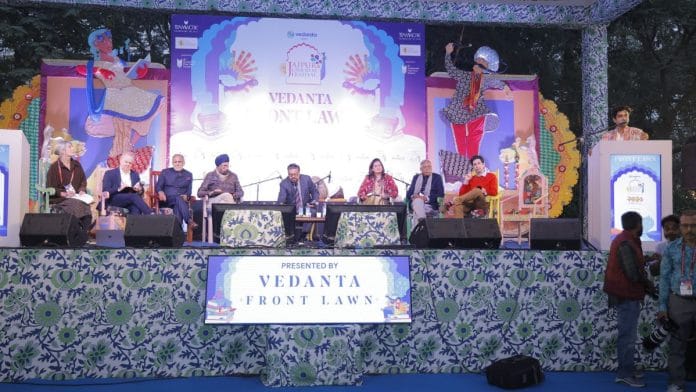



Jaipur: As the sun set on the Jaipur Literature Festival, journalist Vir Sanghvi asked the audience to rate on a scale of 10 if they thought freedom of speech was a dangerous idea. Most voted in the 0-2 category.
Sanghvi was the moderator for the closing debate of the five-day event, where the house proposed, “Freedom of speech is a dangerous idea”. Participants for the motion included politician Anish Gawande, author Fara Dabhoiwala, former Rajya Sabha member Pavan K Varma, and Shiv Sena leader Priyanka Chaturvedi.
On the opposite side stood poet Alice Oswald, journalist Ian Hislop, former Indian diplomat Navdeep Singh Suri, and former Indian ambassador to the United States Navtej Sarna.
Freedom of speech in India, US
The debate was carried out in three rounds: opening statements, rebuttals, and questions by the moderator, followed by a Q&A session.
Most of the panel members were of the opinion that freedom of speech indeed is a dangerous idea, but Hislop and Oswald disagreed.
“It is a less dangerous idea than silence,” Hislop said, a sentiment that Oswald agreed with.
On the other side of the divide, Gawande and Chaturvedi argued that freedom of speech is especially dangerous in India, giving the example of Umar Khalid.
“It is our champagne socialists on this panel today who can defend the freedom of speech and sell that illusion to you. We can defend it from the Jaipur Literature Festival. But you have to rot in jail,” he said, referring to Khalid.
Hislop countered the argument, saying that the whole history of freedom of speech is about people going to jail for it.
Chaturvedi argued that it is good in theory but not in practice. She added that people spread misinformation under the garb of freedom of speech, citing the example of AR Rahman. The musician recently said that the Hindi film industry is becoming communal, which Chaturvedi disagrees with. In the case of Rahman, Chaturvedi said free speech had become a dangerous thing.
Dabhoiwala, whose book What Is Free Speech? The History of a Dangerous Idea (2025) inspired the debate, was technically not allowed to take any side and posed as an interloper. He said that freedom of speech has always been under attack in various ways in India and the US. “Autocrats are always trying to suppress it,” he said.
Hislop chose a different approach to his argument by being funny and witty; the journalist quickly became a crowd favourite. “If freedom of speech is pointless, then I’ve wasted my whole life,” were his opening words. And he ended by yelling “freedom of the press”.
Also read: ‘Judges fear granting bail’—DY Chandrachud takes on Umar Khalid question at JLF
‘Dangerous, but worth it’
Former civil servant Varma posed a question that had the crowd in an uproar. “We have to keep the context in mind while debating this. Would you want to be in jail without bail,” he said, referring to Khalid.
Before one knows it, they are in jail or being raided by the Enforcement Directorate or the Criminal Bureau of Information, Varna added. Asserting one’s freedom of speech is “playing with fire”—it’s available only to those with power.
Suri highlighted that it was Nehru who first introduced “reasonable restrictions” on freedom of speech with the first amendment to the Constitution in 1951. He also joked that in the current political and social climate, there should be a “ministry of hurt sentiments”.
“Laughter toh allowed hi nahi hai (laughter is not allowed), ask Kunal Kamra, ask Munawar Faruqui, ask Vir Das,” he said.
Sarna argued that reasonable restrictions on free speech have been present since ancient Athens, and that if one is critiquing that idea by arguing that it belongs to a select few, then they are “demonising democracy” altogether, as freedom of speech is the bedrock of liberty. But Chaturvedi interjected, questioning who defines these restrictions and why.
According to Oswald, free speech can be found everywhere from the horns on the roads to the beeps at a traffic light—they all signal dissent or disagreement.
“Without freedom of speech, one cannot argue the boundaries of freedom of speech,” Hislop said. “It is more dangerous to try to restrict these things, because then people do not talk about them. And then, they resort to other means. So yes, freedom of speech is dangerous, but it is a lot less dangerous than silence.”
Sanghvi summed up the debate by saying that while many things were covered, there was “no coherent discussion”—something many in the audience agreed with.
“It tells us how complicated life is, and particularly life in India at the moment. And it does tell us that sometimes dissent can be dangerous, but I think they [the panel] would all agree that it’s worth it,” Sanghvi said.
(Edited by Prasanna Bachchhav)