





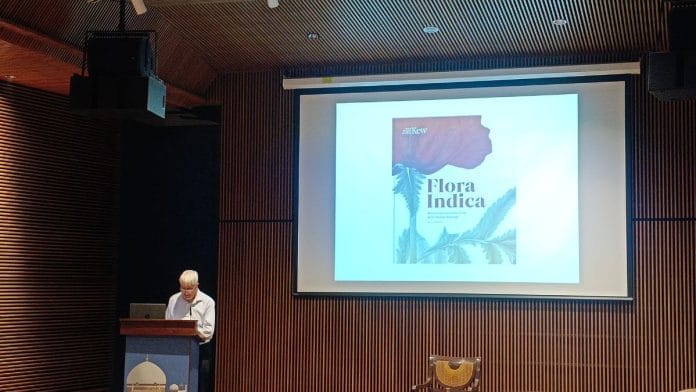



New Delhi: A new book on the history of India’s botanical art brings to light forgotten stories and rare botanical paintings from India. Flora Indica: Recovering Lost Stories from Kew’s Indian Drawings highlights the work of Indian artists commissioned by British botanists between 1790 and 1850.
The story of Flora Indica began with an astonishing discovery: More than 7,500 botanical drawings made by Indian artists were lying largely unnoticed in the collections of the Royal Botanic Gardens, Kew, London.
Speaking at the launch of his new book, author and botanist Henry Noltie revealed that the exhibition and the book grew out of years of research into these remarkable yet overlooked works. The book launch was held at the museum at the Humayun’s Tomb World Heritage Site.
The launch coincides with a related exhibition running at the Shirley Sherwood Gallery of Botanical Art at Kew Gardens in London until 12 April 2026.
“These drawings show the extraordinary skill of Indian artists whose contribution to the great global project of botanical science has long been neglected,” said Noltie. “The exhibition brings together 52 drawings from Kew’s collection of more than 7,500 botanical artworks, created by Indian artists for British patrons in India between 1790 and 1850.”
The book brings together a selection from Kew’s collection along with remarkable stories of the artists who painted them, the colonial context in which they were created, and their role in the development of botanical knowledge.
Noltie explores the work of twenty Indian artists from the previously fragmented, uncatalogued, and largely inaccessible collection of more than 7,000 Indian illustrations in Kew’s archives, showcasing over 100 exquisite watercolours in this celebration of Indian botanical art.
He also traces how the drawings from India eventually reached Kew through British administrators, botanists, and institutions linked to the East India Company.
“When the East India Company’s museum in London was finally abolished in 1879, all its botanical material—including more than a thousand drawings—was transferred to Kew,” Noltie said.
Also read: Ganga has been the lab for this BHU professor. It has earned him a global honour now
Rediscovering the collection
The book and exhibition are the latest outcome of Noltie’s research. He began his work in 1998 on a similar collection at the Royal Botanic Garden Edinburgh, where he spent most of his professional career as a curator and taxonomist.
Going further into the background of the project, Noltie traced the history of Britain’s two major botanical institutions—the Royal Botanic Garden Edinburgh and the Royal Botanic Gardens, Kew to show how Indian botanical drawings eventually entered their collections.
Edinburgh’s garden, founded in 1670, was originally established to support medical education.
“Its primary role was to teach medical students about materia medica, the plants from which medicines were made,” Noltie said.
As Edinburgh became a major centre of medical learning in the 18th century, many graduates travelled across the expanding British Empire. “Many graduates went out to the Americas and the Caribbean, and then to India. Medics made major contributions to the study and documentation of plant biodiversity,” he noted.
These scientists frequently commissioned detailed plant drawings from Indian artists, some of which later returned to Britain.
Kew, however, developed very differently. It began as a royal garden before becoming a scientific institution in the 19th century, eventually evolving into the centre of a global network of colonial botanical gardens documenting plant diversity.
However, despite their importance, many of the drawings gradually faded into obscurity as botanical research came to rely mainly on preserved plant specimens.
Noltie’s research eventually brought the forgotten collection back into focus. Over several years, he systematically reviewed the archives at Kew. “During long weekdays and weekends, I went through about 2,50,000 drawings,” he said, adding that the work helped reconstruct fragmented collections and identify artists and plant species.
Also read: Grown in Karnataka, sold as American — Inside India’s gherkin empire
Story of the artists
Noltie highlighted that many Indian artists played a central role in early botanical science, yet their names were often forgotten or omitted from history.
However, some artists left their own notes on their work.
“A large proportion of these drawings bear annotations written by the artists themselves, the artist’s name and the date and place of that collection”, said Noltie, giving the example of Lakshman Singh, whose signature appears on a botanical illustration.
Noltie also pointed out the variety of artists’ backgrounds, who were commissioned from north to south India.
“One aspect of the drawings I’ve always been keen to stress is the diversity of the backgrounds of artists, available for commissioning by company surgeons and others,” he said, further adding that their styles ranged from naturalistic to highly stylised, reflecting Indian artistic traditions.
The audience listened silently for the whole hour. When the time for questions opened, many hands shot up, eager to clarify and explore further.
“Can you tell us about botanical art in India before colonisation?” a question came from the audience.
Noltie first apologised for not having more knowledge about this, then added that the Mughals did produce paintings, but they were usually very stylised and symmetrical.
“There was a famous album in Tehran, which had very accurate plant drawings; many of the drawings in it are actually copies of European wood engravings. They were more interested in making motifs for things like inlaying and just weren’t terribly good at naturalism,” he answered.
(Edited by Theres Sudeep)