





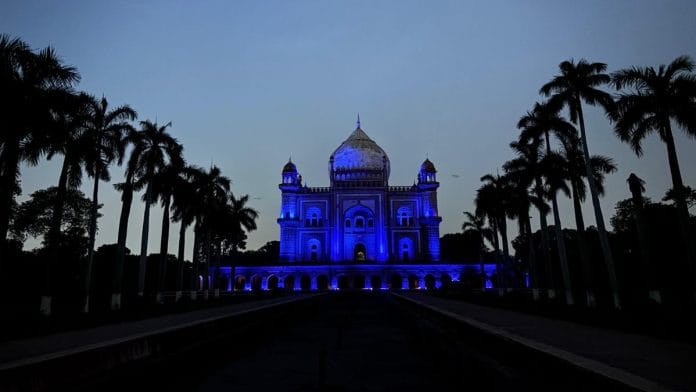



New Delhi: As the sun set on Thursday, Delhi’s Safdarjung Tomb slowly turned a deep shade of blue, its dome glowing against the evening sky. Gathered in front of it, volunteers, teachers, and parents, along with children and adults on the autism spectrum, all dressed in blue, watched the illumination together.
Organised by the Autism Centre for Excellence (ACE) in collaboration with the Archaeological Survey of India (ASI) and Sabhyata Foundation, the event was part of the global Light It Up Blue campaign observed each year on 2 April to mark World Autism Awareness Day. This is not the first time such a gesture has been attempted in Delhi — ACE had earlier collaborated with ASI to light up Qutub Minar in 2017 and 2018.
After the lights came on, the group assembled together and broke into song. From ‘Kholo Kholo’ from Taare Zameen Par to Barfi’s ‘Aashiyan’, familiar tracks and rhythmic claps filled the space, drawing curious bystanders closer to the monument — some stopping to watch, others asking what the gathering was about.
For Dr Archana Nayar, founder of ACE and parent of a child with autism, the symbolism of such events lies in making the invisible visible. “This is more of a symbolic gesture. Day to day life is what our teachers do working with children. But symbolism matters because autism is largely invisible. The struggles of the families are invisible too, and this gives them visibility,” she told ThePrint.
World Autism Awareness Day was designated by the United Nations in 2007. Across the globe, monuments and landmarks are lit blue to support the autistic community. This year, along with Safdarjung Tomb, the Grand Egyptian Museum and landmarks and institutions across Qatar also joined the initiative. This year’s initiative, aligned with the global theme “Autism and Humanity-Every Life Has Value.”
Also read: There’s a shift from evidence-based history to belief-driven narratives, say professors
Awareness to acceptance
In recent years, however, the conversation has begun to shift. “Now people are calling it Autism Acceptance Day,” Nayar said. “We have thankfully moved from awareness to acceptance. Ten or fifteen years ago, people didn’t even know what autism was. Now the question is more nuanced–what does acceptance actually mean?”
For Nayar, that question plays out most sharply in everyday public spaces. “What happens when an autistic person is not in a safe space like home or school? What happens in a mall, a movie hall, an airport? That’s where acceptance really needs to show,” she said.
Over the past decade, she has seen some change. When ACE began, children often came in at older ages and there were fewer trained educators. “Now we are seeing children as young as two or three coming in. There are more teachers, and parents are more open to functional learning, not just academics. Parents want their children to be independent now,” she said.
But that progress does not extend evenly into adulthood. “Inclusion breaks as individuals grow older. In workplaces, it really falls apart,” Nayar said, adding that many adults on the spectrum continue to have limited opportunities. She pointed to a particular gap when it comes to women. “Families are often more protective of girls with disabilities, which further limits their independence,” she said.
The next phase of work, she argued, must focus on adulthood and public engagement. “We need to do the opposite of what we are doing right now. Instead of trying to fit autistic individuals into existing systems, workplaces and public spaces need to understand their lives better,” she said.
(Edited by Aamaan Alam Khan)