





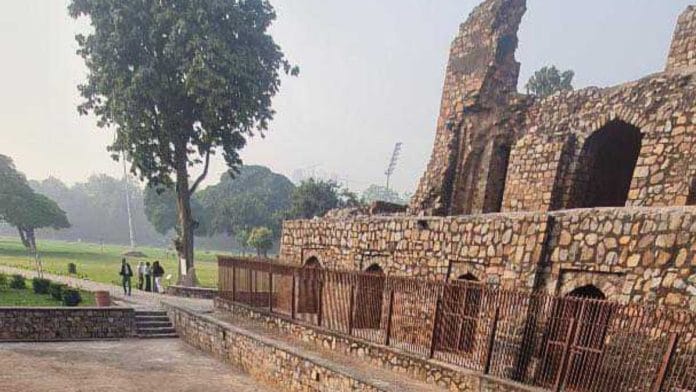



New Delhi: Standing amid the broken walls of Feroz Shah Kotla, a weekend heritage walk in Delhi connected dots between geography and history, linking the Deccan and Delhi across different ruling periods. The walk explored what was happening in the Deccan when Delhi served as the capital under various rulers.
Hyderabad storyteller Yunus Lasania and heritage walk curator Dolan Samanta led the walk that unpacked the layered history of how Delhi and the Deccan—often treated separately in textbooks—were deeply connected through conquest, trade, culture, and power. The walk was titled Delhi vs Deccan: A Heritage Walk.
“Historically and politically, we talk about Delhi, the Mughals, and the north. But we don’t talk about how important the southern states were,” said Lasania. Pointing to maps of South India, he said that while Muslims rulers are commonly associated with North India, Muslim communities had already been living along India’s southern coastal regions as traders.
Rulers based in North India often travelled south but rarely stayed for long. The primary reason was wealth and trade from the coastal regions.
“The first rulers to really look south were the Khiljis—and for good reason. They spoke extensively about the wealth of the southern coastal regions. That wealth is what sustained the Khiljis here in Delhi,” Lasania said.
Also read: British-era tanks & jumbled pipelines—this heritage walk explores Mumbai’s ties to water
Delhi to Deccan
As the walk continued and the group moved deeper into the fort, Samanta stopped in the middle of an open courtyard and pointed to the broken walls on both sides.
“Can you guess what this place must have been?” she asked the group of around ten participants.
The space once served as the sitting and meeting area of Firoz Shah Tughlaq. She used the site to trace the broader history of Delhi’s rulers.
“Do you know that there were seven cities of Delhi?” Samanta asked.
She went on to outline the evolution of the capital. The earliest city was Lal Kot, founded by the Tomar Rajputs and later expanded by the Chauhan dynasty, most notably under Prithviraj Chauhan, before Delhi passed into Turkic hands. Following the defeat of the Chauhans, the Mamluk (Slave) dynasty ruled from the Mehrauli region, marking the beginning of the Delhi Sultanate under rulers such as Qutbuddin Aibak, Iltutmish, and Balban.
In the early fourteenth century, Alauddin Khilji established Siri. This was followed by Tughlaqabad, built by Ghiyasuddin Tughlaq as a massive defensive capital, and later Jahanpanah, founded by Muhammad bin Tughlaq.
“The sixth city was Firozabad, established by Firoz Shah Tughlaq, with Feroz Shah Kotla as its fortified core and administrative centre,” she added. “The seventh city of Delhi is Shahjahanabad, founded much later by the Mughal emperor Shah Jahan, which forms present-day Old Delhi.”
While Samanta traced Delhi through its seven citieṣ, Lasania deliberately shifted the focus southward.
“The Deccan was the financial backbone of empire-building,” Lasania said, adding that Alauddin Khilji and later the Tughlaqs were the first rulers to seriously attempt control over the region. Their campaigns against the Kakatiyas of Warangal, the Yadavas of Devagiri, and the Hoysalas of Dwarasamudra highlighted the immense wealth and power of these kingdoms, which were also deeply connected to global trade networks through the Indian Ocean.
City of Jinns
The group moved through gardens, along walls, and past locked spaces, discussing their history. Samanta spoke about how the Yamuna once flowed close to the fort and how its course has since shifted eastward, toward areas such as Shahdara and Laxmi Nagar. She traced how Delhi’s rulers repeatedly shifted their capitals in response to the changing flow of the river.
What caught the group’s attention and heightened their curiosity, however, was the mention of jinns.
“This is a living monument—the city of the jinns,” Samanta said, as the group sat on the stone steps, their questions growing.
Pointing to locked rooms on either side, she explained that while Delhi has numerous tombs, forts rarely survive intact. “Forts were often dismantled over time. The fort disappears, but the mosque is something nobody will touch,” she said.
“In this case, it was left untouched because of a rumour—the rumour of the Laat Waale Baba, who is believed to be the chief jinn,” she added. “There is a mythology within Islam which says that any abandoned site becomes a city inhabited by jinns.”
Samanta noted that similar stories exist about Tughlaqabad as well. She explained that earlier, when the rooms were not locked, hundreds of people would visit the fort every Thursday to appease the jinns and seek the fulfilment of their wishes.
“Jinns are believed to have departments for every problem—from jobs and missing persons to love and relationships,” she said. “People would write letters and leave them around the monument so that the ‘right jinn’ from the ‘right department’ could find their complaint and resolve it.”
(Edited by Theres Sudeep)
Well begun but the end leaves one yearning for more bytes on the intertwining of the histories of Delhi and Deccan. The Asafjahi Kingdom of Hyderabad Deccan was in itself a continuation of the Mughal rule by proxy , though the Mughals themselves had disappeared gradually after Aurangzeb.