





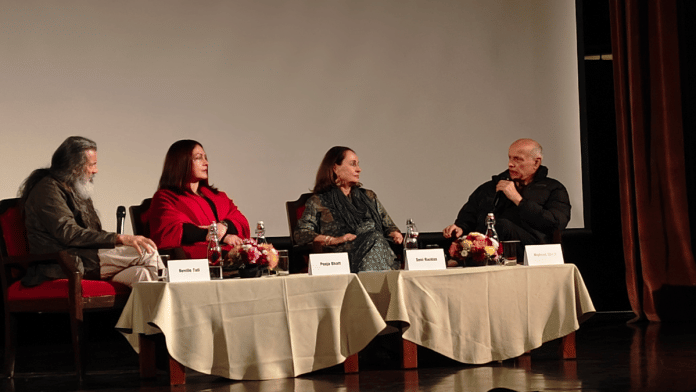



New Delhi: At a time when Indian families are undergoing a change from joint to nuclear, to even being “dysfunctional”a panel discussion featuring filmmaker Mahesh Bhatt, his second wife Soni Razdan and his daughter actor Pooja Bhatt, showed how a “healthy” family dynamic is a bespoke concept.
“My family is not broken. I think our supposed ‘dysfunctionality’ is more functional than most people’s functionality,” said Pooja, acknowledging how the family she shares is unconventional, but one forged in honesty and open communication.
The panel discussion titled ‘The Changing Smile of Childhood: the Modern Family’, held on 23 January, was a part of the sixth Self-Discovery via Rediscovering India Festival at the India Habitat Centre, New Delhi. The festival run till 25 February.
The panel was moderated by Neville Tuli, founder of the Tuli Research Centre for India Studies, which organised the film festival.
“I always treated Pooja like an adult. I remember waking her up from sleep and telling her about Soni. She was eight. I told her that I wanted to speak to her before telling her mother. And she looked at me and smiled–she did not judge me,” said Mahesh.
Pooja also highlighted the need to acknowledge that children can form their own opinions based on observing their parents, and that shapes their adult selves.
“Children can read the silence between parents, and they can know when there is no respect and love in the home. When they are not conceived with great passion, they look at the world with frightened eyes,” said Pooja, crediting her father for always being a dependable and “solid” person.
The family members approached Tuli’s questions with honesty, a trait that resonated with the large audience that had turned up despite the sudden showers in the city. One retired civil servant mentioned that a frank discussion like this is rare to expect, especially from a “film family”.
Also Read: ‘I can only imagine what new girls face’: Actor Mouni Roy alleges misconduct at Karnal wedding
‘Complex’ relationships
The discussion spent a great deal of time on the kind of upbringing both Pooja and her father had, and how each shaped their own dynamic eventually. Pooja mentioned that being acknowledged and treated with respect by her father shaped her own acceptance of the family she shares with her biological parents, as well as with Razdan and her daughters.
She recalled how he wrote a letter to her when she was born, and gave it to her when she turned six.
“It had a quote by Swami Vivekananda, and it went along the lines that you’ve arrived at a time when your father is a struggling individual, and some say your mother brought me love, and some say you will. You are the heartbeat of this unfathomable universe, and you can be whatever you want,” said Pooja, sharing the contents of the letter, which she still considers among her prized possessions.
The honesty with which her father approached his affair and the tough conversation laid the groundwork for their father-daughter relationship. It also helped Pooja and Razdan form a strong bond that has held the family together.
“We constantly look at our parents and want them to give us a break. We need to give them a break, too,” said Pooja, highlighting how relationships can change and evolve.
The actor added that her own decade-long marriage taught her that people often change and choose a different path, but that did not mean being unhappy.
Tuli asked Razdan about her experience raising her daughters, Alia and Shaheen, and being an actor in her own right, a part of the film family she was married into.
Razdan joked about how, despite wanting to be known for her work, she was, for a long time, recognised as Bhatt’s wife, an identifier which she tried to free herself from, only to end up being known as Alia Bhatt’s mother.
“However, I have to say that I am happy to be both these things, and also who I am, and I think I am fiercely who I am,” said Razdan, mentioning how she is in the process of directing her own film.
Also Read: Alia Bhatt reads the riot act to the paparazzi
Saaransh
The panel discussion preceded the screening of Mahesh’s 1984 film Saaransh, which marked the debut of Anupam Kher’s movie career and also featured Razdan.
The film looks at the lives of an elderly couple, BV Pradhan (Kher) and his wife Padma (Rohini Hattangadi), after they lose their son to a mugging incident in the United States. They open their house to a struggling actor, Sujata (Razdan), whose life ends up intersecting with their own.
The film was shot in the house where Mahesh grew up with his mother, Shirin, in Chembur in Mumbai. The filmmaker also recounted a memory of growing up as the son of a Muslim single mother and a Hindu father, who had another family.
“I remember one evening I was collecting glow worms in a bottle, and I saw my mother in an armchair; she was unwell. I tiptoed to her and put glow worms in her long hair. She looked at me and smiled, and that’s a memory etched in my mind,” said Mahesh, adding how “grief” has shaped his cinematic world and helped him develop empathy in his filmmaking.
Razdan spoke of the impact the film had when it was released.
“It was a very clear-cut kind of cinema and on the other hand it was a polar opposite movement happening in the Hindi film industry where you had the angry young man rising and you had these huge Bollywood blockbusters and multi-caste, multi-star, suddenly out of nowhere in this scheme of things a young man, Mahesh Bhatt, comes up with an idea which is real, raw, serious,” said Razdan, introducing the film.
The film was so compelling that Tarachand Barjatya came on board as a producer, despite being known for making more “homely” films under his production banner, Rajshri Films.
The Sadak (1991) director mentioned that there was a special screening held in New Delhi’s Vigyan Bhavan for members of the parliament, while the then 34-year-old director waited anxiously outside with Kher, who was even younger at 28, for the audience’s response.
“I distinctly remember when the show got over, we came out and saw Amrita Pritamji had tears in her eyes. She was quite surprised to see a young man had directed that film. She held my hand and she said, ‘Mahesh ji, meri taraf se, Hindustan ke taraf se, insaniyat ke taraf se, aapka bahut bahut shukriya, aapne aisi film banayi (Mahesh ji, on my behalf, on behalf of India, on behalf of humanity, thank you very much for making such a film),’” he recalled.
(Edited by Insha Jalil Waziri)