





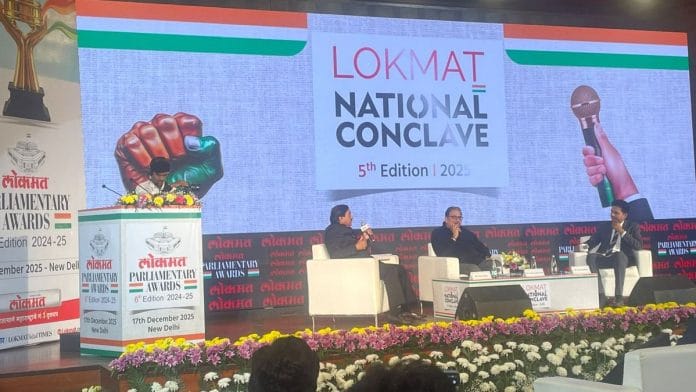



New Delhi: A panel of a former Chief Justice, an ex Chief Election Commissioner, and a Rajya Sabha MP discussed how constitutional bodies like the Supreme Court conform to moral guidelines imposed upon them by society at the 5th Lokmat National Conclave in Delhi on Wednesday.
The new Maharashtra Sadan, the official state house and administrative complex of the government of Maharashtra, hosted the event, where politicians, students, academics, and journalists had converged for two panel discussions — one on freebies and the other on the challenges faced by constitutional bodies.
Rajya Sabha MP and senior lawyer Abhishek Manu Singhvi attempted to answer how India has been able to retain its democratic spirit, despite “lying among the wrecks and ruins of failing democracies”.
He attributed it to two things: good luck and the non-institutional and institutional
pillars of democracy.
Singhvi also argued that judges don’t operate in a silo and must contend with social pressures.
“In every sphere, this compulsion to conform is the biggest self-censorship which we
have to avoid,” said Singhvi, referring to the acquittal of the two men in the
2006 Nithari killings. He noted how difficult it was for the presiding judge to
look solely at facts when the rest of society has already passed a judgement.
Also Read: Chandan Mitra saved The Pioneer. Now, the newspaper is being revived
‘Freebies for poor, hair-cutting for rich’
The first session of the afternoon, ‘Freebies Before Polls – A Boon or Bane’, was a debate between Sunil Tatkare, a Lok Sabha MP from the Nationalist Congress Party (Ajit Pawar faction), and Manoj Kumar Jha, a Rajya Sabha MP from the Rashtriya Janata Dal.
“What effect do freebies have on elections?” asked Chandan Singh, an anchor with
ABP News and the session’s moderator. He asked Tatkare and Jha to lay out their positions: “Are freebies just the topping on a cake, or do they make up the inside parts, based on which elections are won or lost.”
Jha turned to the audience, first acknowledging income inequality in the country. He then recalled how the term ‘freebies’ prompted him to publish an article in a local newspaper in Maharashtra.
“When something is credited in a poor person’s bank account, it is called a ‘freebie’.
But when lakhs of loans, night after night, are forgiven in this country, it’s called ‘hair
cutting’,” said Jha, pointing to the chasm in how the rich and poor are
perceived in the country.
Jha argued that the government has failed to uphold Article 39 of the Directive
Principles of State Policy, allowing wealth to become concentrated in the hands of a few powerful industrialists. These individuals, he said, are often described as “nation
builders,” but in reality are only expanding their own prosperity.
“Fiscal responsibility should be the first priority when you make any kind of transfer announcement,” said Jha, adding that there should be a standard blueprint for welfare policies.
Singh then turned to Tatkare, asking who should be held accountable when fiscal mismanagement becomes a dominant feature of governments.
Tatkare, without blaming any party, calmly invoked the strength of Indian democracy, and how the system puts checks and balances on false promises.
“The people who made promises and didn’t deliver on them, they will lose elections after five years,” he said.
Also Read: School of Global Leadership will further NEP’s vision, says Dharmendra Pradhan
Is the judiciary ‘compromised?’
For the second session of the day, the discussion revolved around the institutional bodies that form the pillars of Indian democracy as the country finds itself embroiled in political debates like the veracity of electoral rolls and political leanings of those in the judiciary.
The debate was moderated by Vasudha Venugopal, editor-politics at NDTV, and the panel included former Chief Justice BR Gavai and former Chief Election Commissioner SY Quraishi.
“If the judge starts going by what you think is a serious charge or what you think is
an innocent person, there will be no justice,” Abhishek Singhvi said.
Gavai pushed back against the idea that a judge’s independence can be measured by how often rulings go against the government.
“The narrative that unless a judge decides all the matters against the government,
he’s not an independent judge might not be correct,” said Gavai. “Because the
judges decide matters on the basis of the facts that are placed before them and
apply the law and the constitutional provisions as are applicable to those facts.”
Quraishi, however, was firm in his opinion— constitutional institutions are compromised. And that people don’t trust these institutions the same way they did twenty years
ago.
“Public perception is that Parliament — being the people’s house — is most supreme,” he said, adding that there is nothing Parliament would do that the executive does not want it to do. “It is totally toeing the line of the executive. And the executive is also twisting the arms of other institutions including, I dare say, the judiciary.”
(Edited by Asavari Singh)