








New Delhi: In the intimate corners of a family’s forgotten papers, a century-old girlhood stirs back to life. A Woman of No Consequence, written by IIT-Madras Associate Professor Kalpana Karunakaran, traces the life of her grandmother, Panjakam—her memory, her silences, and her inner world. While ostensibly a single story –– Panjakam’s life stretches into the politics, history, and culture of a very different kind of Madras and a version of womanhood that continues to ring true.
“In my book, diverse sources are used to reconstruct the story of a girl child,” she said at the launch of the book at Jawahar Bhawan last month. “Pankajam’s story allows me to write about girlhood –– its joys and heartbreaks in the 1910s and 1920s.”
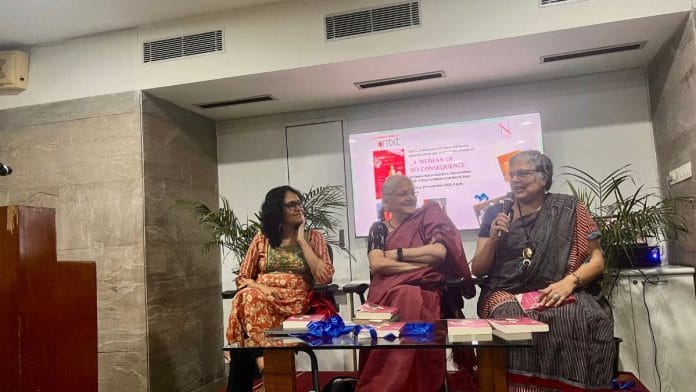
But there is no single story. Education for many women of the time came to a “cruel, abrupt” end when they were shafted, almost conscripted into marriage. Pankajam meticulously documented her life and dreams, the supposedly ordinary lines on which she was living. What you have is autofiction –– written decades before the term was in vogue. At the launch, held at Delhi’s Jawahar Bhawan, writer Githa Hariharan, author and journalist Revati Laul and Karunakaran used Pankajam’s story as a springboard to dive into questions of love, longing, and resistance.
Pankajam had an unhappy, turbulent marriage. She raised five children, and followed through on a quest –– that of education.
“We go out into the world, and we don’t know the silent, the quiet histories lying at home. While we all learnt this phrase, the personal is political, what does it really mean?” said Hariharan.
Hariharan came with her own personal connection to the book; evidence of how truly alive family histories can be. Karunakaran’s mother, firebrand trade unionist Mythili Sivaraman, is a close friend of Hariharan. The weaving together of the personal and political—within a feminism that often scoffs at a woman’s life at home—is a complex question. One that Sivaraman, “one of the most honest people” Hariharan has ever known, continued to ask herself.
Pankajam’s story is about yearning. The desire to claim space in the world through reading and writing. She wrote letters to her daughter, asking her about Cuba, about driving across the US.
Also read: This feminist film festival is feeling a funding crunch. ‘May be forced to not host next year’
Political statement of motherhood
Revati Laul, the author of An Anatomy of Hate, read Karunakaran’s book soon after Arundhati Roy’s Mother Mary Comes To Me. At the outset, both are renderings of a distinctly female experience that are deeply, fundamentally political. But what Laul read were two different kinds of feminisms.
“This is the other kind of political feminism which is lithe and light,” she said. “That book made me want to kill my mother and this book makes me want to keep her. I would like to be someone who is not angry. Kalpana has allowed me to falter, allowed my mother to be herself. That is such an important political statement.”
Panjakam lived many lives. And her personal archive came with characters. She also presented her life in fictionalised form, said Karunakaran. What she couldn’t write about as Pankajam, she wrote as Meera, or as Kamala, or as Dakshmi.
“They were all, of course, Pankajam. What was difficult for her to write about in the first person, she was able to express as the story of Kamala, through this distancing strategy,” she said.
Karunakaran was fortunate that her mother, Sivaraman, never threw away even a “single scrap” of paper. What it left her with was a kind of code, reams of paper, which camouflaged a life. There is an enormity to the endeavour, particularly because Karunakaran is writing her family’s history, which reveals a story of India –– of women and resistance. But despite the pain and the violence, the book holds no anger. In large part, this is due to her mother.
When Sivaraman was diagnosed with Alzheimer’s and Dementia, Karunakaran turned caregiver. It was the most important job of her life.
“It was about being everything I wanted to be in the world. And at the same time, to be able to say that the most important thing I’m doing in my life is to be present for my mother,” she said. “To never look away from her, to look at her, to see who she is becoming. While I can’t reverse it, to witness it.”
It was the ultimate act of love –– and a Woman of No Consequence appears to be entrenched in that same powerful, unwavering, political love.
(Edited by Ratan Priya)