





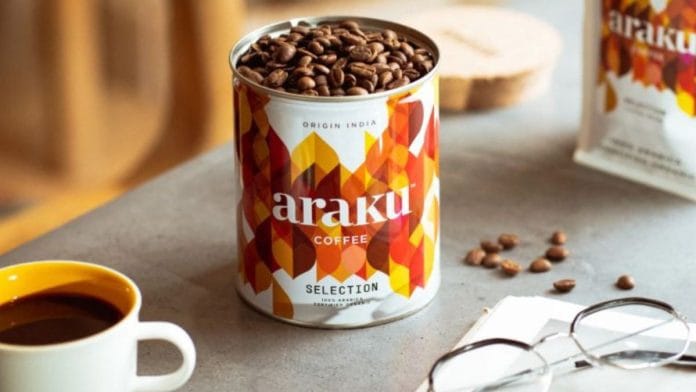



New Delhi: “Starbucks? Are you kidding?” Anand Mahindra responded to a post on X that urged him to add Starbucks coffee to his “NYC glamour selfie”. The light-hearted exchange soon led him to reveal his long-standing “obsession” with Araku Coffee and back homegrown brews over global chains like Starbucks.
“You’re asking someone whose obsession is to spread Araku—an Indian coffee that’s considered one of the best in the world?” he wrote.
Araku Coffee has been developed for more than two decades. It is organically grown by Adivasi farmers in Andhra Pradesh’s Araku Valley. And the brand’s unique selling point—no middlemen. It is “seed-to-cup coffee”. And its fan following—Reddit users describe it as the ‘master of storytelling’.
Store in Paris
Araku Coffee started in 2000 as an initiative to uplift the marginalised communities of the valley. Naandi Foundation, a community-based organisation to eradicate poverty, led the initiative. In 2008, the brand established itself as “Araku Originals” to give the coffee a global identity. Soon, buyers from Japan, South Korea, Switzerland and France, among other countries, took an interest in the coffee.
In 2017, Araku Originals opened its first flagship retail store in Paris, beginning its global journey. It came under Araku Global Holdings, a social enterprise by top businessmen, including Anand Mahindra of Mahindra Group, Kris Gopalakrishnan of Infosys, Satish Reddy, Chairman of Dr Reddy’s Laboratories and Rajendra Prasad Maganti, Chairman of Soma Enterprise. It became one of the premium offerings from India, directly from the farmers.
It claimed to have created a sustainable and resilient farming ecosystem in the region for farmers. Coffee was grown in small microplots of less than one hectare. It is then tested individually by experts and then announced as microlots. It all began by bringing 10,000 farmers together, who depended on middlemen.
At the beginning of the journey, one million coffee trees were planted. The farmers were introduced to biodynamic and organic Arabica farming. It started in 40 villages.
Also read: Andrew is now hanging and sweating at Louvre after Epstein links
The Arakunomics model
Although the coffee has gained its success as one of the best brews of India. The marketing of the coffee is much talked about.
One user on Reddit wrote, “I didn’t expect much and thought that their storytelling and marketing were a bit too much, but tried their signature and quite liked it. Very balanced coffee”.
The first terrier-mapped coffee opened its store in Bengaluru, then in Paris, and now in the US by this year.
In his post on X, Mahindra wrote, “We’ll be opening America’s first Araku Cafe in midtown Manhattan by this summer.”
“You can then count selfies with an Araku cup in my hand,” he added.
The coffee is carefully hand-harvested to bring out its distinct character. On the score card of the Speciality Coffee Association—marking another first for Indian coffee—Araku has secured 90 of 100 by coffee connoisseurs.
In 2018, Akaru became the first one to win the Epicure D’or at the Prix Épicures De L’Épicerie Fine Awards in France. The same year, it won the Rockefeller Foundation’s ‘Food System Vision 2050 Prize for the business model—Arakunomics. Even the World Economic Forum discussed how Indian coffee farmers of Andhra Pradesh are fighting deforestation by growing coffee.
The business is thriving, as the yield for this year is nearly 17,000 hectares.
Last year, the brand launched its Nanolot series—the rarest and purest speciality coffee. Nanolot coffees are grown in exceptionally small quantities. The beans are roasted in micro-batches to reveal the purest expression of their natural environment in which they are grown.
The coffee was priced at Rs 10,000 per kg, the first time an Indian Arabica Coffee sold at such high prices.
(Edited by Saptak Datta)