








New Delhi: Amid the government’s push to repatriate ancient artefacts to India, the Smithsonian’s National Museum of Asian Art in Washington announced on Wednesday that it would return three ancient Chola and Vijayanagar bronze sculptures that were illegally removed from temples.
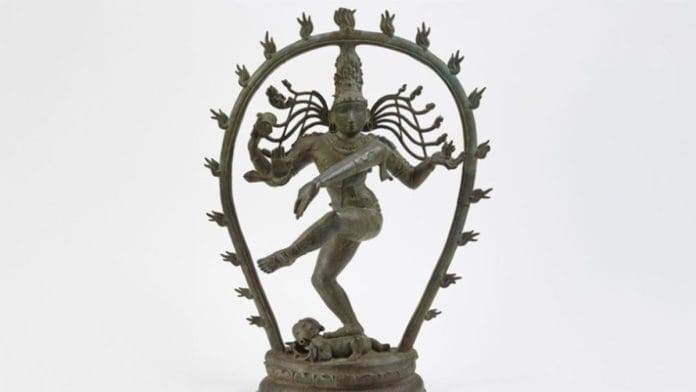
The artefacts include 12th-century Somaskanda, 16th-century Saint Sundarar with Paravai, and 10th-century Shiva Nataraja.
The US museum made the announcement after research showed that the artefacts were illegally removed from temples in Tamil Nadu. It said that in 2023 researchers confirmed that the sculptures had been photographed in Tamil Nadu temples between 1956 and 1959.
As a part of a systematic review of its South Asian collections, the museum undertook a detailed investigation into the provenance of the three sculptures, scrutinising each work’s transaction history.
The Archaeological Survey of India, too, checked its origin.
“Our team reviewed the evidence of the ancient treasure that had been removed illegally and brought to the foreign soil,” said a senior official of the ASI. He said these artefacts represent the rich heritage of the Chola period.
This is not the first time ancient artefacts have been brought back to India. Last year, the Modi government repatriated the Buddha’s Piprahwa relics. In January, PM Modi himself inaugurated the exposition of the relics at Delhi’s Rai Pithora Cultural Complex.
Since the Modi government came to power in 2014, around 640 stolen antiquities have been repatriated, compared to only 13 retrieved between 1947 and 2014. The most celebrated repatriated artefacts are the 12th-century Dancing Ganesha, 11th-century marble Brahma-Brahmani, and 12th-century Parrot Lady sculpture.
“They are fragments of India’s soul and their return signifies a cultural revival,” Nandini Bhattacharya Sahu, ASI joint director general and spokesperson, told ThePrint.
Also read: A ‘terhvi’ for dead dogs—Delhi mourns mass killing of strays in Telangana
Significance of the sculptures
The 12th-century Somaskanda is a specific form of South Indian bronze sculpture from the Chola period that depicts the Hindu deities Shiva and Parvati, along with their son Skanda (Murugan).
The 16th-century sculpture of Saint Sundarar with his wife Paravai belongs to the Vijayanagara period and was photographed at the Shiva Temple in Tamil Nadu’s Veerasolapuram village in 1956.
According to details provided by the museum, the sculptures of Somaskanda and Saint Sundarar with Paravai reached the museum in 1987. They were given as gifts to the museum by Arthur M Sackler.
The museum team found that the Somaskanda was photographed at the Visvanatha Temple in Alattur village, Tamil Nadu, in 1959.
The sculpture of Shiva Nataraja, meanwhile, belongs to the Sri Bhava Aushadesvara Temple in Thanjavur district of Tamil Nadu and was photographed there in 1957.
The Chola-period Shiva Nataraja is to be placed on long-term loan and will be on view as part of the exhibition The Art of Knowing in South Asia, Southeast Asia, and the Himalayas.
“We are profoundly appreciative to the Indian government for enabling us to continue exhibiting the long-admired Shiva Nataraja for the benefit of our visitors,” said Chase F Robinson, the museum’s director.
(Edited by Aamaan Alam Khan)