





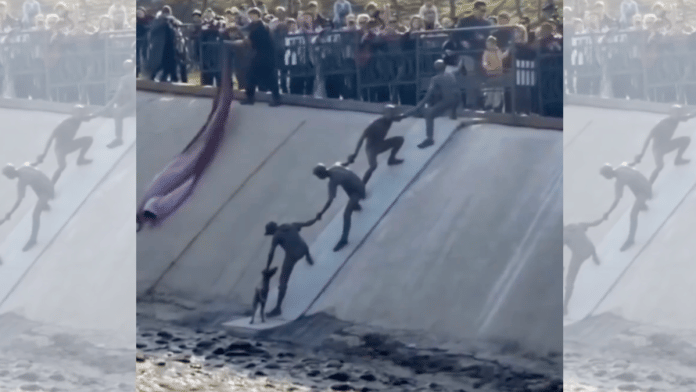



New Delhi: In 2016, a group of men formed a human chain to rescue a dog that had fallen into a reservoir in Almaty, Kazakhstan. A decade later, that powerful moment of compassion has been immortalised in a sculpture, capturing the rescue.
A video of the statue’s unveiling has gone viral, and people are once again appreciating the compassionate gesture.
This powerful act of unity was unveiled on 22 March, serving as a symbol of humanity and kindness.
Strangers uniting
A decade ago, a man noticed that a dog was trapped in a reservoir, finding it difficult to climb to the top because of the slippery slope and current. The man tried to save the dog; however, he was too far away, and the current was too strong.
Noticing the man’s struggle, a few strangers came along to help. They held hands, forming a chain, and saved the dog.
Kursiv Lifestyle reported that the local administration did not fund the sculpture, although it was approved by the Department for the Development of Public Spaces.
The city department, in a statement, said that the installation promotes mutual support, solidarity and unity.
“The composition features figures of people linked together in a chain, symbolising support and collective action in overcoming challenges. It is based on an image that has resonated widely with the public and reflects values that are close to the heart of every resident,” reported the Kazakh media organisation.
However, Twitter claimed that the installation was made by artist Yerbosyn Meldibekov and funded by the Kazakh private bank, ForteBank.
Social media reaction
Since its unveiling on Sunday, social media has been on a trip down memory lane with many users sharing the video of the dog’s rescue.
Indians on Instagram, too, reshared the video. MostlyBharat.in wrote,
The social media platform, Reddit, has also appreciated the effort.
“A society is defined by the things that it values and glorifies. It might seem goofy naively to commemorate a small incident like this, but I think it’s actually quite important to do this kind of thing”, wrote ChironXII.
(Edited by Insha Jalil Waziri)