





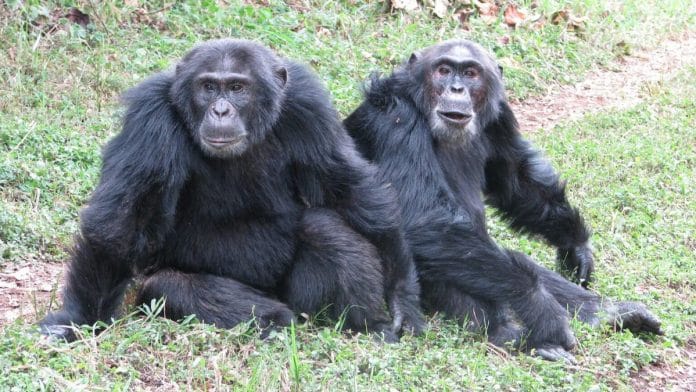



New Delhi: For years, chimpanzees at Uganda’s Kibale National Park coexisted. Then a “civil war” broke out and has continued for the past eight years.
A paper published this week in the journal Science draws on 30 years of demographic data, a decade of GPS tracking, and 24 years of detailed field observations to explain the reasons for the killings and divide.
The turning point was the 2019 killing of Basie, who was in his 36th year in the forest. Like any other day, he spent it in the trees, feeding on juicy figs, until evening changed everything. As the sun began to set, around 13 adult chimpanzees from a rival faction suddenly arrived, surrounded him, dragged him to the ground, and launched a coordinated attack. They piled onto him and bit him, turning an ordinary day into his last.
While this was the second such casualty in the community, the brutality of the attack became one of the clearest signs of the shift in the park’s atmosphere, according to researchers.
“What’s especially striking is that the chimpanzees are killing former group members,” said Aaron Sandel, associate professor of anthropology at UT Austin and the study’s lead author.
National Geographic reported that the last such ‘war’ on record was in the 1970s, when Jane Goodall observed a deadly conflict between two chimp factions in Tanzania’s Gombe Stream National Park. The report noted that in her memoirs, she wrote of how she struggled to come to terms with the “dark side to their nature”.
Also Read: Hindus are worshipping pigs now in this Delhi neighbourhood. Muslims are the target
How the Kibale ‘civil war’ started
For decades, the Ngogo chimp community lived as one large group of nearly 200 individuals.
They groomed, shared food, and moved together. And then slowly, they started growing apart. This, according to a release about the study, started after the deaths of several older males that may have helped keep the community together.
These deaths, of five older males and one adult female, took place in 2014, likely from a respiratory illness. Their absence weakened connections between other group members.
Jacob Negrey, a primatologist and one of the co-authors of the study, explained that once these chimps stopped coming together, they stopped seeing each other as part of the same group.
Over time, this separation deepened, turning familiar individuals into outsiders.
At the same time, a change in leadership added to the instability. A new alpha male took over in 2015, which increased tension and competition. Scientists note that such changes can disrupt existing relationships and lead to more aggression, especially among males.
The group’s unusually large size may have also played a role. With nearly 200 members, far more than typical chimp groups, it became harder to maintain close social ties.
Researchers say this made the community more vulnerable to splitting under stress. By 2018, the rift was complete. The two factions, Western and Central, stopped sharing territory and began attacking each other.
Also Read: Why do weight loss drugs work for some and not for others?
What the findings suggest about human violence
The study says that between 2018 and 2024, researchers “observed or inferred with high confidence” seven attacks on adult males and 17 on infants, all carried out by the Western group against the Central group. The killings averaged one adult male and two infants per year.
“Why did yesterday’s friend become today’s foe? It’s been hard to watch chimpanzees that I have studied for so long, know, and love turn on each other like this,” said John Mitani, one of the authors of the study and professor emeritus of anthropology at the University of Michigan.
Researchers were especially surprised by the sophistication of the attacks.
The violence was often carried out in groups. Several chimps would surround a single individual, overpowering and injuring them. In some cases, infants were taken from their mothers and killed. Researchers say this level of organised aggression shows how deeply the social divide has hardened.
The findings show chimpanzees can turn lethally on former group members once group identity changes.
Despite the violence, researchers stress that such events are rare. Most chimp life remains social and cooperative, built around grooming and bonding.
The study has implications for understanding human violence as well. It suggests violence may grow out of broken personal ties as much as larger group identities.
“This study encourages a reevaluation of current models of human collective violence. If chimpanzee groups can polarize, split, and engage in lethal aggression without human-type cultural markers, then relational dynamics may play a larger causal role in human conflict than often assumed,” the study said.
(Edited by Asavari Singh)