








By David Ljunggren and Nia Williams
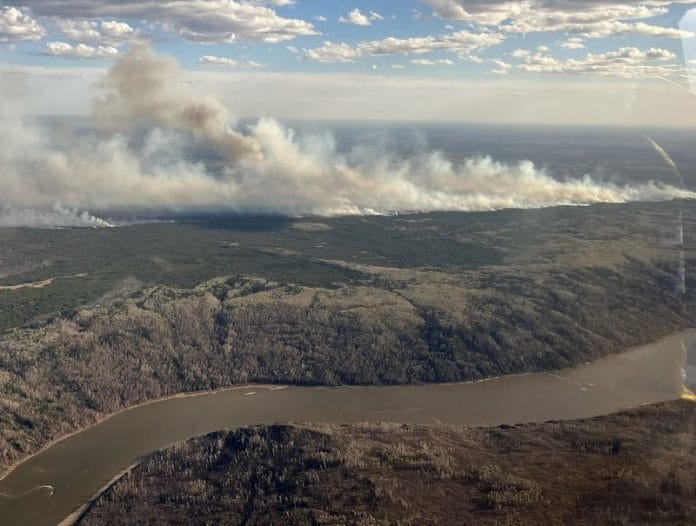
(Reuters) -A large wildfire is slowly approaching the major Canadian oil sands city of Fort McMurray and people in four suburbs have been told to evacuate, local officials said on Tuesday.
The fire, fueled by tinder dry conditions and high winds, has been threatening the city in the western province of Alberta since last week. It is now about 13 km (8 miles) away to the south west.
Alberta Wildfire information Officer Josee St-Onge said the blaze grew significantly on Tuesday and noted winds from the southwest were gusting as high as 40 km/hr (24.8 mph).
“Unfortunately, these are not favorable winds for us and the fire will continue to advance towards the town until we see a wind shift,” she told an online media briefing.
“We’re seeing extreme fire behavior. Smoke columns are developing and the skies are covered in smoke … firefighters have been pulled from the fire line for safety reasons.”
The fire has grown in size since the last known estimate of 9,602 hectares (37 square miles), she said.
In a statement, the local authority said residents in the suburbs of Abasand, Beacon Hill, Prairie Creek and Grayling had to leave by 4 pm Mountain Time (2200 GMT).
In 2016, a huge wildfire in Fort McMurray forced the evacuation of 90,000 residents and shut in more than a million barrels per day of oil output.
“This fire activity is very different than (in) 2016 … We have an abundance of resources and we are well positioned to respond to this situation,” said regional fire chief Jody Butz.
He declined to estimate how many people were impacted by the evacuation orders. He said evacuees were encouraged to leave Fort McMurray but could remain in other neighborhoods in the city if they wished.
Fort McMurray is the hub for Canada’s oil sands industry, which produces roughly 3.3 million barrels per day, two thirds of Canada’s total output. Companies including Suncor Energy, Canadian Natural Resources Ltd and Imperial Oil have oil sands projects within 150 kilometers of the city and many workers live in Fort McMurray.
“This will put more people on edge, we’ll have to see if the actual production sites themselves come under threat,” said Martin King, an analyst at RBN Energy.
“Back in 2016 the fires themselves were getting close so the companies evacuated people for safety, and of course the people that worked in these sites were evacuated and had nowhere to go so they ended up shutting down production.”
(Reporting by David Ljunggren and Nia WilliamsEditing by Sandra Maler and David Gregorio)
Disclaimer: This report is auto generated from the Reuters news service. ThePrint holds no responsibilty for its content.