








By Granth Vanaik and Arriana McLymore
Extreme heat has companies in the United States changing the way they work. One frequent response: work less. Here is how heat affects several large industries and what they do about it:
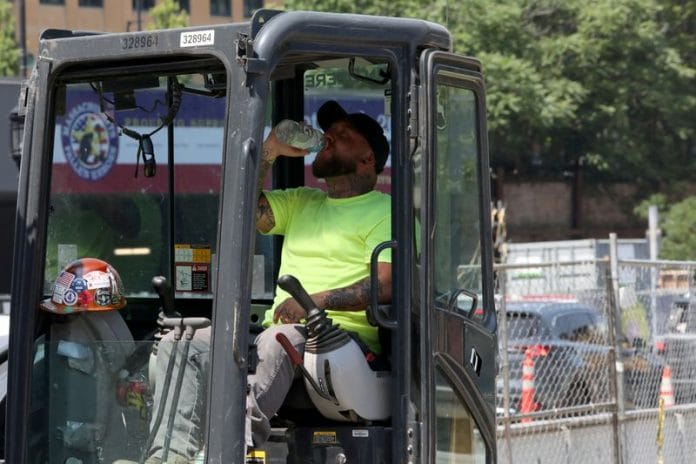
* Construction: Work slows at construction projects. Whatusually takes two days can take three or four as builders takebreaks, estimates Art Hogan, chief market strategist at B. RileyWealth. Changes could include shifting the workday earlier.Slowing projects could also hit the companies that sellsupplies, but the impact to the likes of Home Depot and Lowe’sis likely limited because builders buy in advance and theprojects are not canceled, Hogan added. And such retailers seedemand for air conditioners and fans. * Crude oil: Oil refineries are geared to withstand high airtemperatures, but efficiency drops. Financial-services firmMacquarie Group estimates extreme weather costs the oil industrybetween 1.5% and 2% of refining throughput a year. “Temperaturesmatter a lot,” said Vikas Dwivedi, global energy strategist atMacquarie. Refiners in hot climates limit time workers areoutdoors, set up hydration stations and move work shifts earlierin the day, to cooler hours. Austin Lin, a former refineryworker and now an analyst at energy consultant Wood Mackenzie,said he would organize work so arriving contractors couldimmediately start projects, without waiting for assignmentsor briefings. In extreme heat, around 110 degrees Fahrenheit (43degrees Celsius), workers can only spend about 30 minutes of thehour working and need regular breaks to stay safe. * Retail: Retailers may see more demand for shorts and otherclothing that works well in the heat, in addition to fans andair conditioners. One of the most significant changes in retailfor high-heat situations involves delivery of items orderedonline. Amazon says it adjusts routes on hot days to givedrivers more time to cool off and offers drivers beveragecoolers in vans and water-filled sleeves that keep temperaturesdown. The Teamsters union, meanwhile, is using extreme heat torally workers, saying unions can secure better protection. * Transportation: Heat makes travel harder. Airplane wingsdon’t generate as much lift in heat and flights stuck on thetarmac have been reported with triple-digit-degree Ftemperatures inside. Railroads may limit train speed overconcerns heat will warp tracks and damage engines and electricalcomponents. * Manufacturing and warehousing: Companies with hugebuildings often condition the air with systems that are lesscostly than the air-conditioning used in homes and offices. Fansto drive out hot air, mist to cool work environments and plentyof available water are top responses. Spirit AeroSystems, whichmakes plane parts for Boeing, says its water-cooled system keepsmaximum temperatures in its factories in the low 80s F, andthere is no impact to production. * Agriculture: It would take weeks of prolonged heat toreduce yields of recently planted corn and soy crops in the U.S.Midwest, especially with beneficial rains forecast in comingdays, analysts say. Modern row-crop agriculture requires fewworkers in the fields for planting and newer tractor cabs areair-conditioned, mitigating human risk. But in California’scentral valley, grapes are tended by hand. Temperatures canswing tens of degrees F over a few days, and the heat workingwithin rows of grapes is four or five degrees F hotter than thesurrounding area, some workers estimate. Farmers try to provideextra water for crops and humans alike, as well as shade. Andthey cut hours worked. * Tech: In heat waves, tech companies need extra effort tocool and safeguard big data centers, which are seeing soaringdemand from the artificial-intelligence boom that relies onpower-hungry microchips. That may mean use of backup generators,which data-center operators such as Digital Realty say canremain operational for hours, even days.
(reporting by Gary McWilliams in Houston, Arriana McLymore in New York, Granth Vanaik, Ananya Mariam Rajesh, Zaheer Kachwala, Aditya Soni and Shivansh Tiwary in Bangalore, Caroline Stauffer in Chicago; writing by Peter Henderson in San Francisco; Editing by Rod Nickel)
Disclaimer: This report is auto generated from the Reuters news service. ThePrint holds no responsibilty for its content.