





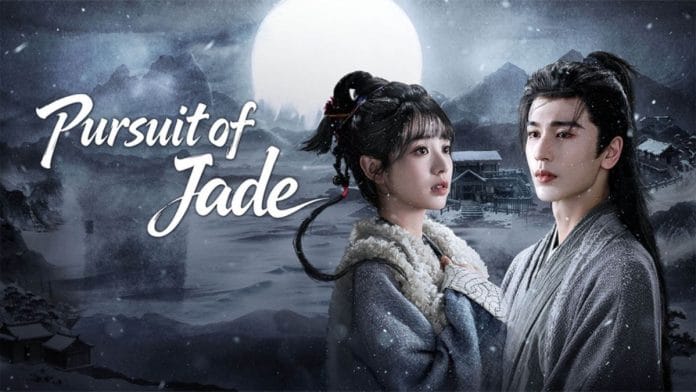



New Delhi: Amid the rising popularity of Korean dramas in India, a Chinese drama, or Cdrama as it is popularly known as, has become the latest fan favourite. Netflix’s Pursuit of Jade, a historical romance, has become fodder for social media edits. Directed by Qingjie Zeng, the series has 40 episodes, each with a 45-minute runtime.
Pursuit of Jade is adapted from a novel of the same name by author Tuanzi Laixi, and tells the story of a butcher’s daughter, Fan Changyu (Tian Xiwe) and a fallen marquis, Xie Zheng (Zhang Linghe). After a chance meeting in a snowstorm, the two stage a marriage of convenience. While Fan Changyu is looking to become the head of her household, Xie Zheng is looking to avenge a 17-year-old massacre. However, the couple developing genuine feelings for each other complicates matters, with a war forcing them apart.
Scenes from the show released on 6 March, especially those including the lead pair and their conflict and romance, are being paired with popular Hindi songs online like Arjun Kanungo’s Ek Dafaa, Gajendra Verma’s Mann Mera, and AR Rahman’s Chinnamma Chilakkamma and being shared online.
One reel with the caption ‘when the fake marriage turns real’ shows an edit where the lead pair navigate their marriage of convenience, while keeping away prying eyes.
Dharshini, a radio jockey from Vellore, Tamil Nadu, who shares Kdrama recommendations, posted a mini review of the show.
Another creator shared a series of edits from the show, whose villains are also gaining popularity for their looks and performance.
“Chinese dramas have all the classic tropes that made Kdramas famous but they are fantastical and otherworldly, bringing an element of surprise and an ethereal quality to it. The visual aesthetics are what sets Ancient Chinese dramas apart from their Korean counterparts. Within limited budgets and sets, the former is able to tell stories across generations and lifetimes,” said Sweta Kushwaha, an assistant professor at Delhi University, who has a PhD in Cinema Studies from Jawaharlal Nehru University.
Also read: Micro dramas are China’s latest cultural export. Luring Indians with wild twists, cliffhangers
A distinct visual language
Pakistani dramas, K Dramas and Turkish dramas have been popular in India, but the surge in popularity of Pursuit of Jade is a new phenomenon. It also comes at a time when the teaser of Salman Khan-starrer Battle of Galwan created ripples in China’s diplomatic circles. The film’s title was later changed to Maatrubhumi.
“There is a visual language that audiences become fluent in when they watch these Chinese dramas over a period of time. They become fluent in a language of love that defies censorship and China’s staunch control over its media. It is through glances, subtle moments of intimacy of holding a hand after 40 episodes and if you’re very lucky, a kiss between the leads that cuts to flimsy curtains and a hint of lovemaking,” said Kushwaha.
Chinese dramas use tropes like enemies to lovers, marriage of convenience, slow-burn romance, arranged marriages, forced marriages, are also popular on Indian TV shows.
“Apart from top tier direction by Qingjie, also known for Blossom, another major 2024 hit, and cinematography that made it pretty popular, the drama also showcases the acting range of Tian Xiwei and Zhang Linghe, with a sizzling chemistry that is hard to miss,” said Kushwaha.
The show has captured audiences not just in China and India but in other places too. As per China Daily, the series ranked first in search volume for Chinese dramas in 15 markets, including the United States, Canada, Thailand, Malaysia, South Korea, and Singapore. It also leads globally among Chinese historical dramas released so far in 2025. Within six days of launch, the series surpassed the iQIYI, a Chinese subscription video on-demand OTT service, popularity index of 10,000 domestically. It was ranked No. 1 on iQIYI International’s ‘Top 10 Chinese Language Dramas Weekly Chart’.
(Edited by Theres Sudeep)