





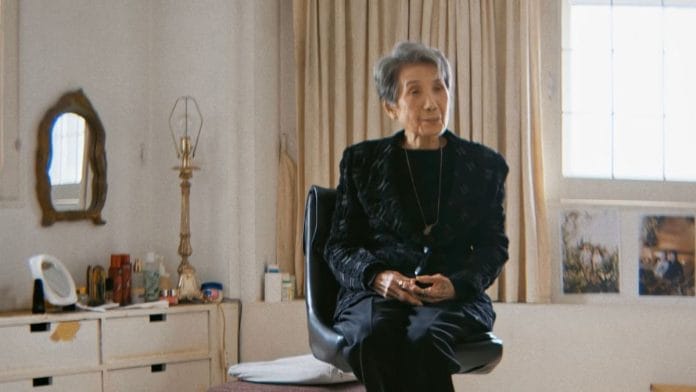



New Delhi: BTS returned from military service with their new album ARIRANG. But much of the attention has shifted to a 98-year-old designer whose work is now back in the spotlight.
Nora Noh, South Korea’s first fashion designer, has remained active for over 76 years. Since 1956, she has presented a fashion show every year, maintaining an unbroken creative legacy.
When BTS’ new album ARIRANG, named after one of Noh’s 1959 collections, was released on 20 March, the conversation initially revolved around their comeback and the music. But at the concert, fans noticed a shift: fluid tailoring and vintage silhouettes had replaced K-pop’s usual maximalism.
As stylists unpacked the album’s visual language, one name kept resurfacing: Nora Noh. The clean cuts and balance between Western tailoring and Korean identity echoed her early work from the 1950s and ’60s. Noh laid the foundation long before ‘K-fashion’ became a global keyword. After headlining conversations for decades, her name gradually slipped into the background. Then came her association with BTS.
“BTS are the biggest cultural phenomena, but what’s amazing about these boys is that they haven’t forgotten their roots,” said journalist Puja Talwar, who follows Korean culture and BTS. “Korea’s own history has been one of struggle and persistence. It keeps rising on the soft power index and influences people globally. So, BTS wearing a traditional brand was an ode to their legacy.”
Talwar described Nora Noh as a trailblazer in her field, noting she is referred to as “Korea’s Coco Chanel.”
“Noh’s designs and BTS speak a similar language—modern but rooted in tradition. The significance of their roots and where they come from remains in their respective art forms,” Talwar added.
BTS’ mini documentary Keep Swimming with BTS also highlighted Noh’s journey, bringing her back into conversation. In it, Noh reminisces about her early days in the US and reflects on her life and career. Expressing her hope that the name “Nora Noh” will endure, she said, “You have to try until you’ve tried. No one can force you to do it.”
Also read: South Korea building on K-pop craze to boost art scene. And India is part of its ‘big mission’
First fashion show; mini skirt trend
Noh achieved several historic milestones, from staging Korea’s first fashion show in 1956 to introducing designer ready-to-wear collections tailored for working women in 1963, which helped redefine how modern Korean women dressed.
At just 19, she travelled to the United States in 1947 to study fashion. After two years of training, she returned to Korea and established the House of Nora Noh, which became the country’s first true fashion brand and introduced South Korea to Western designs.
Noh dressed a nation before it even knew what fashion could be. In the rubble of post-war Korea, she introduced structured jackets, softened lines, and hemlines that hinted at freedom. Her mini-skirt, designed for singer Yoon Bok-hee, helped spark the mini-skirt era of the 1970s.
“Nora Noh has a special place in Korean fashion history. Although there were instances of women presenting fashion during the Japanese colonial period, Nora Noh was the first person to showcase their designs as a professional fashion designer,” Moon Jae-un, curator of Daegu Textile Museum, told The Korea Times in a 2024 interview. The same year, Jae-un organised an exhibition of iconic Korean designs, from military blanket coats to haute couture. It also included Noh’s Arirang designs.
Now, social media, fashion columns, and fan discussions are tracing that lineage. Younger audiences are encountering Nora Noh for the first time—not through textbooks or exhibitions, but through BTS. There was no formal collaboration or campaign. What the band did instead was subtler: they brought her aesthetic back into circulation.
For Noh, the irony is poetic. Decades ago, she looked outward, bringing global silhouettes into a local context. Now, through BTS, her influence travels outward again. The loop is complete.
(Edited by Prashant Dixit)