





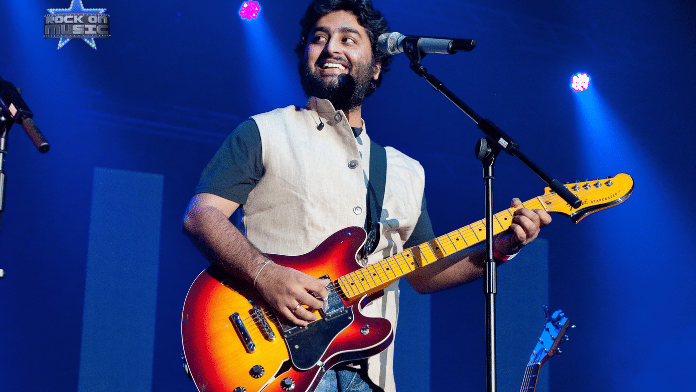



New Delhi: One of Bollywood’s most recognisable and enduring voices of the past decade, Arijit Singh, announced his retirement from playback singing on 27 January. The announcement brought the curtain down on a career that redefined the sound of romance in Hindi films.
The 38-year-old singer shared the decision via his social media handle, clarifying that while he will no longer take up new film assignments, he is not stepping away from music altogether. While the singer did not elaborate on the reasons behind his decision, he emphasised that his creative journey is not yet over.
“God has been really kind to me. I am a fan of good music and in the future will be learning more and doing more on my own as a small little artist. Just to be clear that I won’t stop making music,” Singh wrote.
Known for being the man behind songs like the heartbreak anthem of one-sided love, ‘Channa Mereya’ from Karan Johar’s Ae Dil Hai Mushkil (2016), to the song symbolising carefree life, ‘Ilahi’ from the 2013 cult-classic Yeh Jawaani Hai Deewani and the anthem of love ‘Tum Hi Ho’ from the 2013 super-hit romantic film Aashiqui 2. Singh’s career has been a compilation of how one falls in love and experiences its various stages.
The singer started when reality shows were at their peak on Indian television – from Sa Re Ga Ma Pa, Indian Idol, to Fame Gurukul, where Singh made his first appearance.
Born to a musically inclined family in Bengal’s Murshidabad, the classically trained Singh participated in Fame Gurukul in 2005 at 18 years of age. While he did not win the show or even reach the finals, his singing did have an impact. The show was judged by Javed Akhtar, Shankar Mahadevan and KK. Although he finished sixth, Singh continued to sing, eventually outshining the show’s winner.
Also Read: Arijit Singh was an era, a feeling—fans react to singer’s retirement post
Misses to blockbuster hits
After Fame Gurukul, he participated in another reality show, 10 Ke 10 Le Gaye Dil. The show was a musical face-off between contestants of Fame Gurukul and Indian Idol.
Singh won the show and set up his own studio with the prize money of Rs 10 lakh. He was noticed by filmmaker Sanjay Leela Bhansali and got a chance to sing the song ‘Yun Shabnami‘ for Saawariya (2007), which was Ranbir Kapoor and Sonam Kapoor’s debut film. But his version of the song did not make it to the album, with Parthiv Gohil singing the verse instead. After this, Ramesh Taurani signed him for a music album, which also never saw the light of day.
Singh’s big break came with the song ‘Phir Mohabbat’ from Murder 2 (2011), starring Emraan Hashmi and Jacqueline Fernandez. The film’s music was composed by Mithoon, Harshit Saxena and Sangeet-Siddharth.
But it was two years later that he became “viral”, and no one could get his voice out of their heads. Director Mohit Suri signed Singh on for the song ‘Tum Hi Ho’ for his film Aashiqui 2, earning Singh his first Filmfare Award for Best Male Playback Singer. Singh eventually scored 7 more FilmFare Awards, for songs like the title track of Ae Dil Hai Mushkil.
He has continued to receive awards for his works in films, such as Humpty Sharma Ki Dulhania (2014), Ae Dil Hai Mushkil (2016) and Brahmāstra: Part One – Shiva (2022). In 2025, Singh also received the Padma Shri, India’s fourth-highest civilian honour, for his exceptional contribution to the field of performing arts.
Also Read: We are wrong to cancel AR Rahman who contributed so much to Bollywood patriotism
Atif Aslam’s exit, change of fortunes
After KK, it was Singh’s soulful voice that became synonymous with romance in Bollywood, from falling in love to heartbreak. The only other singer whose songs could evoke similar emotions was from the other side of the border – Atif Aslam.
In 2016, when the Indian army announced surgical strikes to neutralise terror launchpads across the Line of Control in Pakistan-occupied Kashmir, the Indian Motion Picture Producers’ Association (IMPPA) banned Pakistani actors and technicians from partaking in Bollywood projects, causing Aslam to leave Bollywood and India.
That year, Singh’s voice was part of 37 Hindi films, from Ae Dil Hai Mushkil, Rustom, to Dangal. In 2017, tracks like ‘Galti Se Mistake’ from Jagga Jasoos, ‘Phir Bhi Tumko Chaahunga’ from Half-Girlfriend and ‘Zaalima’ from Raees became chartbusters.
Aslam’s exit paved the way for more work, and his collaboration with Pritam cemented his position in the industry that he once could not find an entry into.
Singh also won two National Film Awards for Best Male Playback Singer — for ‘Binte Dil’ from Padmaavat (2018) and for ‘Kesariya’ from Brahmāstra: Part One – Shiva (2022).
From winning the cash prize of Rs 10 lakh in 10 Ke 10 Le Gaye Dil, to charging Rs 10 lakh per song in Bollywood, Singh swiftly climbed the ladder of success. His net worth is now estimated at Rs 414 crores, with earnings from his playback singing and live shows.
In an interview, renowned playback singer Shaan spoke about how his collaboration with Pritam established Singh’s career.
“I think Arijit grabbed a little bit of a few artists like Atif (Aslam) and others. He was with Pritam recording a lot of voices, so he has watched them really closely and has been able to pick up. He very intelligently created his style and saw a lot of success with it, “ said Shaan.
Despite his success and earnings, Singh, unlike most singers in Bollywood, continues to stay in his hometown in Murshidabad, travelling for work when needed. Singh is married to his childhood friend Koyel Roy, and shares two kids with her, and also a daughter from her previous marriage. When British singer Ed Sheeran came to India in 2025, he meet with Singh in Murshidabad and collaborated with him on the song ‘Sapphire‘, with the official music video showing glimpses of the two roaming the city streets.
(Edited by Insha Jalil Waziri)