





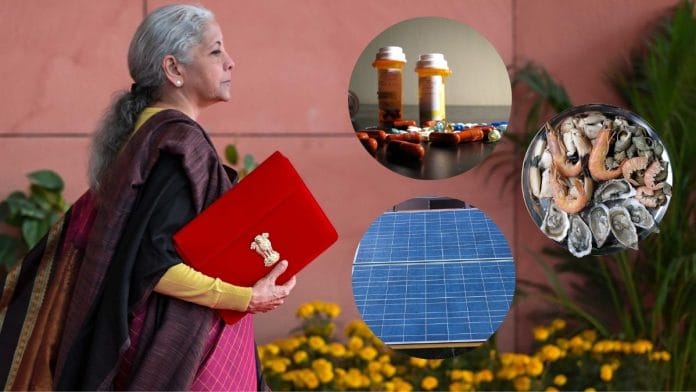



New Delhi: The Budget, presented Sunday in Parliament, has reduced costs for priority sectors, such as clean energy, strategic minerals, electronics manufacturing, aviation, healthcare, and exports, while selectively raising costs for derivatives trading and non-priority imports at the same time.
The pattern reflects targeted industrial and financial market signalling rather than broad-based consumer price changes.
In this report, ThePrint presents an item-wise snapshot of what has become cheaper or turned costlier, following the Budget. This is based solely on announced changes to customs duty, excise duty, and transaction taxes.
First, what got cheaper.
Critical minerals, clean energy
In the critical minerals and clean energy sectors, basic customs duty has been reduced to zero on several strategic inputs, thereby lowering costs for clean energy, batteries, and strategic minerals.
The customs duty on monazite, used in the processing of rare earth elements; sodium antimonate, used in the manufacture of solar glass; specified capital goods, used in lithium-ion cell manufacturing for battery energy storage systems; and capital goods and components, used in the processing of critical minerals, have been reduced to zero.
Nuclear energy equipment
All goods required for nuclear power generation—nuclear power equipment, including reactor-related equipment and absorber rods—have been fully exempted from basic customs duty. This exemption extends till 2035 and applies irrespective of plant capacity.
Consumer electronics
In the electronics cum consumer manufacturing sector, the government has exempted specified parts used in microwave oven manufacturing from basic customs duty to increase domestic value addition in consumer electronics. Domestic value addition constitutes increasing the local share of the bill of materials, reducing import dependency, creating local jobs, and boosting GDP contribution.
Civil & defence aviation
Under the Budget, aircraft components and parts, including engines, imported for manufacturing aircraft, are exempted from customs duty. Raw materials for the manufacture of aircraft parts used in defence maintenance, repair, and overhaul (MRO) are also exempted. This will bring down airlines’ maintenance and engine overhaul costs.
Pharma & healthcare
At least 17 additional medicines, primarily cancer‑related, have been fully exempted from basic customs duty. Import duty exemption has been extended to special medical purpose drugs, medicines, and food, used in the treatment of seven notified rare diseases.
Personal imports
Customs duty on dutiable goods imported for personal use has been reduced from 20 percent to 10 percent, effective from April 2026, lowering costs for international travellers and personal imports.
Exports-oriented sectors
The limit on duty-free imports in case of inputs used in seafood processing for exports later has been increased from one percent to three percent of the previous year’s FOB (free on board) exports value.
On the other hand, export timelines for leather garments, footwear, shoe uppers, and textile garments manufactured from duty-free imported inputs have been extended from six months to 12 months, reducing compliance pressure and working capital stress.
Now, for items and activities that have become costlier.
Futures & options trading
Transaction costs in the derivatives market have increased—securities transaction tax (STT) on futures rose from 0.02 percent to 0.05 percent. STT on options premium and options exercise increased to 0.15 percent. This makes high-frequency and speculative derivatives trading more expensive.
Selected chemical & consumer imports
Potassium hydroxide, used in soaps and detergents, batteries, textiles, chemicals, and food processing, now attracts 7.5 percent basic customs duty. Earlier, it was nil.
Customs duties have been revised upward on umbrellas and certain umbrella parts and accessories, through either a higher ad valorem duty or a specific duty per unit.
Withdrawal of legacy exemptions
A large number of long-standing customs duty exemptions have been withdrawn, including exemptions on certain chemicals, industrial inputs, machinery, and components, and selected electronics parts, printing equipment, and industrial intermediates. Where exemptions have lapsed, effective import costs will rise, even if headline tariff rates appear unchanged.
(Edited by Madhurita Goswami)
Also Read: Union Budget 2026-27: What it really says about India’s economy