








New Delhi: In a major boost to India’s space and astronomy ambitions, Finance Minister Nirmala Sitharaman announced the setting up and upgradation of four telescope infrastructure facilities in the Union Budget 2026-27.
“To promote astrophysics and astronomy via immersive experiences, four telescope infrastructure facilities will be set up or upgraded—the National Large Solar Telescope, the National Large Optical-infrared Telescope, the Himalayan Chandra Telescope, and the COSMOS-2 Planetarium,” Sitharaman said in her Budget speech Sunday.
The announcement aims to expand India’s scientific infrastructure and observational capabilities, while also supporting advanced research and scientific temperament among the public in these areas, she said.
Bengaluru’s Indian Institute of Astrophysics (IIA) said in a statement on Sunday that this announcement will offer a big push for “building large next-generation telescope facilities and astronomy outreach centres in India.”
Also read: Cheaper cancer, diabetes drugs: Rs 10,000 cr ‘Biopharma Shakti’ to power India’s biologics push
Which facilities will be improved?
The National Large Solar Telescope (NLST) is an under-construction facility located near Pangong Lake in Merak, Ladakh, at an altitude of around 4,200 m.
The proposed 2 m class optical and near-infrared (IR) observational facility, once operational, will be the largest ground-based solar telescope in the country. The facility has been designed to address an array of key scientific issues related to the origin and dynamics of solar magnetic fields at a spatial resolution of 0.1-0.3 arc-seconds.
“The instrument has a broad scope to support and substantiate the multitude of solar atmospheric observations from space-based ADITYA mission and ground-based MAST telescope (Udaipur),” read the NLST website.
The location is also significant because it offers long periods of clear, coronagraphic skies.
Another facility that has found mention in Sitharaman’s Budget speech is the National Large Optical-Infrared Telescope. The proposed facility consists of a 10-12 m segmented primary and is designed for high throughput in both the optical and IR wavelengths of 0.3-5 μm.
A research paper published by scientists from IIA in 2022 highlighted that the telescope will have a remote operations capability.
The capabilities of the Himalayan Chandra Telescope (HCT) and the COSMOS-2 Planetarium will also be upgraded.
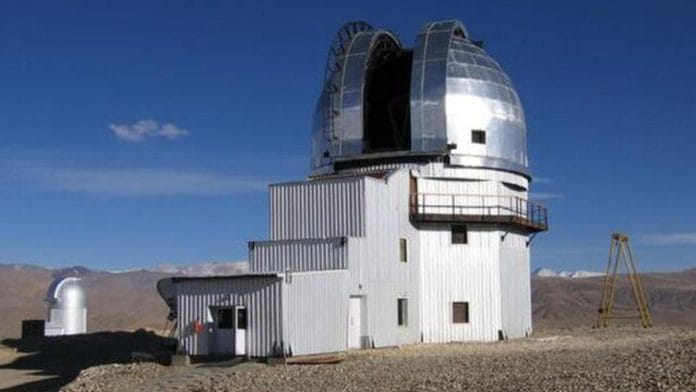
The HCT is a 2 m optical-infrared telescope located at the Indian Astronomical Observatory (IAO) in Hanle, Ladakh, and is one of the world’s highest observatory sites. Presently, it is remotely operated by IIA from Bengaluru and is a key facility for observations of stellar explosions, exoplanets from the dark, clear skies, and comets.
The COSMOS-2 Planetarium, on the other hand, is a proposed plan to strengthen science education and outreach in the country. The project aims to popularise science among the younger generation through immersive content.
Lieutenant General AK Bhatt (retd), Director General, Indian Space Association (ISpA), said that the announcement is a meaningful step toward strengthening India’s scientific base in astrophysics and astronomy.
“Together, these measures can improve observational capabilities, enable long-term research, and strengthen collaboration between ISRO, academia, and industry, gradually enhancing India’s contribution to global space science and the broader space ecosystem,” he added.
(Edited by Prasanna Bachchhav)