





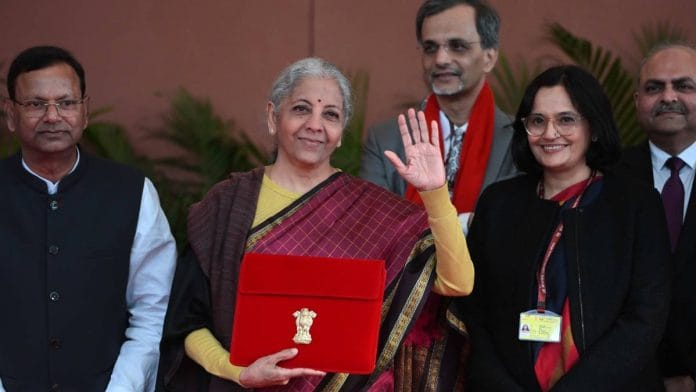



New Delhi: Presenting the Union Budget FY2026-2027 on 1 February, Finance Minister Nirmala Sitharaman proposed the development of 15 archaeological sites across the country into vibrant and experiential cultural destinations.
“I propose to develop 15 archaeological sites, including Lothal, Dholavira, Rakhigarhi, Adichanallur, Sarnath, Hastinapur, and Leh Palace, into vibrant, experiential cultural destinations,” said Sitharaman in her ninth consecutive budget speech on Sunday.
Among the selected sites are Indus Valley Civilisation (IVC) sites such as Rakhigarhi in Haryana, and Dholavira and Lothal in Gujarat. It also includes Buddhist sites in Uttar Pradesh, such as Sarnath and Hastinapur.
The Archaeological Survey of India (ASI), since Independence has carried out several excavations at these sites. The government is now keen to show these excavated materials to the public.
“The Modi government’s announcement regarding the 15 sites is commendable. This will allow for specific planning and development of these sites,” ASI Director General, YS Rawat, told ThePrint after the budget announcement.
Rawat said that opening the excavation sites to the public will be a new experience for archaeology enthusiasts. “Previously, excavation sites were limited to books, but now they will be made accessible to the general public,” he said.
“Excavated landscapes will be opened to the public through curated walkways,” added Sitharaman.
However, in her speech, the finance minister only named seven sites; the remaining eight are not yet known.
Responding to the proposal, Union Minister of Culture Gajendra Singh Shekhawat said that the Budget has a “vision of inclusive growth” as India continues to be the fastest growing economy.
“Under the Budget provisions, emphasis has been laid on promoting the culture and tourism sector,” said Shekhawat.
Also Read: Union Budget 2026-27: What it really says about India’s economy
What’s the thinking behind the choice of sites
The selected sites for development are significant because of their ancient history, that have long struggled for importance in the historical canon and is now finding renewed interest under the Modi government, with the current administration upping research and infrastructure in the area.
For instance, at Lothal in Gujarat, the Modi government is already developing a National Maritime Museum.
According to veteran archaeologist Vasant Shinde, Lothal may be the earliest dockyard in the world. “Earlier, we didn’t have a museum that could showcase our entire maritime heritage,” said Shinde in 2025.
The Union Cabinet in 2019 had approved the development of a maritime heritage complex at Lothal.
The other Harappan site in Gujarat is Dholavira in the Kutch district, and is known for its advanced urban planning, sophisticated water management and extensive stone architecture. It was declared a United Nations Educational, Scientific and Cultural Organisation (UNESCO) World Heritage site in 2021.
The archaeological findings in the area suggest that Dholavira was a port city based on the fact that roughly 5,000-6,000 years ago, the sea level was higher than it is currently.
“It means this site was almost on the sea and the people living in this area were aware of the tsunami,” said Rajiv Nigam, a geologist and former chief scientist at the National Institute of Oceanography in Goa, last year. Nigam concluded that ancient Indians knew how to protect themselves from tsunamis.
The Harappan site closest to the national capital, Rakhigarhi, is also on the Modi government’s priority list. The site is one of the largest urban centres of the IVC and flourished circa 2600 and 1900 BCE.
Previously, in the 2020-21 budget, Sitharaman had announced Rakhigarhi as one of the five archaeological sites to be developed as iconic sites.
But in the last five years, Rakhigarhi has fallen prey to empty promises. The site is encroached, full of garbage and no facilities; and its ambitious site museum project is still in limbo.
Although the ASI did install walk-through ramps along the excavation site for the general public in May 2025, it didn’t give a license to any archaeologist for the excavation of Rakhigarhi.
Rawat told ThePrint last year that the next license of excavation at Rakhigarhi will be given to new archaeologists. The site was previously excavated by senior archaeologist and additional director general of ASI Sanjay Manjul for several years.
“This year, the excavation will start at Rakhigarhi and will be done by ASI’s Excavation Branch-II,” Nandini Sahu Bhattacharya, spokesperson and joint director general at ASI told ThePrint.
The Adichanallur site, located in Tamil Nadu, has also been selected and offers insights into early Iron Age life and ancient Tamil Civilisation. It was the first site in India where the ASI installed walk-through ramps along the excavated area.
In Uttar Pradesh, the Modi government is already vying for the Sarnath site to be included in the UNESCO World Heritage list. Last year, a UNESCO team visited the site to document its status.
Meanwhile, the Chief Minister Yogi Adityanath’s government is planning on developing Hastinapur as an important archaeological and religious site, as a major tourism destination.
The site in western UP belongs to the Mahabharata period, according to the veteran archaeologist BB Lal, who first excavated it in 1952.
Also Read: IT sector as India’s ‘growth engine’: Budget boosts tax certainty with safe harbour revisions
Buddhist Sites in north-eastern India
The finance minister also announced a proposal to develop Buddhist circuits in the North-eastern region.
“I propose to launch a Scheme for Development of Buddhist Circuits in Arunachal Pradesh, Sikkim, Assam, Manipur, Mizoram and Tripura,” said Sitharaman.
India’s north-east has several Buddhist sites with major monasteries such as the Tawang Monastery in Arunachal Pradesh, Rumtek and Tashiding in Sikkim and Sualkuchi in Assam.
Sitharaman said that the north-eastern region is a civilisational confluence of Theravada and Mahayana/Vajrayana traditions.
“The scheme will cover preservation of temples and monasteries, pilgrimage interpretation centres, connectivity and pilgrim amenities,” added Sitharaman.
On the announcement of the Buddhist circuit in northeast India, Rawat said that people only know Nalanda and Sarnath, however, there are many other Buddhist sites in the country, and their development is also very important.
“Many such Buddhist sites exist in northeast India, and their development will bring them onto the national map,” he said.
(Edited by Insha Jalil Waziri)