








New Delhi: The government has continued its capital expenditure (capex) push in Budget 2026-27, a move that is expected to give a big leg-up to infrastructure development in the country.
From new dedicated freight corridors to seven high speed rail corridors and 20 new national waterways, Union finance minister Nirmala Sitharaman proposed a slew of infrastructure projects and said delivering a powerful push to infrastructure is one of the five kartavyas (duties) of the Modi government.
Presenting her 9th budget, Union finance minister Nirmala Sitharaman said she proposes to increase capex to Rs 12.2 lakh crore to “continue the momentum”. In the 2025-26 budget, the capex allocated for infrastructure development was Rs 11.2 lakh crore.
The government’s infrastructure thrust can be gauged from the fact that public capex in FY 2014-15 was merely Rs 2 lakh crore.
Besides increasing capex, Sitharaman also proposed to set up an Infrastructure Risk Guarantee Fund to provide prudently calibrated partial credit guarantees to lenders. This, she said, will strengthen confidence of private developers regarding risks during infrastructure development and construction.
Dedicated freight corridors, new high speed rail corridors
A slew of announcements were made in the infrastructure sector that will drive the momentum.
Sitharaman announced the government would establish new dedicated freight corridors connecting Dankuni in the east to Surat in the west and operationalise 20 new national waterways over next 5 years, starting with NW-5 in Odisha to connect mineral rich areas of Talcher and Angul and industrial centres like Kalinga Nagar to the ports of Paradeep and Dhamra.
The 2,843 km Dedicated Freight Corridor (DFC) is one of the largest rail projects executed by Indian Railways. It comprises the Eastern Dedicated Freight Corridor that provides seamless freight transportation between Ludhiana and Sonnagar and the Western Dedicated Freight Corridor from Jawaharlal Nehru Port to Dadri.
As of December 2025, 96.4 per cent of the 2,843-km DFC had already been commissioned. The remaining work is scheduled for completion by March 2026.
The finance minister also proposed establishing seven more high-speed rail corridors, to be developed as “growth connectors”.
These corridors include Delhi-Varanasi, Varanasi-Siliguri, Chennai-Bengaluru, Mumbai-Pune, Pune-Hyderabad, Hyderabad-Chennai and Hyderabad-Bengaluru.
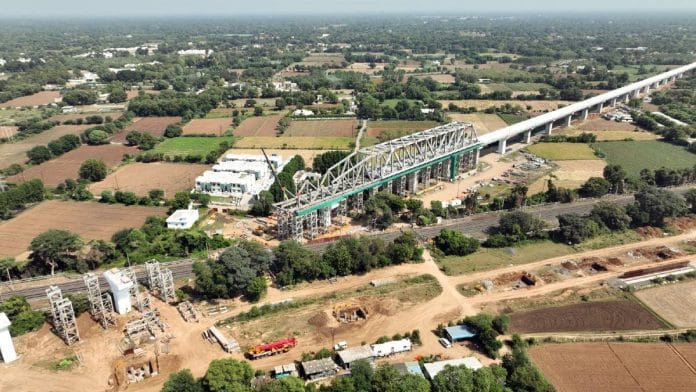
The railways ministry is already implementing the Mumbai-Ahmedabad high speed rail project. The Gujarat portion of the corridor between Vapi and Sabarmati is planned to be completed by December 2027. The entire project is expected to be completed by December 2029.
Overall, the allocation for railways in FY 2026-27 has seen a 10.25 per cent increase, the highest ever—from Rs 2.5 lakh crore in the 2025-26 revised estimate to Rs 2.8 lakh crore in 2026-27.
The highway sector has also seen a hike in allocation to Rs 3 lakh crore in the 2026-27 budget estimate from Rs 2.87 lakh crore in the 2025-26 revised estimate.
The ports and shipping sector’s allocation has been increased to Rs 3,470 crore as compared to Rs 2,899 crore in the 2025-26 revised estimate.
(Edited by Viny Mishra)
Also read: ‘Blind’ Budget: Congress says Centre ignored jobs, growth and Economic Survey