





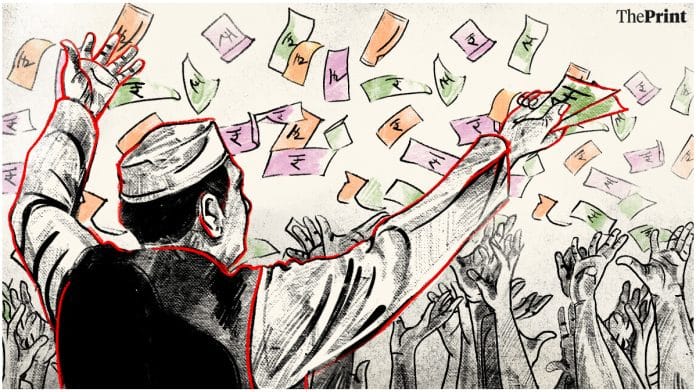



New Delhi: The Economic Survey 2025-26 warned that the increasing use of unconditional cash transfers (UCT) by states and Union territories risks crowding out expenditure for critical infrastructure, threatening fiscal stability and public investment.
The survey, tabled in Parliament Thursday, flagged how UCTs have contributed to rising revenue expenditure with serious implications for fiscal space at the state level, even as political parties increasingly resort to such schemes to woo voters.
“While these provide immediate income support, their growing scale risks increasing expenditure rigidity and crowding out resources for capital investments, including human capital,” the report released by Finance Minister Nirmala Sitharaman said.
Aggregate spending on UCT programmes, particularly for women, is estimated at approximately Rs 1.7 lakh crore for FY26, it said.
The survey pointed out that the number of states/UTs implementing such transfers has increased more than fivefold between FY23 and FY26, with around half of them estimated to be in revenue deficit.
The Bihar example illustrates the political appeal of UCTs. In the run-up to last November’s assembly elections, the Nitish Kumar-led government in Bihar announced the Mukhyamantri Mahila Rozgar Yojana, giving eligible women Rs 10,000 to start a business. The scheme is widely considered to be a contributing factor for the National Democratic Alliance’s victory in the election.
Other than Bihar, cash transfers for women have been introduced over the past few years by several other states, among them Tamil Nadu, Maharashtra, Jharkhand, Odisha, Haryana, Andhra Pradesh, Assam and West Bengal.
Also Read: Borrowing to survive: Indian households are saving more, why are they still in debt?
The Economic Survey highlighted that UCT expansion has occurred amid constrained fiscal space. The combined gross fiscal deficit of states rose from 2.6 percent of GDP in FY22 to 3.2 percent in FY25, while the combined revenue deficit increased from 0.4 percent to 0.7 percent of GDP, “indicating continued borrowing to finance revenue expenditure”, it said.
Outstanding liabilities stood at about 28.1 percent of GDP in FY25. Committed expenditures — salaries, pensions, interest payments and subsidies — absorbed about 62 percent of states’ revenue receipts in FY24, “leaving limited fiscal room”, it said.
“In this context, higher allocations to UCTs involve clear trade-offs. Unless deficits widen further, additional spending will crowd out resources for critical social and physical infrastructure,” the survey said.
The report also cited an Economic and Political Weekly article by academic Chandrika Singh, who assessed such transfers to be in the range of 0.19-1.25 percent of GSDP (state GDP) and 0.68-8.26 percent of total budgetary expenditures across states.
Singh estimated that cash transfers account for a significant share of monthly income of female casual labourers (11-24 percent) and self-employed workers (11-87 percent) across seven states where a detailed study was undertaken.
“They reportedly account for 40 to 50 percent of the Monthly Per Capita Consumption Expenditure of at least half of the rural population,” the report said.
Some supporters, including some states, have argued that cash transfers provide immediate income support, helping women meet unmet health and personal needs. Others say such transfers are a return for women’s unpaid contribution to GDP.
On this, the Economic Survey pointed to mixed evidence on long-term efficacy of unconditional cash transfers.
Citing an analysis by the National Bureau of Economic Research covering 72 UCT programmes in 34 low- and middle-income countries, it said that while UCTs improve consumption, food security and short-term income stability, they do not consistently improve child nutrition, educational outcomes or enable sustained exits from poverty.
“Such outcomes depend critically on complementary public services and employment opportunities, underscoring that UCTs are not substitutes for investments in health, education, nutrition, childcare, or growth-enhancing public expenditure,” the survey said.
The report, instead, pointed to international examples where countries have linked cash transfers to clear, verifiable actions rather than providing open-ended income support.
In Mexico’s Progresa/Oportunidades programme, for instance, families received cash only if children attended school regularly, and pregnant women and young children visited health clinics for check-ups and nutrition monitoring. Payments were stopped if these conditions were not met, and households were periodically reassessed, it said.
Brazil’s Bolsa Família followed a similar approach, requiring minimum school attendance and compliance with basic health requirements such as immunisation and maternal care. These conditions ensured that public spending directly supported education, health and nutrition outcomes, not just consumption.
Some programmes also have built-in exit or review mechanisms.
“These experiences show that cash support can be designed as conditional, review-based, and time-bound, reducing long-term fiscal rigidity while strengthening human capital,” the survey said.
(Edited by Prerna Madan)