








Shimla: Reeling from a financial setback after the Centre accepted the 16th Finance Commission’s recommendation to abolish the revenue deficit grant (RDG) to states, the Himachal Pradesh government has introduced 2% annual revenue cess on the total land held by hydropower projects in the state, projecting an annual income of around Rs 1,800 crore.
This comes after an earlier attempt to impose a water cess on hydro projects was struck down by court, highlighting the hill state’s ongoing struggle to balance its books amid rising debt and high committed expenditures like salaries and pensions.
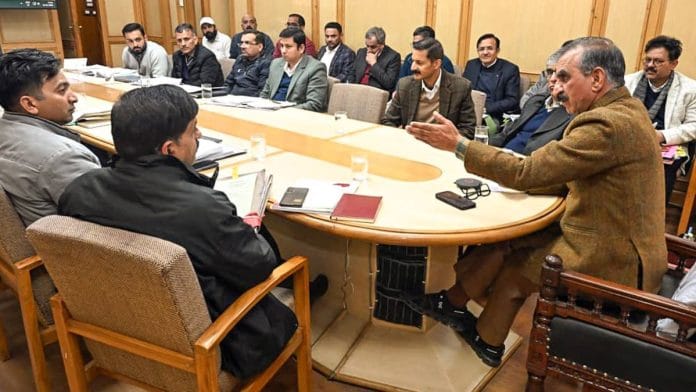
“We have decided to charge land revenue cess from hydropower projects in the state,” Chief Minister Sukhvinder Singh Sukhu announced Wednesday.
The decision to levy the cess stems from amendments to the Himachal Pradesh Land Revenue Act, 1954, which was updated last year to allow special assessments on land used for non-agricultural purposes, including hydropower projects.
The key provision enabling the land revenue cess comes under Sections 50-51 of the amended Act, which empowers the government to assess and collect revenue based on the average market value of land.
A notification for the levy was issued on 12 December, 2025, with the charge effective from 1 January, 2026. However, the state delayed immediate enforcement to consider objections from power producers, who argue that the move is arbitrary and can increase electricity costs.
“If the state would have got RDG even a bit less than last time’s allocation, this land revenue move could have been put on hold or seen some amendment, but now the state needs to generate more funds, wherever it can,” a senior official in the state government told ThePrint.
“You can see stricter moves in the days to come as these three months—the last quarter of the financial year—are crucial.”
The levy has already sparked opposition, particularly from neighbouring Punjab.
Punjab’s water resources minister Barinder Kumar Goyal termed it “baseless and illegal”, saying it imposes an additional annual burden of around Rs 200 crore on the state, though the Bhakra Beas Management Board (BBMB)—which operates key hydropower projects—faces a total hit of nearly Rs 500 crore.
“The financial burden of nearly Rs 500 crore on the Bhakra Beas Management Board is a brazen assault on federal principles and a direct conspiracy against Punjab’s interests,” Goyal told the media.
According to Himachal’s 12 December notification on land assessment, projects facing the highest cess annually include the Bhakra Dam (Rs 227.46 crore), Beas-Sutlej Link (Rs 146.92 crore), and Pong Dam (Rs 58.77 crore). Satluj Jal Vidyut Nigam could pay around Rs 283 crore yearly.
Beyond Punjab, other stakeholders have voiced concerns.
The BBMB, in a media statement, termed the new cess as “ultra-vires, arbitrary, and legally unsustainable”, citing historical agreements and constitutional grounds. Power producers, including central undertakings like NHPC and NTPC, have also objected, warning that Himachal’s new levy could raise power tariffs and deter investment in the sector.
In a meeting with hydropower producers, chaired by CM Sukhu early last month, the state reaffirmed that collecting land revenue was a legitimate right, emphasising compliance and timely payments, while opening discussions on rationalising rates.
Also Read: Himachal farmers are ditching apples for persimmons. ‘Earnings on par with JEE packages’
‘Never imagined losing RDG’
Sukhu has been vocal about the RDG loss, which he described as a “black day” for Himachal.
“I had never imagined that the state would lose the revenue deficit grant,” he said Wednesday, adding that under the 15th Finance Commission, the state received around “Rs 48,000 crore (via RDG) over five years”.
“This time, when we will prepare the budget for the next fiscal, we do not have a huge grant—you can imagine the situation. So, I have decided to go ahead with land revenue charges.”
This is not the first time Himachal has tried taxing hydro resources. In 2023, the state had imposed a water cess on hydropower projects, aiming to raise Rs 1,800-2,000 crore annually. However, the Himachal Pradesh High Court struck it down as unconstitutional in March 2024, ruling that the move exceeded the state’s legislative powers under Articles 246 and 265 of the Constitution. The cess affected 175 projects and faced challenges from over 40 companies, leading to refunds of collected amounts.
Sukhu Wednesday highlighted the state’s environmental contributions, noting: “Himachal Pradesh acts as the lungs of northern India through its forests, provides water to neighbouring states and resources for power generation by central companies… Himachal protects ecology and gets nothing in return.”
He further hinted at exploring legal options, calling the RDG discontinuation arbitrary and unjustified, potentially leading to a loss of Rs 50,000 crore over five years.
A look at Himachal’s finances
Himachal’s finances have long been under strain. The state’s debt-to-GSDP ratio rose to 43.98% in 2023-24, with total liabilities at Rs 95,633 crore, breaching FRBM (Fiscal Responsibility and Budget Management) targets.
For 2025-26, the fiscal deficit is projected at 4.74% of GSDP (Rs 10,338 crore), with revenue deficit at 2.5% (Rs 6,390 crore).
Salaries and pensions dominate the budget for 2025-26, with 25% going to salaries and 20% to pensions. Developmental works get 24%, while interest and debt repayments take 12% and 10%, respectively.
The revenue gap persists, with own tax revenue estimated at Rs 16,101 crore for 2025-26, insufficient to cover committed costs amid natural disasters and limited industrial growth.
FRBM projections for the next five years indicate continued pressure, with debt stabilisation requiring higher growth and lower primary deficits.
The 16th Finance Commission has kept states’ overall tax share at 41%, but discontinued the RDG, arguing states have scope to increase revenue and rationalise expenditures. However, economists warn this could strain fiscally fragile states like Himachal, Punjab, and Andhra Pradesh.
BJP defends Union Budget
BJP leaders, including former Union minister Anurag Thakur, have defended the Union Budget announced Sunday, noting that under the 16th Finance Commission, Himachal’s share in the divisible tax pool increased from 0.83% to 0.914%, adding Rs 2,388 crore in 2025-26.
Thakur attributed the RDG discontinuation to the state’s weak tax efforts and high committed expenditures, comparing it unfavourably to Uttarakhand.
The Himachal BJP also defended the Union Budget without stating a clear position on the RDG issue.
The Centre has rebutted allegations, stating central transfers to Himachal have increased, with Rs 13,946 crore estimated for 2026-27 and total devolution of Rs 76,799 crore from 2014 to 2026.
The Himachal Pradesh government is set to hold a cabinet meeting Sunday to discuss the implications of the RDG abolition, followed by a meeting of MLAs in which BJP legislators would also be invited. The government is mulling holding a special session of the state assembly to discuss the issue besides amplifying the concerns.
In a separate measure to boost revenue, the government has imposed Rs 2 per unit cess on electricity consumed by commercial banks and insurance firms operating in the state.
The cess, notified under the Himachal Pradesh Electricity (Duty) Act, 2009, targets institutional consumers and is expected to generate additional funds amid the fiscal squeeze. Himachal Pradesh State Electricity Board has been tasked with collecting it.
(Edited by Nida Fatima Siddiqui)
Also Read: 100+ ex-civil servants write to 16th Finance Commission, say Himalayan states ‘going to pieces’