





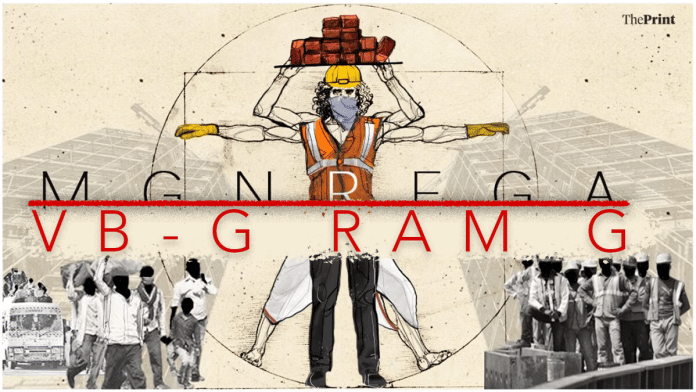



New Delhi: A month after the enactment of the Viksit Bharat-Guarantee for Rozgar and Ajeevika Mission (Gramin) Act, 2025, the Economic Survey of India has set the stage for justifying the new law, reiterating the “gaps” in the implementation of the Mahatma Gandhi National Rural Employment Guarantee Act, 2005 (MGNREGA).
The VB-G RAM G Act has come under intense scrutiny from civil society as well as the Opposition parties, ever since it was introduced in Parliament’s Winter Session last year. The Congress had launched a nationwide protest, calling it the “MGNREGA Bachao Sangram” earlier this month.
The Opposition also raised slogans demanding a roll-back of the law Wednesday, following President Droupadi Murmu’s reference to the VB-G RAM G Act in her address to the joint sitting of both houses of Parliament as the Budget Session kicked off.
The Economic Survey, tabled in the Parliament Thursday, now acknowledges that since its enactment in 2005, MGNREGA provided wage employment, stabilised rural incomes, and created basic infrastructure, offering at least 100 days of guaranteed unskilled work to rural households. However, it asserts that while MGNREGA has long served as a critical safety net for rural households, recent trends reveal a notable decline in work demand under the scheme.
The survey further alleges that monitoring in several states revealed certain “gaps” in the implementation of the scheme. This included work not being done on ground, expenditure not matching physical progress, the use of machines in labour-intensive work, and frequent bypassing of digital attendance systems.
“Misappropriation accumulated over time, and only a small proportion of households completed the full 100 days of employment post-pandemic, indicating that while delivery systems improved, the overall architecture of MGNREGA has reached its limits and warrants reassessment in light of evolving rural realities,” it, therefore, says.
The survey calls the new law a “comprehensive statutory overhaul” of MGNREGA, and says that the new law “represents a significant upgrade over MGNREGA, fixing structural weaknesses while enhancing employment, transparency, planning, and accountability”.
A comparison
Among other things, critics take objection to the removal of Mahatma Gandhi’s name from the law, and allege that the new law places more burden on state governments.
Under MGNREGA, the central government used to provide the entire cost of wages for unskilled manual work, up to three-fourths of the material cost, and a share of administrative costs. However, the new law provides for a fund-sharing pattern of 60:40 between the Centre and state governments.
In a tabular format, the survey lists down the differences between the two laws, making a case for the superiority of VB-G RAM G Act. It points out that while MGNREGA spoke of 100 days of wage employment per rural household, the new law provides a legal guarantee of 125 days of unskilled wage employment per rural household per financial year.
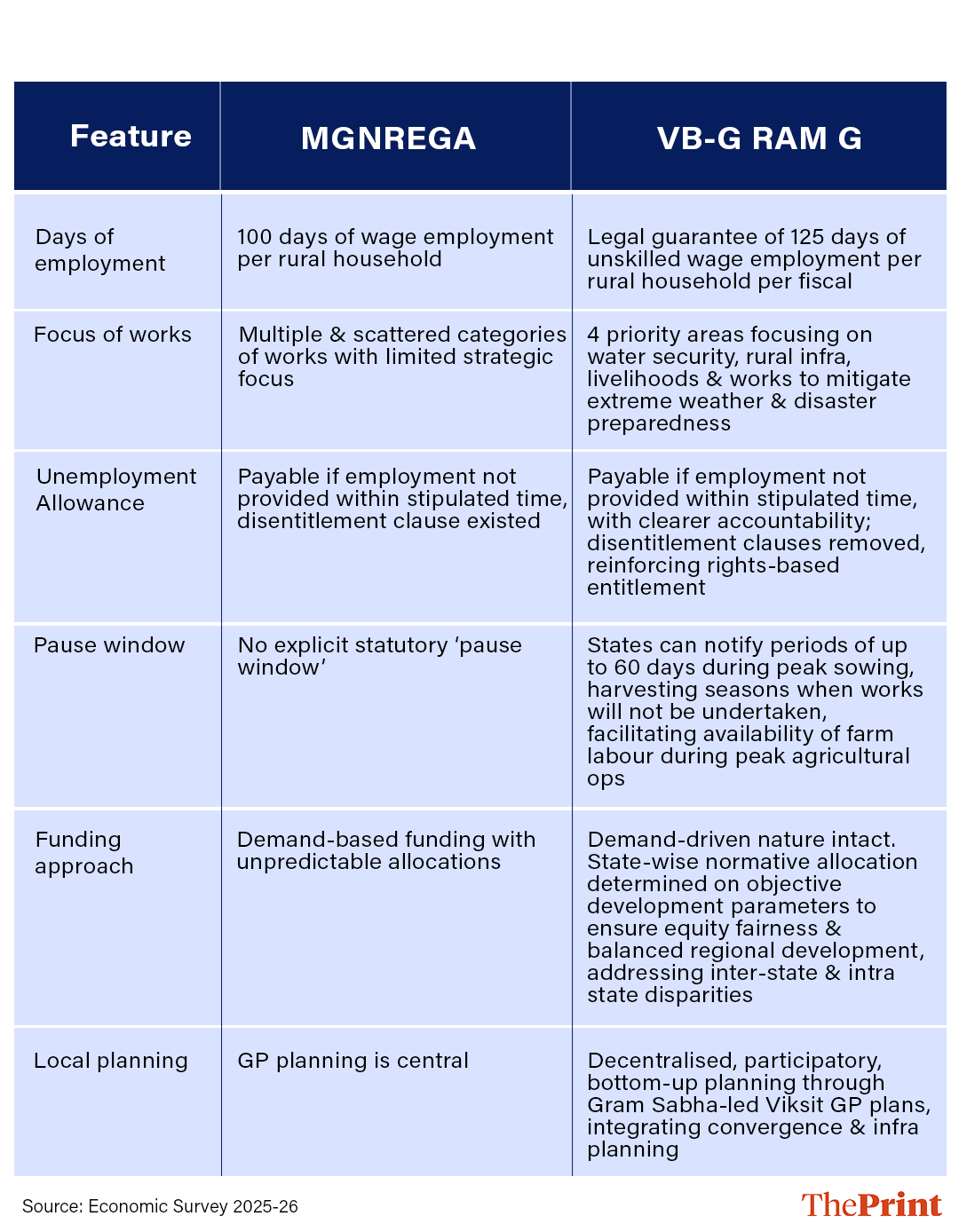
On the funding approach, the survey says that MGNREGA had a “demand-based funding with unpredictable allocations”. However, under the new law, it says, “Demand-driven nature is intact. State-wise normative allocation is determined on objective development parameters to ensure equity (samata), fairness (nyaysangata) and balanced regional development while addressing inter-state and intra- state disparities.”
The survey asserts that the new Act enhances transparency and accountability across the system, because the Centre is empowered to investigate complaints, suspend fund releases in cases of serious irregularities, and direct corrective measures as necessary.
(Edited by Mannat Chugh)