





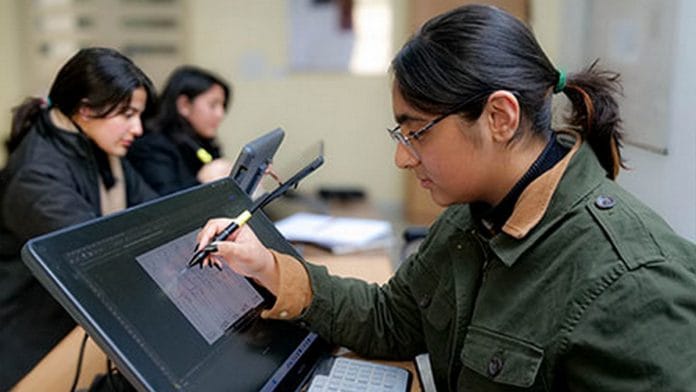



New Delhi: In a boost to India’s creative industries, Finance Minister Nirmala Sitharaman has announced government support for the country’s “Orange Economy” in the Union Budget 2026-27, with a focus on the AVGC sector—animation, visual effects, gaming, and comics. The industry is projected to require two million professionals by 2030.
“Orange economy. India’s animation, visual effects, gaming, and comics (AVGC) sector is a growing industry projected to require 2 million professionals by 2030. I propose to support the Indian Institute of Creative Technologies (IICT) Mumbai in setting up AVGC content creator labs in 15,000 secondary schools all over the country and 500 colleges,” Sitharaman said during her Budget speech.
IICT was launched in September last year with six specialised courses in gaming, four in post-production, and eight in animation, comics, and XR.
Dr Vishwas Deoskar, CEO of IICT, called it a “landmark step” and a “powerful investment in shaping India’s creative economy”. He said in a written message to ThePrint that the decision is aligned with the highest global benchmarks of the times ahead, and poised to illuminate India’s distinctive contribution to future-ready creative and technological standards.
“By introducing students early to animation, visual effects, gaming and comics, this initiative will democratise access to cutting-edge creative technologies, nurture grassroots talent, and significantly strengthen India’s global leadership in AVGC and digital storytelling,” Deoskar said, citing examples such as the USC School of Cinematic Arts and the MIT Media Lab in the US, where students are introduced to AVGC at a young age.
Deoskar described the initiative a “powerful investment” in skills, jobs, and “India’s cultural and creative capital”, adding that IICT would dedicate itself to “translating this vision into sustainable, high-impact outcomes that reflect India’s commitment to global excellence”.
The four pillars of IICT, Deoskar said, are academics (with future-ready programmes in animation, VFX, gaming, and XR), start-up incubation (empowering creative tech entrepreneurs through mentorship, funding access, and industry networks), policy advocacy (driving India’s AVGC-XR policy agenda in collaboration with government and industry bodies), and research (advancing technology, skills, and IP creation in creative media).
IICT has also signed a Memorandum of Understanding (MoU) with the University of York in the United Kingdom, paving the way for collaborative research, faculty exchange, and global certification pathways.
Companies such as Google, YouTube, Adobe, Meta, Microsoft, NVIDIA and JioStar have committed to long-term collaborations with IICT as well.
Sitharaman’s emphasis on the ‘Orange Economy’ aligns with findings from the Economic Survey 2025-26, which highlighted that creativity-led sectors, including culture, media, entertainment, and intellectual property, can be significant drivers of employment, urban services, and tourism.
Also Read: What are the 4 telescope sites FM Nirmala Sitharaman mentioned in Budget speech?
What is the Orange Economy?
The term “orange economy” was coined in Colombia by former President Iván Duque Márquez and his culture minister in 2013 as a label for the creative industries. The colour was chosen as a symbol of creativity.
Also known as the creator economy, it encompasses people and companies that turn skills, ideas, and storytelling into scalable digital businesses. What makes it powerful is the mix of technology, direct distribution, and ownership. Today, a single creator can build audience, credibility, and revenue without traditional gatekeepers.
“It is no longer limited to influencers posting content; it now includes educators building learning communities, designers creating intellectual property, gamers running media channels, and founders building authority around expertise,” said Aryan Anurag, co-founder, Binge Labs.
The Delhi-based company is a strategy-first organic growth social media tech firm that helps founders, venture capitalists, and brands build an intentional, scalable online presence.
The impact of the orange economy, Anurag said, is already visible in everyday behaviour: people discover products on social media, solve problems on YouTube, and increasingly trust relatable digital voices over traditional celebrities.
“Every industry, from politics to education, is becoming a media industry, and the Union Budget’s push toward AVGC and creator labs simply formalises this cultural shift,” he said.
However, he added that creator labs will only succeed if they are paired with mentorship and realistic expectations.
While early exposure gives creative careers legitimacy, the odds of breakout success are low, and without guidance these spaces risk becoming distractions rather than skill-building platforms.
“With the right industry mentors and focus on storytelling, design thinking, and digital literacy, they can nurture thoughtful digital professionals, not just aspiring influencers. The opportunity is not just in producing more creators, but in producing skilled, thoughtful digital professionals who understand media as both a craft and a responsibility,” he added.
(Edited by Asavari Singh)