





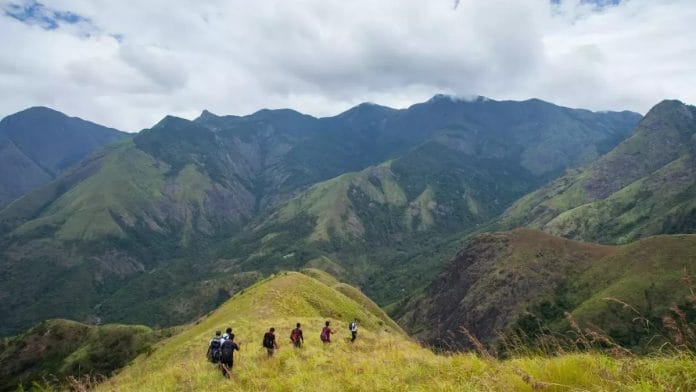



New Delhi: Finance Minister Nirmala Sitharaman has specially mentioned developing mountain trails as a way to promote trekking and hiking in her Budget speech this year. The Union Budget 2026 proposes “ecologically sustainable” mountain trails across Himachal Pradesh, Uttarakhand, Jammu and Kashmir, and select regions in the Eastern and Western Ghats. The trails are meant to boost rural tourism and provide employment to local people.
“India has the potential and opportunity to offer world-class trekking and hiking experiences. We will develop ecologically sustainable mountain trails in Himachal Pradesh, Uttarakhand and Jammu and Kashmir; Araku Valley in the Eastern Ghats and Podhigai Malai in the Western Ghats,” said Sitharaman.
This was not the launch of a brand-new tourism programme. It was a policy signal rather than a dedicated funding announcement.
India’s mountain tourism bounced back after Covid-19, with mountain sports in hilly areas such as bungee jumping, paragliding and river rafting. It has increased domestic adventure tourism and nature travel in areas such as Bir, Manali and Rishikesh, but many remote Himalayan areas are still untouched. The trails can help boost the tourism industry there.
The government has been trying to boost the tourism industry for the past few years with long-running scheme-based interventions such as Swadesh Darshan and PRASHAD. The Ministry’s National Strategy for Ecotourism (2022) and National Strategy for Sustainable Tourism (2022) emphasise community livelihoods, carrying-capacity and ecosystem safeguards. Tourism ministers have repeatedly pitched India as a global adventure destination by inviting foreign climbers and proposing mega Himalayan trails.
Schemes such as Swadesh Darshan, launched in 2015 and later upgraded to Swadesh Darshan 2.0, fund tourism infrastructure such as trail development, training of guides, last-mile connectivity and signage.
Under Swadesh Darshan 2.0, dozens of projects worth over Rs 2,200 crore have been sanctioned to strengthen sustainable and responsible tourism infrastructure. Approvals for Himachal and Uttarakhand locales like Kaza and Rakchham-Chitkul have already come through in recent years.
Challenges and consequences
The projects announced by Sitharaman are likely to be routed through existing Ministry of Tourism destination development schemes, including Swadesh Darshan 2.0.
“As of now, it isn’t clear how they will make these mountain trails, what the road network will be, and what kind of financing will be there. The government has to be clear on all these points. There should be decentralisation in the plan, and the government should understand that it will invite more tourists to the mountains, and we have to be careful about the carrying capacity,” said Guman Singh, an environmentalist from Himachal Pradesh.
“State governments will face the challenge to balance footfall growth with environmental clearances, carrying-capacity limits and long-term maintenance of fragile mountain routes. We all saw what happened in Manali recently, crowds entering the hills. There is an 80 lakh population, but almost 4 crore tourists every year,” he added
The implementation of mountain trails will be dependent on each state—how fast they can prepare project reports and secure the centre’s approval under tourism infrastructure schemes.
“States will require specific routes, land ownership, clearances for wildlife and forest. This will need strong coordination between states and the centre, and also with the forest departments and local panchayats. Timelines are heavily dependent on state capacity rather than central directives alone,” said a source from the tourism ministry on the condition of anonymity.
Lalit Kumar, chief secretary, Jibhi Valley Tourism Development Association, is cautiously optimistic.
“This will certainly help the tourism sector and create job opportunities, but we also need to look at the consequences. If we are talking about sustainable tourism, we must account for the ecological, social and safety impacts. There are illegal activities in parts of the tourism and mountain sports sector, and enforcement remains weak,” he said.
He also raised the question of promoting quantity tourism over quality tourism. And highlighted the need to strengthen disaster management, especially in areas like Manali and Kullu, where rapid road expansion has amplified the impact of recent disasters in 2023 and 2025.
“This is a positive step for tourism in Himachal and other Himalayan regions, but it needs a more holistic approach,” he said.
(Edited by Theres Sudeep)