





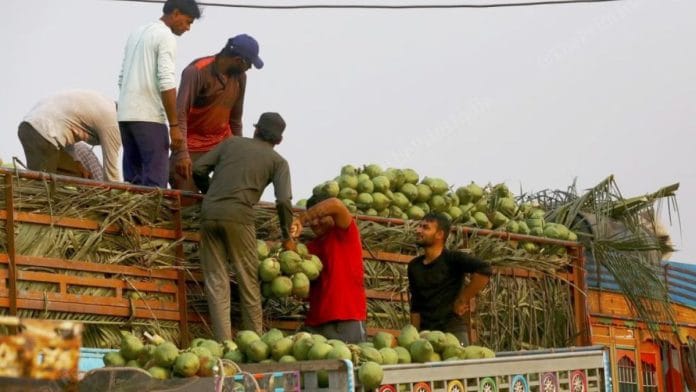



New Delhi: It is a celebration for coconut producers in India as this is probably for the “first time” the fruit has received such a big push in the Union Budget.
Under the section Increasing Farmer Incomes, finance minister Nirmala Sitharaman announced Coconut Promotion Scheme “to further enhance competitiveness in coconut production and enhance productivity through various interventions, including replacing old and non-productive trees with new saplings/plants/varieties in major coconut growing States.”
“The Union Budget scheme will streamline the efforts of coconut organisations that have worked towards improving the production of coconut in India,” K Balachandra Hebbar, director of ICAR-Central Plantation Crops Research Institute in Kasargod, Kerala, told ThePrint.
The new variety of coconut
India is the highest producer of coconut globally. About 30 million people, including 10 million farmers, depend on the coconut for their livelihood. However, one of the major challenges is that India’s coconut plantations are old and ‘senile’ (approx 60-80 years old). It is very important to replace them with improved varieties. The Union Budget emphasised this.
In recent years Central Plantation Crops Research Institute and the Coconut Development Board have been working on supplying quality planting material. The two coconut research-oriented organisations have launched initiatives, including enhanced subsidies for orchard rejuvenation.
“If quality planting material is not developed scientifically and the seedling goes wrong, and it doesn’t flower or produce nuts, the entire effort of so many years is lost,” K Balachandra Hebbar said.
The coconut-based organisations have started licensing planting materials for improved varieties.
“There are both varieties and hybrids–dwarf into tall and tall into dwarf, but everything is site specific. You cannot plant the same variety everywhere,” Hebbar said.
CPCRI and CBD have been pushing coconut production in western and eastern states. The latest example of this success is Gujarat, which has emerged as one of the highest suppliers of coconut to Northern states.
Also read: What Budget 2026 has in store for India’s tourism sector—Ladakh to Tamil Nadu
Push for by-product
With the aim to support high-value crops, the government also pushed for cocoa production, apart from coconut, sandalwood and cashew in coastal areas.
“A dedicated programme is proposed for Indian cashew and cocoa to make India self-reliant in raw cashew and cocoa production and processing, enhance export competitiveness and transform Indian Cashew and Indian Cocoa into premium global brands by 2030,” she announced.
India’s value addition or processing is only 8 per cent compared to countries such as Indonesia and the Philippines that boast figures over 30 per cent.
Production of Cocoa in India is roughly 27 to 30 thousand tons, whereas the demand is almost one lakh tons.
“Our target is to increase this value addition or processing to at least 20 per cent by 2030,” said Hebbar, “for this production and productivity have to be increased,” he added.
According to Hebbar, not much impetus was being given to this industry and the new scheme will help make India self-sufficient.
It is easier for India to grow cocoa as an understory crop, because India already produces a lot of coconut and palm oil. The two plants have similar attributes.
“If there we increase the planting material production and a large area is brought in and we can produce whatever the demand is there we can produce in India itself,” Hebbar said.
“The scheme will benefit both coconut and cocoa.”
(Edited by Ratan Priya)