








New Delhi: Slowing growth, depleting forex reserves and persisting uncertainty—the energy crisis triggered by Iran’s blockade of the Strait of Hormuz has once again brought into focus how India’s energy strategy has evolved at the intersection of geopolitics and domestic realities.
Forty percent of India’s crude oil imports, 50 percent of its LNG imports, and 90 percent of its LPG imports go through the strait.
On Thursday, representatives from more than 40 countries participated in virtual talks hosted by the UK to discuss the future security of the strait.
Against this backdrop, ThePrint looks at six geopolitical conflicts that shaped and disrupted India’s economic and energy strategy, from the 1970s to present day.
Also Read: India’s strategic oil reserves tell a tale of structural constraints & stalled expansion. Here’s why
Yom Kippur War (1973)
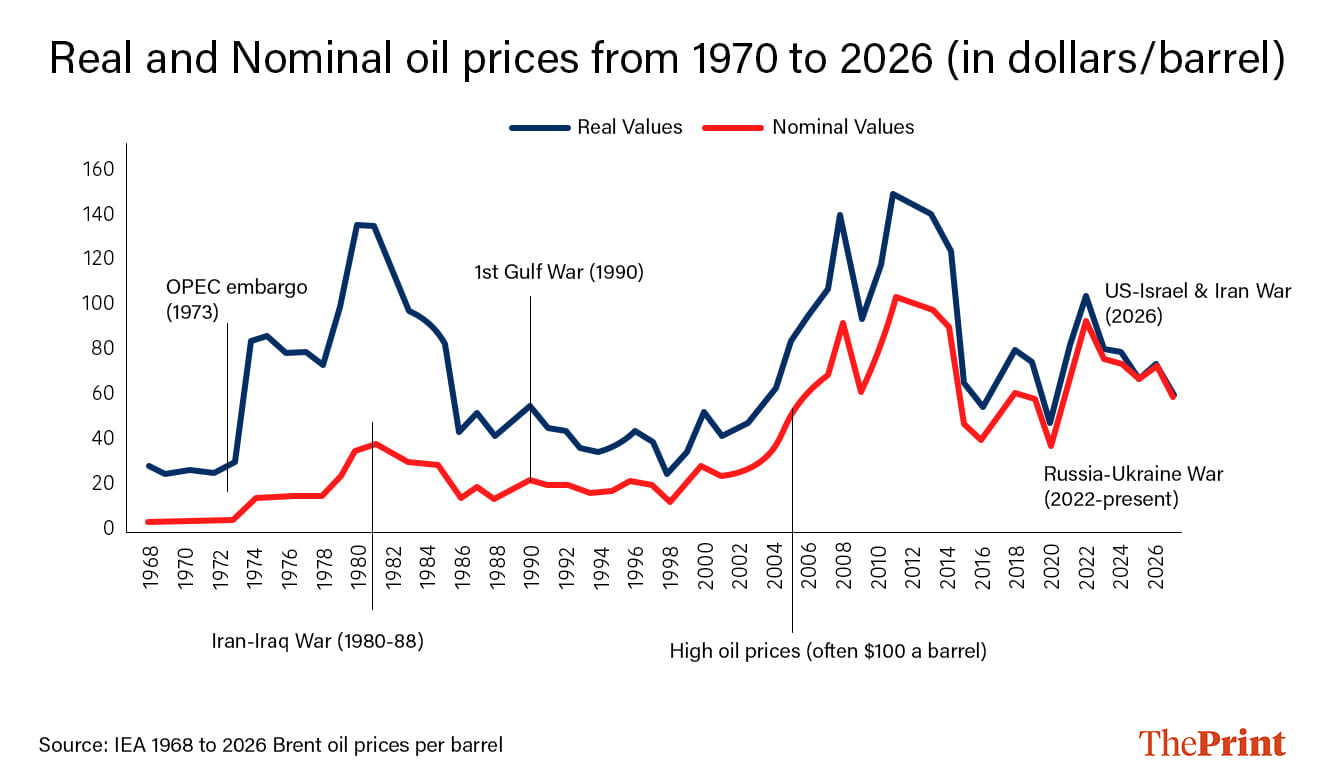
In the 1973 Yom Kippur War, Egypt and Syria launched a surprise attack on Israel, which fought back after securing emergency military aid from the United States. In response, Saudi Arabia mobilised the Arab countries under the banner of OPEC (Organization of Petroleum Exporting Countries) to implement an oil embargo on the US from 1973 to 1974.
In addition to the embargo, OPEC also cut global oil production, contributing to a sudden 300 percent increase in global oil prices, leading to the global recession of 1973-75. In the long-run, the OPEC embargo compelled the Western nations to develop diversified sources (including the North Sea offshore oil fields) and improve fuel efficiencies.
The impact of this first ‘oil-shock’ was acutely felt by India, as the country’s oil import bill surged from $500 million in 1973 to $1.4 billion in 1974, while its economy grew by just 1 percent in that year. Beyond the economic consequences, the 1973-75 energy crisis led to a substantial restructuring of India’s oil and energy industry.
Prior to the oil crisis, India imported most of its oil from West Asia, especially from Iran and Iraq. However, as OPEC’s cutbacks in the 1970s led to a sharp temporary decline in oil imports from West Asia, India started importing more oil from the Soviet Union, a trend that continued until its collapse in 1991 and the subsequent balance of payments crisis.
This was part of a larger pattern of cooperation post the 1971 Indo-Soviet Friendship Treaty which increased India’s strategic co-operation with the USSR in the fields of defence and energy.
The 1970s were also a time when Indira Gandhi steered India’s economy further towards socialism. Under her leadership, India nationalised the three Western oil companies (Shell-Burmah, Esso, and Caltex) which had previously dominated India’s refinery sector. Finally, rattled by the geopolitical volatility of oil imports, the Indian government once again prioritised domestic coal-based thermal energy.
Iranian Revolution (1979) and Iran-Iraq War (1980-88)
The Iranian Revolution (1979) and the Iran-Iraq War (1980-88) once again led to shortages in oil production causing an almost two-fold increase in global oil prices. A maritime component of this conflict was the ‘tanker wars’ (1984-88) when both countries targeted one another’s oil vessels transiting the Strait of Hormuz.
For India, this second ‘oil shock’ contributed to a domestic recession as the economy shrank by roughly 3 percent in real GNP, accompanied by high levels of inflation. What made this crisis worse for India, was that the country was still recovering from back-to-back wars with Pakistan, a severe drought, the Emergency, and the previous oil-crisis of the 1970s.
The subsequent ‘oil-shock’ of 1979-80 resulted in widespread shortages of kerosene, diesel, electricity, sugar (and in some places even salt) which, in turn, led to violent protests and political turmoil. The energy crisis was among the factors that brought about the downfall of the Janata Party in 1980, even as it propelled Indira Gandhi back to power, partly on the back of her assurance to provide coal, kerosene, and electricity.
Global prices only started to stabilise by the mid-1980s, when Saudi Arabia discreetly defied the OPEC agenda and emerged as a major exporter. By this time, India’s dependency on foreign oil also eased as domestic oil discoveries like Mumbai High oil and gas fields reached peak capacity. This also marked the commercial scale utilisation of natural gas as part of India’s energy basket.
This was the first and the last time India reduced its import dependence to 30 percent, which has been growing ever since.
Also Read: Build-up stalled, House panel pulls up govt on underutilisation of funds for new crude storage sites
First Gulf War (1990)
In 1990, Saddam Hussein invaded and briefly occupied Kuwait, partly on the pretext of an oil-dispute. A US-led coalition backed by a UN resolution moved in to liberate Kuwait, even as retreating Iraqi forces scorched large swathes of Kuwait’s oil-fields.
Once again, there was the familiar pattern of war driving global oil prices. Almost on cue, India’s oil import bill doubled, depleting forex reserves and precipitating the 1991 balance of payments crisis. The First Gulf War further accentuated the forex crisis as remittances fell after the Indian government repatriated almost 100,000 Indian workers from Kuwait back to India.
With the collapse of its closest strategic partner, the Soviet Union, India undertook deep reforms in its economy and foreign policy.
The 1991 economic crisis compelled the P.V Narasimha Rao government to initiate free-market reforms which ushered in a period of high economic growth. The liberalisation of the Indian economy led to an increase in the domestic demand for oil, especially from the country’s growing automobile and aviation sectors.
On the supply side, liberalisation opened the doors for increased global trade and private investment to meet the rising demand. In 1999 Reliance commissioned the world’s largest refinery in Jamnagar, which signalled India’s emergence as a major exporter of refined petroleum. Private companies also ventured into oil and gas exploration, with a Reliance-Niko joint venture finding the KG offshore gas fields (in 2002), and Cairn’s onshore gas discovery in Mangala, Rajasthan (in 2004).
US invasion of Iraq (2003)
The US invasion of Iraq (2003) signaled a decade of high oil prices, which repeatedly breached $100 a barrel, largely driven by heightened demand from China, India, and other emerging economies. Despite inflationary pressures, the robust growth of the Indian economy allowed the government to partially absorb and manage higher oil prices during this period.
Growing domestic demand for energy further increased the country’s dependence on oil imports, which shot up from 33 percent of domestic consumption in 1990-91 to 85 percent in 2019-20. A similar pattern was visible with natural gas, with India entering into a 25-year agreement to import natural gas from Qatar starting from 2004.
This was also a period when the government sought to further liberalise the domestic fuel market through the partial introduction of market price mechanisms for petrol (in 2010) and diesel (in 2014), although targeted subsidies were continued for LPG users.
Also Read: India’s energy paradox: Coal dominates at 79% of supply even as renewables surge, says MoSPI report
Russia-Ukraine War (2022-present)
When Russia invaded Ukraine in 2022, the US and the EU imposed sanctions on Moscow and oil prices surged past $100 per barrel but came down in later months. The sanctions led Russia to redirect its crude exports away from Europe towards Asia by offering discounted rates to India and China which emerged as major buyers.
From being a relatively negligible supplier to India prior to the war, Russia quickly became India’s largest crude oil supplier accounting for 35.8 percent of India’s imports in FY 2024-25. The US in August 2025 imposed a punitive 25 percent tariff on Indian exports for buying oil from Russia.
This was not the first time India’s energy requirements were constrained by US foreign policy. In 2019, India had to similarly stop importing oil from Iran in light of US sanctions. That same year, US sanctions on Venezuela compelled India to similarly reduce oil imports from Caracas.
However, with the ongoing US-Israel and Iran war disrupting global supplies, the US has announced a 30-day ‘temporary waiver’ for India to make oil purchases from Russia.
US-Israel & Iran War (2026)
In its ongoing war with the US and Israel, Iran has selectively blocked and weaponised the Strait of Hormuz, effectively disrupting roughly 20 percent of the world’s oil and gas supplies. While Tehran has subsequently allowed tankers from ‘friendly nations’ (including India, China, and Pakistan) to pass through the strait, there is uncertainty over future supplies in a region still embroiled in an ongoing conflict.
Even though disruptions are partially offset by the Saudi Arabia East-West pipeline and the UAE’s Abu Dhabi pipeline, both of which bypass the Hormuz Strait, the diversification is still limited to crude oil.
The LNG and LPG flows continue to be disrupted as imports from India’s primary supplier Qatar are severely hit. The US-Israel and Iran war and the Hormuz crisis have resulted in roughly 54 percent of India’s LPG supplies and 30 percent of India’s LNG supplies being cut-off in recent weeks.
However, the Hormuz crisis provides India with an opportunity to bolster an energy strategy centred on greater diversity, domestic capacity, and global diplomacy.
Energy diversification: A strategic necessity
While geopolitical conflicts have repeatedly highlighted India’s energy vulnerability, they have also created the space for a more diversified energy strategy. Energy diversification is essential since India is the world’s third largest oil importer and fourth largest importer of natural gas.
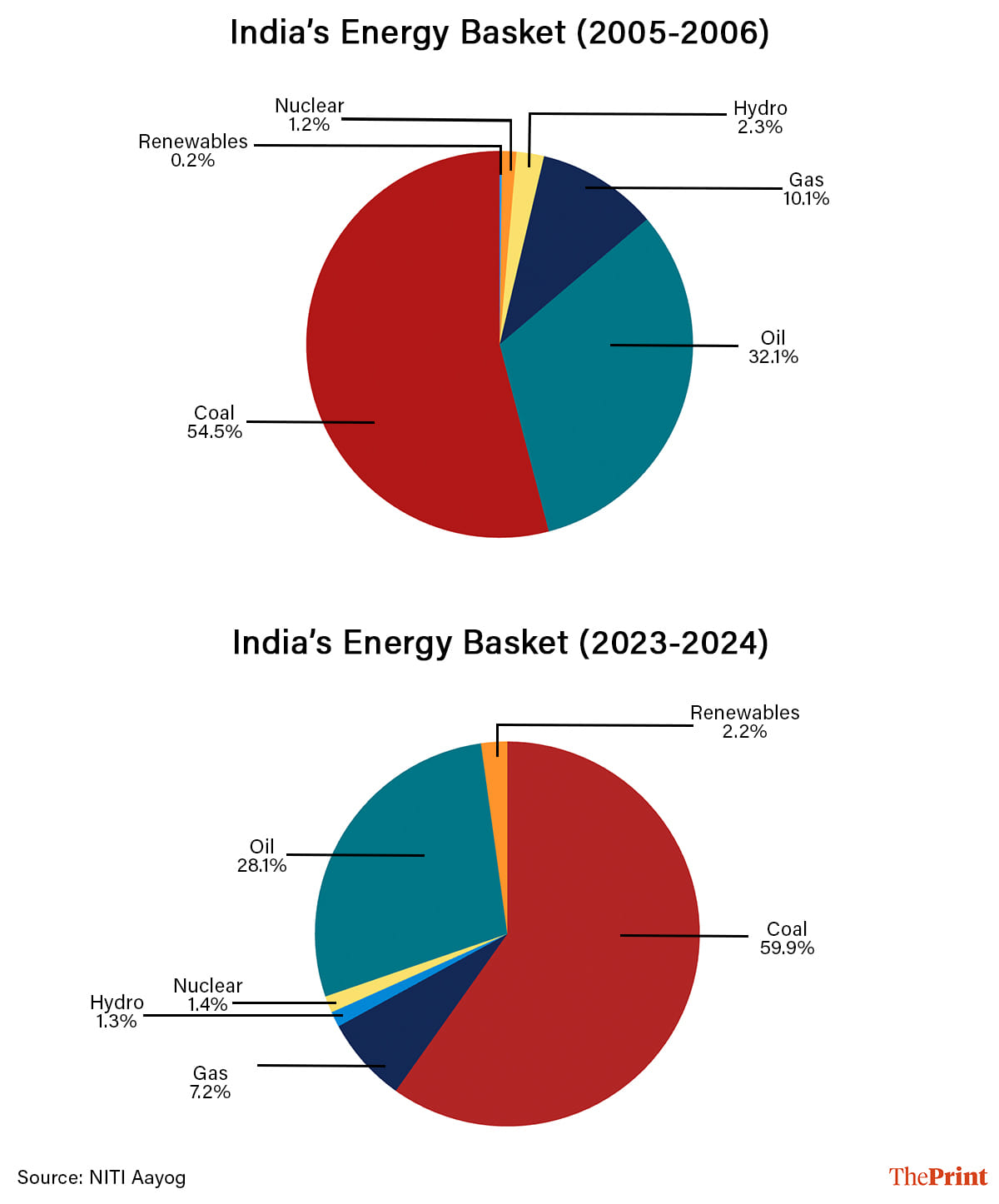
Shifting economic and geopolitical realities have compelled India to diversify its energy basket in recent decades. For instance, the share of oil fell from 32.1 percent (in 2005-06) to 28.1 percent (in 2023-24).
Similarly, the share of gas has fallen from 10.1 percent to 7.15 percent during the same period.
However, this decline in oil and gas imports is driven not only by a modest rise in renewables, but also by India’s increased reliance on coal. India’s vast reserves of coal have ensured that it stubbornly remains the dominant fossil fuel in India’s energy basket for successive decades now.
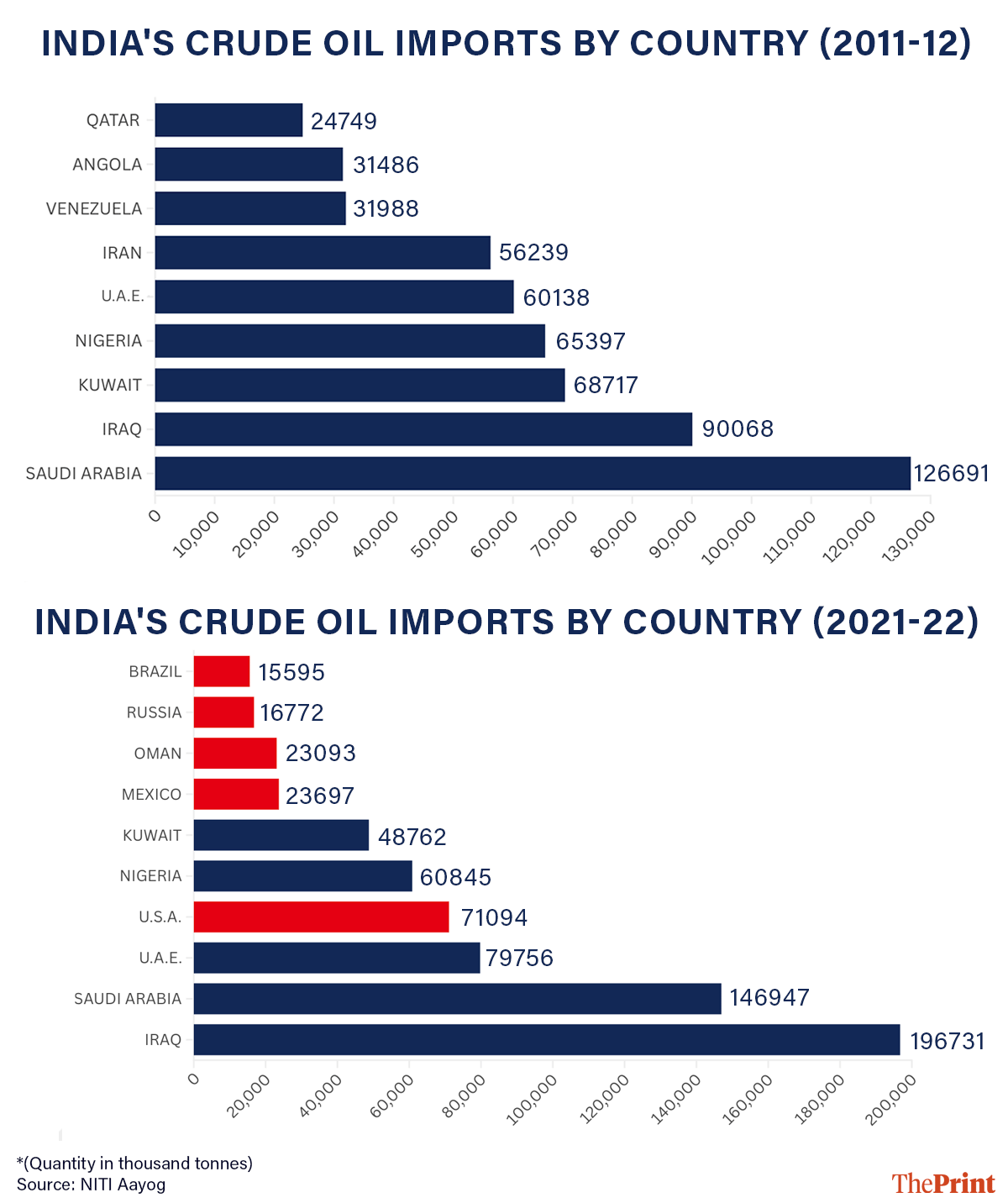
Diversification of country-wise import sources is also evident from data. Both the United States and Russia have emerged as major oil importers to India over the last decade.
In the case of natural gas, India’s reliance on Qatar declined between 2010-11 and 2023-24, owing to increased imports from the US, the UAE, Nigeria, and Angola.
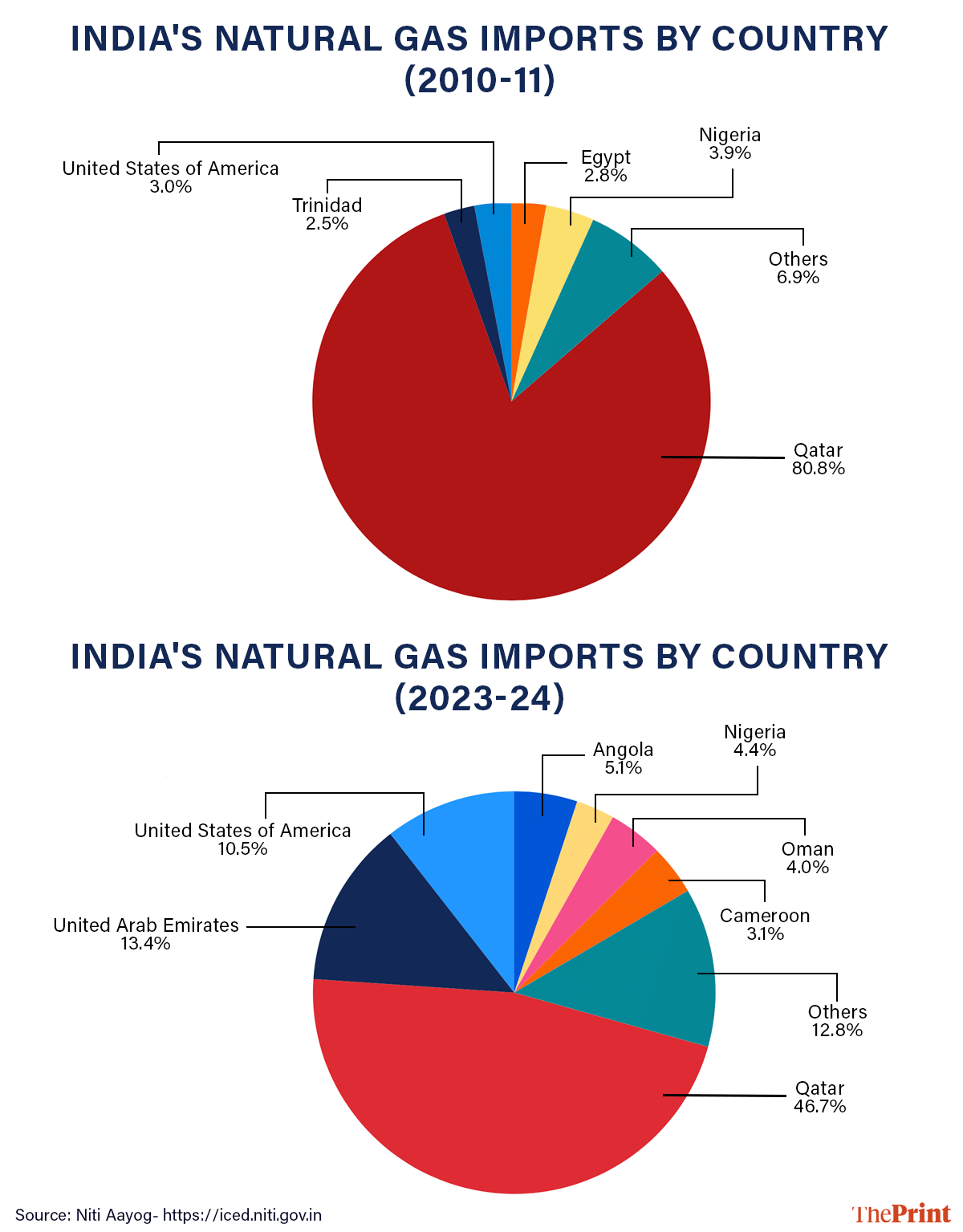
Energy diversification remains prudent for negotiating geopolitical volatility. India’s energy security is also contingent on bolstering strategic oil reserves (currently adequate for two months).
Rahul Saikia is an alum of ThePrint School of Journalism, currently interning with ThePrint
(Edited by Amrtansh Arora)
Also Read: Venezuela crude returns to India’s oil basket. But only as ‘supplementary’ supply