








New Delhi: Bangladesh remains committed to addressing sensitive issues with India “in all sincerity and candour”, including trade, security and resource-sharing, Bangladesh’s High Commissioner to India M. Riaz Hamidullah has said.
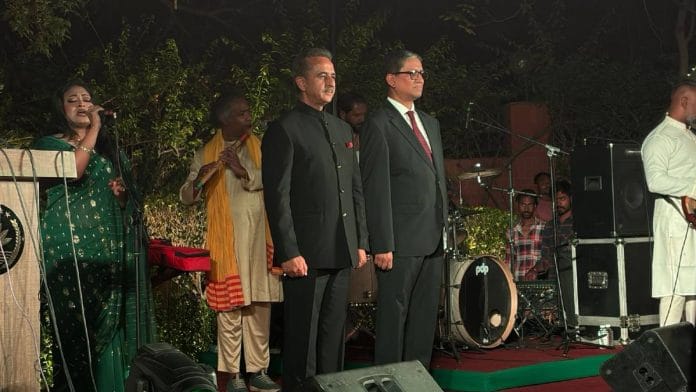
“Our shared values should call for appreciating others’ needs, endowment and expectations. In the closest proximity as ours, should there be difficult or sensitive issues, those can—and ought to be—addressed forthright in all sincerity and candour, be it trade, security or sharing natural resources,” he asserted, speaking at Bangladesh’s 56th Independence and National Day celebrations in New Delhi Thursday.
He quoted from a recent message sent by Bangladesh Prime Minister Tarique Rahman to Prime Minister Narendra Modi, which said that “Bangladesh accords high importance to its relationship with India, a partnership shaped by history, culture, and geography”.
“As our government embarks on a robust mandate, we look forward to advancing our ties and engagements with India, premised on dignity, equality, mutual trust and respect, and shared benefits. I do believe, if Dhaka and Delhi would address issues in ways that yield gains for the common people, there is so much that our two countries can accomplish in shared interests,” Rahman had stated.
Hamidullah also pointed to a series of high-level exchanges between the two countries in the last few months, including External Affairs Minister S. Jaishankar attending the funeral of former PM Khaleda Zia in Dhaka last December, and Lok Sabha Speaker Om Birla and Foreign Secretary Vikram Misri attending the swearing-in of Bangladesh’s new government in Dhaka this year.
The envoy added that PM Rahman had reiterated the commitment to a “pragmatic and mutually respectful and beneficial partnership with India, for shared prosperity”.
“As we speak, both our countries navigate complexities and uncertainties in the global order. While we foresee tumultuous times ahead, Bangladesh looks forward to walk and work together to preserve the values and principles of open regionalism and multilateralism, for both, as responsive and responsible nations,” he added.
Reflecting on Bangladesh’s Liberation War, he said his country continued to remember those who “withstood a genocide” and fought for independence, including the role played by (Tarique Rahman’s father) Ziaur Rahman in “making the Declaration of War of Independence, for the people”. He also acknowledged the contribution of India, including the sacrifice of 1,668 Indian soldiers during the 1971 war.
Hamidullah described India and Bangladesh as sharing a “unique and multi-dimensional relationship” rooted in a common cultural heritage that spans figures such as Rabindranath Tagore, Kazi Nazrul Islam, Satyajit Ray and Ravi Shankar, whose “Concert for Bangladesh” helped draw global attention to the 1971 war.
He said Bangladesh’s social fabric is defined by syncretism and openness, allowing citizens “to live and prosper freely, irrespective of one’s faith or belief”.
Turning to domestic developments, he said that 76 million Bangladeshis had voted in the February polls this year in a “participatory and exceptionally peaceful transition to democracy”.
“Our future rests firmly on the people’s shared belief in democracy and common developmental aspiration,” he said, noting the youthful demographics in both India and Bangladesh.
Closing on a personal note, Riaz paid tribute to his “Indian friend”, late Assamese singer Zubeen Garg, who had planned to perform at Thursday’s event.
“It is indeed possible for us to chart a pathway towards inter-dependent relations for generations to advance in Bangladesh and India, beyond all differences or divergences,” he said.
(Edited by Nida Fatima Siddiqui)