





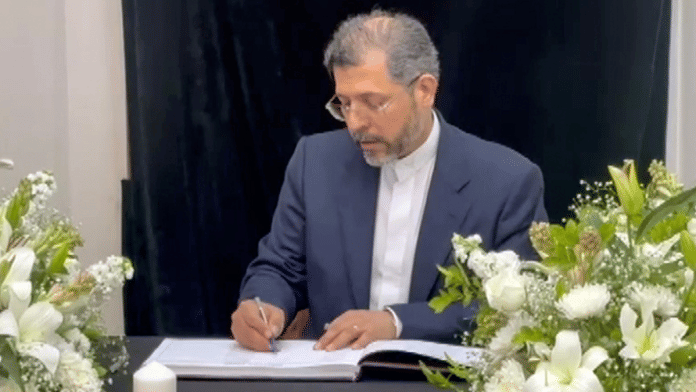



New Delhi: Iran is fighting an “existential war” and the attacks on oil and civilian infrastructure in West Asia are “false flag” operations, Deputy Iranian Foreign Minister Saeed Khatibzadeh said Friday.
Speaking at the Raisina Dialogue, Khatibzadeh added that the attack on Iran came at a moment when Tehran was negotiating for an “inclusive” framework with its regional neighbours, which the US and Israel have tried to prevent.
“America decided to put an end to the existence of Iran. Israel has been promising this for many decades due to their delusions of Greater Israel,” Khatibzadeh said at the Raisina Dialogue organised by the Ministry of External Affairs and the Observer Research Foundation (ORF).
“We have no option but to put an end to the existence of America in the areas surrounding Iran… We told the Americans, and our neighbours, if they would like to put an end to the oldest civilisation on earth, then we will put an end to their existence in the Persian Gulf region,” he added.
“My country is under attack based on lies… A week ago we were in Geneva for negotiations. We nailed down a practical agreement. We identified Monday to go to Vienna to write down everything. We left the room. The American negotiators said, ‘It’s very promising: we will meet on Monday to write everything down.’ This is a TV reality show. There is no understanding of why they started this,” he further said.
Calling the war an “existential” one for Iran, Khatibzadeh said the country had strong institutions that had survived despite the assassination of its Supreme Leader, Ayatollah Ali Khamenei, during the opening phases of the conflict last Saturday.
The Iranian deputy foreign minister said that the regional neighbours were warned well in advance that any attack on Iran would lead to Tehran retaliating at US bases in the region, including American radar stations in Qatar and the Fifth Fleet in Bahrain.
“Why are they there? To fish in the Persian Gulf?” Khatibzadeh said.
Hitting out at the US and Israel, he said that the attacks came as Iran was in discussions with Qatar, Oman and other regional countries for a new “inclusive” regional architecture, while simultaneously negotiating an agreement with Washington at Geneva over its nuclear programme.
“Parallel to our nuclear negotiations with the US in Geneva… There were parallel negotiations between Iran, Oman, Qatar and other countries in the Persian Gulf to have an inclusive dialogue happening at the same time. The second was not announced, but I am now revealing that,” said Khatibzadeh.
“The Americans and Israelis just spoiled that. We believe that because they knew that, they rushed into dragging everyone into this war… The moment that this atrocity stops, it is the moment for the region to move to a new security and inclusive arrangement,” he added.
The Iranian deputy foreign minister said that their only strategy in this war is to resist, while asserting that if the US and Israel want to “stop this atrocity today”, they can do that.
While defending Tehran’s retaliation at US military installations across the region, Khatibzadeh highlighted that the attacks on energy infrastructure in Saudi Arabia were “false flag” operations, with Iran sharing the information it has with Riyadh.
“Aramco was a false flag. Cyprus was a false flag. They know that because we shared information with those asking from us,” said the Iranian Deputy Foreign Minister.
The war began last Saturday with a joint US-Israel strike on Tehran.
Iran’s Islamic Revolutionary Guard Corps vowed revenge for the attack and has since targeted US installations in half a dozen countries: Bahrain, Kuwait, the United Arab Emirates, Oman, Qatar and Saudi Arabia.
US President Donald J. Trump first called the operation an effort at regime change before shifting justifications for the war emerged from Washington.
US Secretary of State Marco Rubio earlier this week claimed that the conflict was “pre-emptive” knowing that Israel was unlikely to back down from any strike on Iran. Mike Johnson, the US Speaker of the House of Representatives, has described the war in religious terms, as a “crusade” of sorts.
The muddying of the US’s goals and justification for the war has led to some domestic pushback, in particular from the Democrats, according to media reports. The minority party has failed to limit the war through failed resolutions in the US Congress in the last 48 hours.
(Edited by Sugita Katyal)