





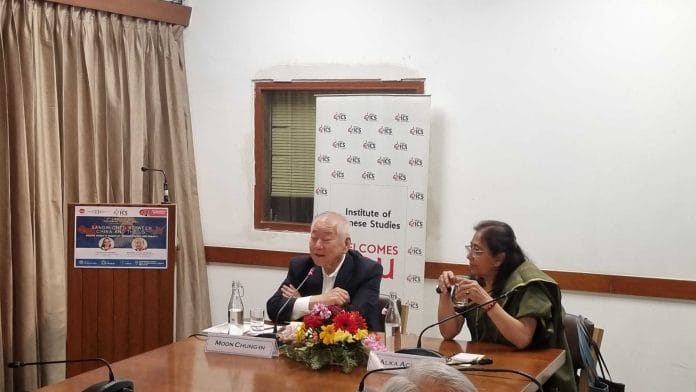



New Delhi: “South Korea must maintain its military alliance with the United States while simultaneously pursuing a strategic cooperative partnership with China to avoid national catastrophe,” Professor Moon Chung-in, the James Laney Distinguished Professor at Yonsei University and a former special adviser to the South Korean presidency, said Wednesday.
History, he warned, demonstrates that it has been a fatal mistake to sideline a “rising challenger” over a “declining hegemon”.
Moon made these remarks at a lecture on ‘Sandwiched between China and the US: South Korea’s Quest of Transcending Diplomacy’, organised Wednesday by the Institute of Chinese Studies (ICS) at the India International Center here.
Moon, while emphasising that South Korean diplomacy has always leaned towards the US, noted that deepening structural rivalry between Washington and Beijing across the four modern battlegrounds—geopolitics, geoeconomics, technology, and values—is at a clash.
He explained that the so-called ‘Shanghai school’ of thought, represented by Henry Kissinger, former US Secretary of State, has been marginalised by the growing ‘Crow school’ faction. He added that ‘Crow school’, which takes a relatively hard-line stance on US-China relations, views the current friction as a prelude to military conflict.
“History has always warned South Korean people that putting everything into the US can be self-defeating,” Moon said, though adding, “It is better for us (South Korea) to maintain a strategic collaboration with China while maintaining the security partnership with the US.”
He also said that the dilemma for Seoul is not just limited to the security apparatus but also on the economic front, where Washington has ‘arm-twisted’ South Korean giants like Samsung and Hyundai to divert billions in investment from China to the US.
“This led to the US becoming the largest trading partner for South Korea, but Korean companies are still caught in the middle. Korean companies are sandwiched between China and the US in the context of China-US trade,” he noted.
Moon also said that the current US administration is no longer a disruptive leader but a destructive one, which is actively undermining the rule of law. As a consequence of this, he highlighted that, on issues of global governance, Seoul may find itself more aligned with the Chinese position of preserving the existing international framework.
“On the issue of global governance, I think the South Korean government is more likely to be prone toward China rather than the United States. Because the United States has been destroying liberal and national borders,” Moon said.
To escape this trap, Moon proposed a shift towards a more “transcending diplomacy,” where the middle powers lead the way forward.
He said this strategy would involve moving away from “collective defence” to “collective security,” which in turn, would foster “collective pluralism”.
Moon argued that in this process of diversification, he identified India as a team member. He said, “For us, India is the number one partner for our diversification.” He concluded by stressing the coalition of middle powers to restore order in a world of a “rising monster”.
ThePrint is a media partner
(Edited by Vidhi Bhutra)