





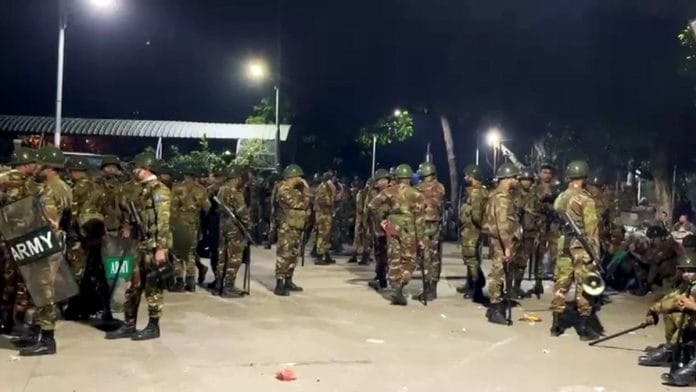



New Delhi: Bangladesh Army Sunday announced a sweeping military leadership reshuffle just days after Prime Minister Tarique Rahman took office following his party’s landslide victory in the first polls since Sheikh Hasina’s ouster.
Key changes include the chief of general staff (CGS), principal staff officer (PSO) and director general of the Directorate General of Forces Intelligence (DGFI), the country’s premier military intelligence agency.
Major General Kaiser Rashid Chowdhury is set to become director general of the Directorate General of Forces Intelligence, replacing Major General Mohammad Jahangir Alam, who has been posted to the Foreign Ministry as an ambassador.
Maj. Gen Mir Mushfiqur Rahman, general officer commanding of the 24 Infantry Division in Chattogram, has been promoted to lieutenant general and appointed principal staff officer (PSO) of the armed forces division (AFD).
He succeeds Lt Gen S. M. Kamrul Hasan, who had been serving as the PSO of the AFD since 22 August 2024, and has now been assigned to the Ministry of Foreign Affairs as an ambassador.
Meanwhile, Lt Gen Md Mainur Rahman, previously serving at the Army Training and Doctrine Command (ARTDOC), has been appointed chief of general staff (CGS) at Army Headquarters.
The changes also affect Bangladesh’s military representation in New Delhi.
Brigadier General Md. Hafizur Rahman, currently serving as defence adviser in the Bangladesh High Commission in New Delhi, and attached to military intelligence, has been promoted to major general and will assume command of the 55th Infantry Division upon returning to Bangladesh.
Such reshuffles are not unusual after a change in political power. But in Bangladesh, where the military has historically played an outsized role in political transitions, they carry particular weight.
“Historically, the restoration of democracy has been done by the Bangladesh Army,” a source in the Bangladesh Army in Dhaka told ThePrint.
In moments of institutional breakdown, he argued, “there was no other option” but for the military to step in—sometimes as a self-styled stabiliser, at other times as an instrument of those in power.
Over the past two decades, successive governments have reorganised senior military posts after taking office. Each administration, he said, sought to ensure that key commanders were aligned or at least not hostile to its interests.
“This is exactly what happens whenever there is a new political government,” they said, describing the reshuffles as linked to the “security of the political party”.
The latest round of promotions and transfers fits that pattern, he suggested.
Retd Major general Dr Md Nayeem Ashfaque Chowdhury, vice-chairman of Osmani Centre for Peace and Security Studies in Dhaka, told ThePrint: “Military postings and promotions are normal administrative processes. Officers are promoted based on seniority, suitability, and the needs of the service. Appointments—especially key coordinating roles—are given to those considered the best fit. When one officer is moved, it creates another vacancy, leading to a chain of routine transfers.”
“There is no connection between these changes and any change in government. They are standard, routine postings and should not be viewed with suspicion,” he said.
Regarding the defence adviser in New Delhi, he added that even if his tenure was not complete, he was promoted based on seniority and suitability. For service requirements, he was called back after his promotion, he said.
(Edited by Viny Mishra)