





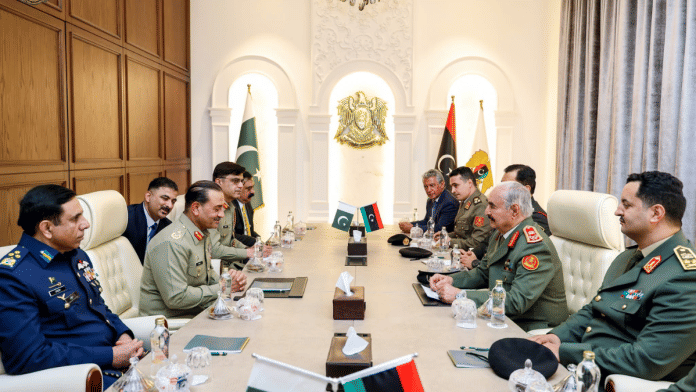



New Delhi: In one of its largest weapons exports, Pakistan has signed an arms agreement worth $4 billion-plus dollars with Libyan National Army (LNA) even as a United Nations arms embargo is placed on the African nation since 2011.
Citing Pakistani officials, Reuters reported that the deal could be worth as much as $ 4.6 billion and would be implemented over two and a half years.The deal was finalised last week in Benghazi following meetings between Pakistan’s Chief of Defence Staff, Field Marshal Asim Munir, and Saddam Khalifa Haftar, the deputy commander-in-chief of the LNA and son of its leader, General Khalifa Haftar.
The LNA, according to Reuters, is set to purchase 16 JF-17 fighter jets, a multirole combat aircraft jointly developed by Pakistan and China, along with 12 Super Mushak trainer aircraft used for basic pilot training. A Pakistani official was reported saying that the package includes land, sea and air equipment, while two others described it as Pakistan’s largest arms export deal to date.
Neither the LNA nor the Government of National Unity in Tripoli, currently operate a substantial air force, making the acquisition significant for Libya’s military balance.
On Sunday, the LNA’s official media channel announced the defence cooperation pact that included weapons sales, joint training and military manufacturing, though it did not disclose details.
“We announce the launch of a new phase of strategic military cooperation with Pakistan,” Haftar said in remarks broadcast by local television channels.
It was not immediately clear whether Pakistan or the LNA had applied for any exemptions. Under the UN arms embargo, all transfers of weapons or related material to Libya require approval from the Security Council.
Three Pakistani officials were quoted by Reuters saying that the arms deal did not violate the embargo. While one of them said Pakistan was not the only country supplying arms to Libya, another argued there were no sanctions on Haftar while the third said Benghazi authorities had seen improving relations with Western governments amid rising fuel exports.
Libya has remained fractured since a NATO-backed uprising in 2011 toppled Muammar Gaddafi, splitting the country between rival authorities.
The Tripoli-based government, led by Prime Minister Abdulhamid Dbeibeh, controls much of western Libya, while Haftar’s forces govern the east and south, including key oil fields, and do not recognise Dbeibeh’s authority.
Meanwhile, Field Marshal Munir publicly promoted Pakistan’s military technology in Benghazi, presenting it as both combat-tested and indigenously produced.
Referring to skirmishes with India during Operation Sindoor, he said Pakistan had “shown (our) technology to the world,” claiming that 90 percent of it was domestically developed.
Munir even claimed that Indian aircraft and air defence systems, including Rafale, Su-30, MiG-29 and Mirage 2000 fighter jets, as well as the Russian-made S-400 system, was “taken out” during the 84-hour confrontation. India has already rejected the Pakistan establishment’s claims.
Also Read: Spymaster to convict—Pakistan army court sentences ex-ISI chief Faiz Hameed to 14 yrs in jail
Pak’s African outreach
Addressing LNA officers, Munir said Pakistan was prepared to share all of its military capabilities with Libya. “Every piece of equipment and technology which is there with Pakistan is available for our brothers,” he said, adding that any assistance Libya required would be delivered “at your doorsteps.”
“Please make your armed forces as strong as possible because armed forces guarantee the existence of countries.”
He described Libya as “a land of lions,” invoking Omar al-Mukhtar, the Libyan Islamic scholar who resisted Italian colonisation through guerrilla warfare.
Munir also said that historical ties between Pakistan and Libya have been strong and Islamabad aimed to restore the relationship “to that level where it used to be.”
He presented Libya’s turmoil within a broader narrative of decline across the Muslim world, saying that over the past two decades, “seven or eight magnificent Muslim countries, one after the other, have been destroyed,” leaving the region in “great difficulty and pain.”
Türkiiye’s footsteps?
Haftar launched a failed offensive to seize Tripoli in 2019 with backing from the UAE, Saudi Arabia, Egypt and Russia, before Türkiiye intervened in support of the Libya government. Ankara then also signed a controversial maritime agreement with the Tripoli authorities. However since then, Libya’s alliances have shifted.
The UAE and Saudi Arabia have extended ties to Tripoli, while Türkiiye has sought to cultivate relations with Haftar through his son, Saddam.
Ankara’s outreach to eastern Libya is a strategic hedge, aimed at embedding Turkish interests nationwide in counter to Greece oil projects while maintaining its core position in Tripoli and securing long-term legitimacy, according to geopolitical experts.
This strategy is based on security cooperation, with emerging defence talks, training, UAV supplies and advisory support signalling a shift from engagement to operational partnership.
Pakistan seems to follow the lead of Ankara in spreading its influence in African Muslim countries, invoking history, religion and strategic ties.
Islamabad maintains close relations with Saudi Arabia and the UAE, the latter remains Haftar’s closest Gulf ally. Saudi Arabia has also provided support and lobbied on Haftar’s behalf.
The Haftar family’s relationship with Egypt has become strained over its alleged coordination with Sudan’s paramilitary Rapid Support Forces (RSF). Libya’s southeast borders Sudan’s Darfur region, and Haftar is accused of facilitating arms shipments to the RSF.
In August, Pakistan finalised a $ 1.5 billion dollar defence agreement, another major military collaboration, with Sudan. The deal aims at helping the Sudanese Armed Forces amid their ongoing conflict with the RSF.
(Edited by Tony Rai)