





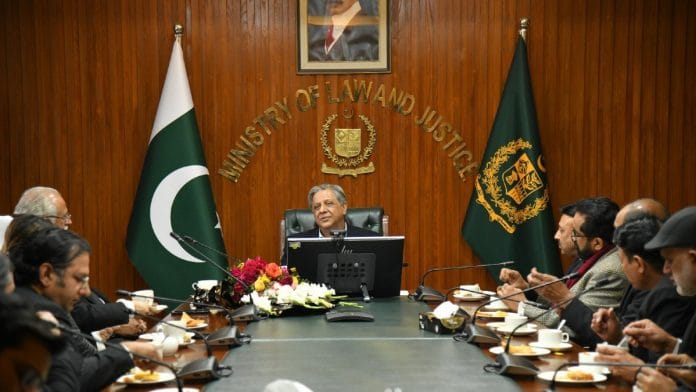



New Delhi: The Pakistan government is now closely monitoring TV debates around the West Asia conflict, and has asked journalists and commentators to ‘exercise caution’ when discussing the country’s foreign policy especially with regards to the current escalation.
Pakistan’s Federal Minister for Law and Justice & Human Rights Azam Nazeer Tarar told reporters in a press conference Tuesday that freedom of expression must be exercised within legal boundaries, particularly when it concerns relations with foreign states.
“Every citizen has the right to receive accurate information and to express what is in their heart,” Tarar said in Islamabad, as reported by Dawn. “However, we cannot ignore constitutional limits and restrictions.” He warned that commentary framing Pakistan’s foreign policy choices in binary terms such as suggesting the country must choose between Iran and its Gulf allies could undermine delicate diplomatic relationships.
Analyses coming out of Pakistan, he claimed, had caused “unease on diplomatic fronts from at least a friendly country or some other corner”.
“We have been asked if this was Pakistan’s stance or an individual one,” Tarar said.
“Leave such decisions to the State,” he added, asking the public to trust the government’s handling of international affairs.
The minister then cited the Constitution of Pakistan, which guarantees freedom of expression under Article 19 but allows “reasonable restrictions” in matters involving national security, the integrity of the State and friendly relations with other countries.
“You have the fundamental right to freedom of expression, but you must be careful when it comes to the glory of Islam, the integrity, security and defence of Pakistan or any part thereof, and friendly relations with foreign states,” Tarar said.
In Pakistan, authorities have in recent years increasingly relied on the Prevention of Electronic Crimes Act (PECA) to pursue cases involving digital content that officials say spreads misinformation or threatens national security. In August 2025, Pakistan’s Senate Standing Committee on Information and Broadcasting itself expressed alarm over the growing misuse of PECA after a Senate report revealed that a total of 689 FIRs had been registered under the law across the country including nine against journalists.
Journalists and analysts have called out such restrictions and argue that such laws have also been used to pressure journalists and silence dissent. Among those raising concerns about the government’s approach is senior Pakistani journalist and political analyst Najam Sethi, who said public debate about foreign policy should not be curtailed. Speaking on his YouTube program, Aaj Ki Baat Sethi ke Saath, Sethi argued Friday that open discussion is essential in democratic societies, especially when national interests are involved.
“In the international media there is open debate, even criticism of their own country’s foreign policy. Media there, especially when it comes to foreign policy, is critical,” he said. “National interest is not decided by a single party alone.”
He said journalists and analysts often provide valuable feedback that governments should consider rather than suppress. “If you shut down debate,” he said, “how will policymakers know the possible consequences of the decisions they are making?”
He also argued that disagreements with media commentary should be addressed privately rather than through public warnings.
“We are all patriotic people,” he said. “During crises we do not want instability. But closing people’s mouths is not the answer. Are you saying you are the only ones who understand what is happening and no one else has ever understood what is happening in the Middle East?”
The debate comes amid broader questions about press freedom in Pakistan. In January this year reports circulated that media outlets had been informally advised to limit coverage of tensions between Saudi Arabia and the United Arab Emirates over developments in Yemen.
An investigation by the US-based outlet Drop Site News alleged Pakistan’s military media wing, Inter-Services Public Relations (ISPR), instructed some newsrooms to cut down reporting on the dispute, which involved a Saudi-led strike on the Yemeni port city of Mukalla. Pakistan’s Ministry of Information rejected those claims, calling them part of a disinformation campaign spread by anonymous social media accounts.
Meanwhile, Pakistan PM Shehbaz Sharif Thursday visited Jeddah and pledged his country’s “full solidarity and support” for Saudi Arabia. The trip followed a phone conversation a day earlier between Sharif and Iran’s President Masoud Pezeshkian.
Tehran has launched repeated missile attacks on its Gulf neighbours, including Saudi Arabia, in retaliation against strikes by Israel and the US. The confrontation has driven up oil prices and disrupted global supply chains. For Pakistan, the stakes are high. Saudi Arabia remains the largest source of remittances for Pakistani workers abroad and a critical energy partner, while Iran shares a long and sensitive border with the country.
But journalists and analysts warn that restricting debate could weaken, rather than strengthen, public understanding of the choices the country faces. “The media has the right to ask questions,” Sethi said. “Whether the government has the answers is another matter.”
(Edited by Amrtansh Arora)
Also Read: After Pakistan protests, US Trade Representative quietly removes map showing J&K as part of India