





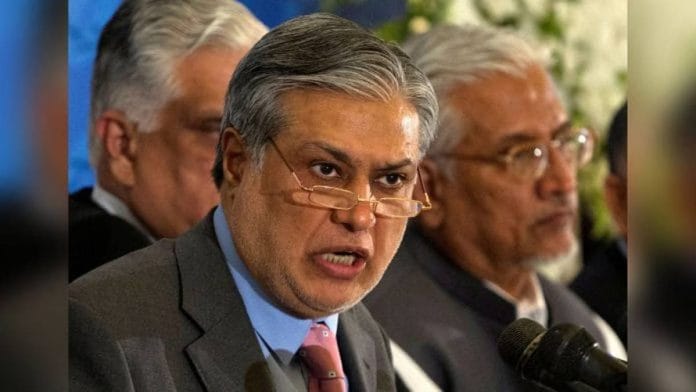



New Delhi: Pakistan’s Foreign Minister and Deputy Prime Minister Ishaq Dar Saturday said the nation’s military performance during Operation Sindoor was a “strong message” to the world, given that India claimed to being South Asia’s primary security provider, a narrative that had been accepted by “big powers”.
India had launched Operation Sindoor this May against terrorist infrastructure in Pakistan, following the 22 April terror attack in Jammu & Kashmir’s Pahalgam.
Speaking at a year-end press conference in Islamabad, Dar argued that Operation Sindoor had served as a real-world test of New Delhi’s self-projection as a hegemon and “net security provider”.
“The biggest success that Allah has given Pakistan in South Asia was the performance of Pakistan’s armed forces in the four-day conflict. The world received a strong message, because India claimed that they are the hegemon, they are the net security provider in this region. Some big powers might have bought it,” Dar said, adding that assumptions about India’s military dominance had been challenged.
Though he did not take any names, Dar’s remarks appeared aimed at the US and Indo-Pacific partners, particularly the Quad grouping, which includes India, US, Japan and Australia.
Washington has in recent years publicly endorsed India’s role as a stabilising force in the Indian Ocean region, part of a broader strategy to counter China’s growing influence. A joint US-India statement earlier this year reaffirmed American support for that role.
The Quad leaders’ summit was due to be hosted by India this year after the previous one in the US, but is yet to be scheduled.
Dar claimed that Operation Sindoor had altered several perceptions. Both India and Pakistan remained locked in an 87-hour confrontation in early May, involving air and missile strikes, before a ceasefire was announced.
“Pakistan was known as a diplomatically isolated country,” he said. “That perception has now changed.”
Also Read: Op Sindoor is India’s first AI-enabled operation. How ‘heavy use’ of modern tech by Army played out
‘Ready to lead Ummah’
Dar attributed the shift in perception to what he described as “principled, proactive and result-oriented diplomacy” under Prime Minister Shehbaz Sharif.
He said the crisis period was marked by intense engagement with foreign capitals, and claimed the PM spoke with more than 60 international counterparts before and after hostilities escalated on 7 May.
Recounting the lead-up to the confrontation, Dar said Pakistan’s civil-military leadership authorised key decisions during a late-night meeting on 9 May.
He stated that India then “made the mistake” of attacking the Nur Khan Airbase in the early hours of 10 May, triggering Pakistan’s retaliatory response. “The process that had been authorised by the prime minister had to be implemented,” he said, terming India’s move a “super mistake”.
Dar also claimed that India’s assertions about Pakistani attacks inside Indian territory failed to convince the international community. He said he challenged one of the five permanent members of the United Nations Security Council, arguing that such claims could not be hidden in the digital age.
“They called me back after 16 or 17 hours and told me we had not attacked anywhere in India,” he said, describing it as a diplomatic setback for New Delhi.
According to Dar, de-escalation came after intervention from key international players.
He said that US Secretary of State Marco Rubio called him early one morning to convey that India was ready for a ceasefire and asked whether Pakistan would agree.
“I told him we never wanted to go to war,” Dar said. He added that Saudi Foreign Minister Prince Faisal later confirmed India’s acceptance of the ceasefire after speaking directly with New Delhi.
The episode, Dar argued, reinforced the credibility of Pakistan’s military and defence capabilities. “It has been established that Pakistan’s armed forces, its technology and its capacity for defence are very solid,” he said.
Dar also linked security credibility to economic strength, saying Pakistan’s nuclear and missile capabilities must be matched by economic power.
Pointing to the country’s mineral wealth and energy resources, he said economic revival under PM Sharif would allow Pakistan to play a larger role in the Muslim world. “With economic power,” he said, “we will be able to lead the Ummah.”
(Edited by Nida Fatima Siddiqui)
Also Read: Op Sindoor: Inside story of what led Pakistan DGMO to make frantic calls for ‘ceasefire’
Pakistan has not learnt anything and it is on the confirmed suicidal path.