





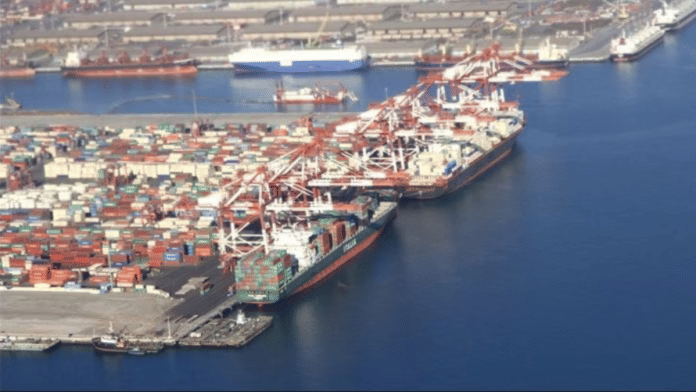



New Delhi: The Union Budget 2026-27 makes no allocation for the port of Chabahar for the first time in almost a decade, a further sign of India’s move to wind up its operations in the Iranian port.
The US has been applying a “maximum pressure” campaign on countries to curtail its investments in Iran. The expenditure outlay for the Ministry of External Affairs (MEA) in this year’s budget makes no mention of specific figures allocated to the Chabahar Port, which had for years received allocations anywhere from Rs 100 crore to Rs 400 crore.
In the revised estimates (RE) for the 2025-2026 financial year, Rs. 400 crore was allocated to the Iranian port, which has strategic implications for India. However, earlier this year, the Indian government is reported to have exited the project, after transferring roughly $120 million to the Iranian government to complete its financial commitments to the project.
Chabahar gives India access to Central Asia and Afghanistan, bypassing the traditional land route via Pakistan. Seen as a strategic outlet for India, the port looks to build transport corridors linking its Western coasts to Europe and further.
It was seen as a potential route as a part of the larger International North-South Transport Corridor (INSTC), which is a trade route connecting India with Russia, through multi-modal transportation methods including sea routes and rail routes.
However, the Chabahar project had hit a number of issues, mainly due to domestic legal requirements in Iran. In 2024, India finally signed a long-term agreement to run the Shahid Beheshti terminal at the port for a decade.
Since President Donald Trump first pulled out of the Joint Comprehensive Plan of Action (JCPOA) agreement with Iran in 2018, the US reimposed harsh sanctions on Tehran, which made investments in Chabahar risky.
However, the US had given India a sanctions waiver to continue operating the port in view of it being a potential trading route with Afghanistan.
However, since reassuming power at the White House, the Trump administration in 2025 initially did not extend the waiver given to India to operate Chabahar. In October 2025, the US finally gave India a six-month extension until April 2026. Trump also announced last month that any country continuing to trade with Iran will face a further 25 percent tariff.
Last month, MEA spokesperson Randhir Jaiswal had said at a regular press briefing that India remains engaged with the US to “work” on the arrangement for continuing operations in Chabahar.
Tensions between Iran and the US have risen in recent days. The US has been significantly building up its military presence in the region near Iran, with Trump threatening Tehran with military strikes if it does not come to the negotiating table over its nuclear programme.
Iran was also rocked with domestic protests for a few weeks starting at the end of December due to the prevailing economic situation.
The Iranian government has been accused by Western countries of using repressive methods to put down the protests that have left thousands dead. The European Union moved recently to sanction the Islamic Revolutionary Guard Corps (IRGC) as a terrorist organisation.
(Edited by Tony Rai)
Also Read: ‘Examining implications’: Why Trump’s move on Iran’s Chabahar port is a setback for India