





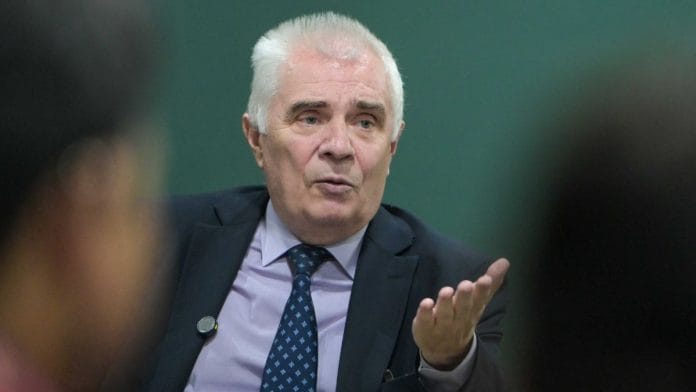



New Delhi: Trade policies by New Delhi were seen as protectionist, but the newly concluded Free Trade Agreement (FTA) with the European Union (EU) has opened a “strategic chapter” in bilateral ties between the country and the bloc, Poland’s Ambassador to India Piotr Antoni Świtalski has said.
The FTA must serve as the launchpad, not the limit, of this reinvigorated bilateral relationship, Świtalski said in an exclusive interaction with ThePrint Wednesday.
The Polish envoy described the moment as a “golden time” to deepen ties after what he candidly called a “lost decade” of drift.
“The FTA should be the floor, not the ceiling,” Świtalski said, adding that India’s image had transformed from a country once viewed as difficult and protectionist.
“The new India has a very attractive image. It’s the image of modernity, technology, advancement and talented people,” he said.
The FTA, he said, had already shifted sentiment among Polish businesses. “Lowering down the barriers, opening up the possibilities, this convinced our business community that it is time to start seriously thinking about India,” he said, asserting that Polish companies were now lining up to invest billions in the country.
He cited a high-tech company’s executive who had expressed intent to put “one billion dollars in India” to build a joint venture—aimed not just at India’s domestic market but at third-country markets.
“What they see is that you have the know-how. You have very qualified, very educated engineers and researchers in the high-tech business. Forging efforts with India makes sense because the main target is to sell in third markets—to create the bases here, together, and then expand,” Świtalski said.
The optimism comes against a modest baseline. Annual bilateral trade between India and Poland stands at roughly $6 billion — a figure Świtalski labelled “far below the potential”.
“Yes, we have a lost decade behind us. Now we have to catch up. I want to use this time to expand our ties and to forge the economic basis of our cooperation. We want to boost our relationship. We consider India to be a friendly country,” he said.
Also Read: 4 years of Ukraine war: Envoy flags ‘lull’ in ties with India—‘Kyiv’s efforts have been unilateral’
Cold War legacy and the China detour
Świtalski traced lack of focus on India to Poland’s post-Cold War pivot westward, when Warsaw’s energies were wholly consumed by EU and North Atlantic Treaty Organization (NATO) accession. “In the case of Poland, the challenge at that time was integration with the Euro-Atlantic structures. Our politicians, our business people, they were totally focused on Western Europe and the United States,” he said.
Then came a blunter admission. “As a professional diplomat, I can tell you: a whole part of the world disappeared from our radars, including, unfortunately, India. So, we lost interest. We stopped doing business with India,” he said.
When Poland did eventually look East, it looked at Beijing. “Ten to fifteen years ago, the absolute priority in Asia was China,” the ambassador said. The rethink came only recently. “We realised three, four years ago that this overemphasis was not probably the right course. There are other countries which may offer even better opportunities—like India,” he said.
Shared values, strategic pitch
Beyond economics, Świtalski drew on democratic affinity as a binding force. “What is attractive about India is the cultural proximity, the traditional links, which somehow disappeared, but they are still there. And also the fact that you (India) are a democracy. Your values are our values. We don’t have to convince ourselves in these values, because we practice them. And the climate for doing business is very open to us,” the ambassador said.
He made a pointed pitch for Poland as India’s gateway into Europe: “We are still very cheap. Our labour costs are cheaper. Secondly, we are safe—Polish cities are probably the safest in the European Union. Thirdly, we are modern. Our infrastructure, including internet accessibility, is one of the most developed in Europe.
People-to-people ties are already deepening. Daily flights operate between Warsaw and Delhi, carrying roughly 160,000 passengers a year. Nearly 30,000 Indian citizens live and work in Poland — the third-largest foreign community there after Ukrainians and Belarusians. “They feel well. They feel at home. They integrate well. They do not cause problems and they make good money,” Świtalski said.
The relationship received a diplomatic boost following Prime Minister Narendra Modi’s visit to Poland in 2024, which elevated bilateral ties to a formal strategic partnership. A concrete sign of momentum came at the recently concluded AI Impact Summit in New Delhi, where a letter of intent was signed between the Polish Federation of Entrepreneurs and the Karnataka government on high-tech collaboration.
“I believe that this new free trade agreement between the European Union and India should open a new strategic chapter in our relations. And then use Poland. You can always rely on Poland,” Świtalski said.
He pitched, “Poland and India are friendly countries. We should rediscover ourselves after a long break during which our radars had different priorities. But now, after Prime Minister Modi’s visit in 2024, we are strategic partners. We in Poland take it very seriously.”
(Edited by Prerna Madan)
Also Read: No country is ever fully sovereign. Cold War era taught India its real meaning