





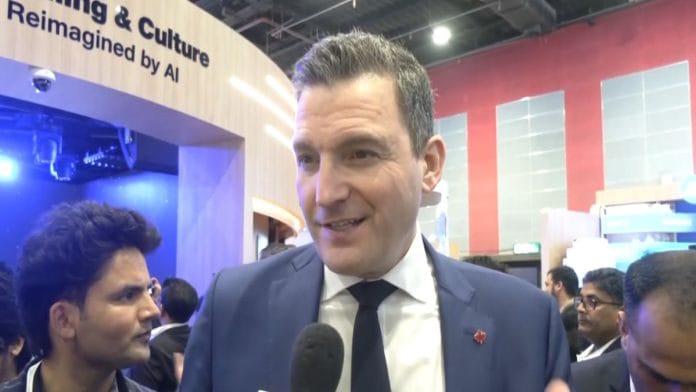



New Delhi: Sounding a warning against dependence on hegemonies like the US and China, Evan Solomon, the Canadian Minister for Artificial Intelligence and Digital Innovation, has called for deeper partnership between Ottawa and New Delhi.
He underlined that being sovereign does not mean being in “solitude” and hence it was important for Indo-Canadian ties to grow deeper despite the “recent challenges”.
“Now, building new ties in energy, business, research, education, and technology is really important. We share great resources… What we say often is, sovereignty does not mean solitude. We’re still trading (with different countries). But it does mean strength. It does mean deeper partnerships. It does mean security,” Solomon said, speaking to the media after backing a new initiative—LawZero—launched at the Canadian High Commission in the national capital on the margins of the AI Impact Summit.
He added: “For Canada, this is really important. We’ve had, as everybody knows, a long relationship between our two countries, two democracies, but it’s gone through challenging times. But since Prime Minister Carney has come, he’s met with Prime Minister Modi, he’s coming to India in two weeks. We’ve had a series of ministers come. The Minister of Foreign Affairs has been here. The Minister of Natural Resources and Energy and myself.”
Solomon led the Canadian delegation to the AI Impact Summit in New Delhi between 16 February and 20 February.
Ties between India and Canada have picked up momentum since Carney’s tenure as Prime Minister began in March 2025.
India had in October 2024 expelled six Canadian diplomats from the country and withdrew six of its own diplomats from its missions in Canada, including then High Commissioner Sanjay Kumar Verma as ties cratered over the killing of Indian designated terrorist Hardeep Singh Nijjar in British Columbia in June 2023.
“India has been on the frontier of many events. Deep, deep experience in tech. And so, we have a natural alliance. More than 33,000 Canadians work for Indian companies in Canada. We’ve got many great Canadian companies here. So, we’re growing the talent in business, innovation, health, life sciences, energy, education. The ties are growing,” said Solomon.
One of the latest initiatives announced by New Delhi and Ottawa is the trilateral partnership on critical technologies along with Australia on the margins of the G20 summit last year. The Australia-Canada-India Technology and Innovation Partnership (ACITI) was launched by the three prime minister, including Anthony Albanese in South Africa.
ACITI & middle power cooperation
The ministers in charge of artificial intelligence for the three countries—Ashwani Vaishnaw from India, Solomon from Canada and Andrew Charlton, Australia’s Assistant Minister for Science, Technology and the Digital Economy—held a trilateral Thursday on the margins of the AI Impact Summit, to start the process of formally establishing the ACITI.
“I met with the other two counterparts and we had a trilateral meeting here to start putting a framework around that, to start crafting what it would look like where we can map our alliances in terms of life sciences, mining. One of them is also AI safety… but how we can all benefit. So, you’ll see more of that when the prime ministers are together in two weeks, but we’ve really moved a lot to build a framework where these three countries can work together,” said Solomon.
He added: “But look, remember, we’re moving pretty quickly. They met in November. Here we are already in February, and we’ve already had a trilateral meeting. We brought up real business cases, investment cases. We’ve talked about mining and energy. We’ve talked about safety. And you saw my counterpart in India, the minister who was chairing it, when I intervened today, I spoke about it. He mentioned India is very interested in both governance solutions that are political and governance solutions to AI that are technical.”
Carney has been pushing for greater cooperation between the “middle powers” such as Canada and European nations as the race between the US and China on various frontiers continues to heat up. The Canadian position of curtailing dependencies on potential hegemons was reflected in President Emmanuel Macron’s address to the press in Mumbai Tuesday, as well as by Prime Minister Dick Schoof of The Netherlands Thursday.
Canadian and European administrations are pushing to strengthen their own economies as their traditional ally—the US—has been pushing an “America First” agenda under President Donald Trump. The US President has used access to the American economy as leverage in trade and tariff negotiations with every country in the world, disturbing eight decades of the post-World War II international order.
“I think what Prime Minister Carney said, what Prime Minister Modi said throughout this is, we need to work together. And we need options. We need to explore transparently, openly. But trusted partners for our democracies are really important, and that’s what we’ve got to build on,” the Canadian minister said.
Carney’s expected visit in March is set to see a number of deals struck between New Delhi and Ottawa including a long-term uranium supply deal worth $2.5 billion, apart from the potential signing of the terms of reference of a free trade agreement between the two countries. For Ottawa, access to the Indian market is a key part of its diversification strategy given that almost two-thirds of its merchandise exports is to the US currently.
(Edited by Viny Mishra)
Also read: NSA Doval’s Ottawa visit: India-Canada to appoint liaison officers to tackle transnational crimes