





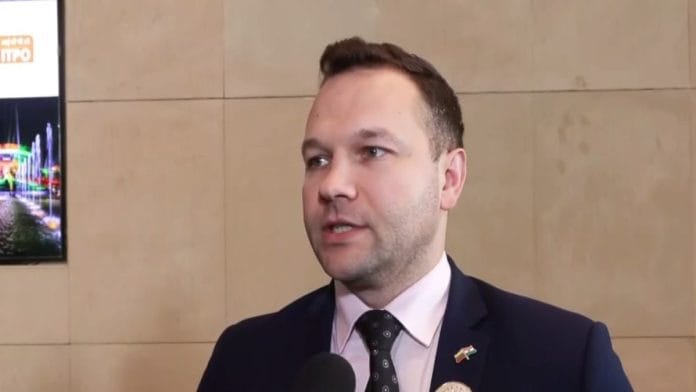



New Delhi: Technological sovereignty must be maintained said Lithuanian Minister Edvinas Grikšas in an exclusive interview with ThePrint, as potential concerns over New Delhi’s long-standing ties to Russia remain.
“Yeah, I guess we will have a lot of discussions, and this part of security, will be one of the topics, one of the main topics, maybe, but yeah, when I speak about cooperation, bilateral cooperation between Lithuania and India, it’s important to have the same priorities, to have the same approach to technological sovereignty. It is a part of security and is important, because AI can be used in every type of technology. It is important we create (technologies) bilaterally, that is how it should be,” Grikšas said.
He added: “You use AI in manufacturing, in defence, in biotechnology, in medicine technologies, actually everywhere, in public-private sectors. Actually it’s my first time in India, in New Delhi, so I hope, you know, to get in contact with the right people, and to build more bilateral cooperation and this international collaboration, when we speak about AI.”
The Lithuanian minister is leading the delegation for the Impact AI Summit in New Delhi held between 16 February and 20 February.
The Baltic country of 2.9 million people has a robust financial technology and artificial intelligence sector. Vilnius welcomed the recently concluded free trade agreement between India and the European Union (EU). As a part of the set of deals, India and the EU also signed the Security and Defence Partnership, which would allow for closer cooperation in strategic areas.
Countries in Central and Eastern Europe remain wary of India’s continued partnership with Russia, despite Moscow’s open warfare with Ukraine since February 2022. The nearly four-year war has seen India deepen its energy cooperation with Moscow. Indian oil imports from Russia reached $56 billion in the last financial year, raising some concerns among EU members and India regarding the transfer of technology.
Sources pointed out the robust technology partnerships India has been able to develop with Berlin and Paris and the strong track record of maintaining end-user agreements in ensuring the sovereignty of technologies.
In 2025, the Information and Communication Technology (ICT) sector accounted for roughly 7 per cent of Lithuania’s gross domestic product, with Vilnius focussed on scaling up its companies through partnerships in India.
“Lithuania is considered a hub for fintechs in Europe, actually. Sometimes I can even say I can be brave about this, yeah, it’s globally, because we created the best possible environment to attract investments, to help our national startups to grow in the field, and when we jump to AI, we have this ambition in this field also, you know,” said Grikšas.
He added: “We see ourselves as a hub because, we are part of the European Union and we are quite a small country, but this gives us, this agile approach, because Lithuania is very dynamic, we are quite a digitalised country, so we have a mission to be a hub for AI, not only in Europe, but, we see ourselves as a gateway to Europe.”
Grikšas called for closer global cooperation with partners like India as it is keen to scale up its own AI sector. Vilnius recently received EUR 130 million from the European Commission to build an AI factory in Lithuania.
“Today New Delhi, India is the heart of AI, you know… this format (AI Summit), more than 40 countries, leaders from all the countries, so from my side it’s important to help colleagues from abroad to hear more, to know more about Lithuanian approach to AI, to learn more about our capabilities, and, of course, when we speak about India, it’s important for us, you know, to share good practices, because AI, it’s the most horizontal breakthrough technology nowadays,” said the Lithuanian minister.
Grikšas highlighted that Lithuania is the number one country by GDP per capita created by technology unicorns, and two of the unicorns—with net value above $1 billion—are in cyber security.
“We have niche technologies, we have niche good practices, which we can share, in which we can cooperate with other countries, and of course, India’s ICT sector is growing very fast, and you have wonderful solutions in AI, so, you know, sharing good practices maybe bringing our business to business cooperation… to build some products,” the minister said.
He added: “Cyber security is one of the other parts, you know, (of) advanced manufacturing, you know, when we speak about productivity, industry revolution 5.0 is already here, actually. It’s not only about digitalisation, it’s about robotics, it’s about using AI to be more productive, to use less workforce, human resources, you know, and then to have connected humans, for example, hand manufacturing, together with AI, with robotics, it gives us the best possible way to be productive and competent.”
(Edited by Viny Mishra)
Also read: ‘Guardrails needed’—Lithuanian diplomat flags tech transfer risks amid growing India-EU defence ties