








New Delhi: India Monday warned its citizens to “exercise due discretion” while travelling to or through China following the case of an Indian national being harassed by authorities at the Shanghai Airport a couple of weeks ago. The warning by India came on the day when China announced that it will soon allow Indian citizens to apply for Chinese visas through an online portal.
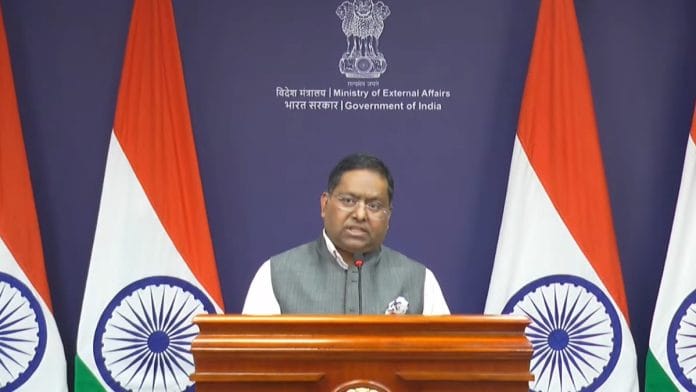
“We fully share your concern following the recent incident at Shanghai airport that you have cited. We expect the Chinese authorities to provide assurances that Indian citizens transiting through Chinese airports will not be selectively targeted, arbitrarily detained or harassed and that regulations governing international air travel would be respected by the Chinese side. MEA would advise Indian nationals to exercise due discretion while traveling to or transiting through China,” Randhir Jaiswal, the official spokesperson for the Ministry of External Affairs said at a regular press briefing.
The latest statement comes almost two weeks after India issued a strong démarche to both Beijing and the Chinese embassy here in New Delhi after an Indian citizen transiting through Shanghai airport was held up by authorities at the Shanghai airport for 18 hours. Pema Wangjom Thangdok, the Indian citizen, was born in Arunachal Pradesh and has been living in the United Kingdom for the past 14 years. She was on her way to Japan.
Thangdok alleged that Chinese authorities declared her Indian passport “invalid” and informed her that Arunachal Pradesh is a part of China. India’s latest statement comes as it seeks to reaffirm its territorial integrity and sovereignty over the North-Eastern state, which China has claimed as ‘Zangnan’ province.
Indian officials in China had to resolve the case and helped Thangdok leave the country. Beijing’s harassment of the Indian citizen is in “contravention” of both the Chicago and Montreal conventions on civil aviation, as reported by ThePrint.
“China’s border inspection authorities carried out checks procedures in accordance with laws and regulations, the law enforcement was impartial and non-abusive, the lawful rights and interests of the person concerned were fully protected, no compulsory measures were taken on her, and there was no so-called detaining or harassing,” Mao Ning, a spokesperson in the Chinese Ministry of Foreign Affairs said on 25 November, refuting the allegations of harassment, while reasserting Beijing’s claims on Arunachal Pradesh, at a regular press conference.
The latest war of words has come at a time when India and China have sought to stabilise ties following an almost half decade of a diplomatic chill. The chill began following the clashes between Indian and Chinese militaries in Galwan in the summer of 2020.
However, ties in the last year have moved forward, with New Delhi and Beijing coming to an agreement on de-escalation at the friction points across the Line of Actual Control (LAC) in October 2024. Prime Minister Narendra Modi travelled to Tianjin, the Chinese city, earlier this year to attend the Shanghai Cooperation Organisation (SCO) Heads of States summit.
Chinese Ambassador Xu Feihong Monday announced that the online visa application system for Indian nationals will be launched on 22 December.
“Applicants could enjoy (the) convenience of filling out the form and uploading application materials online by visiting (the website.) Welcome to visit the website for more details,” Xu said in a post on the social media platform X.
Beijing has been pushing for the resumption of tourism and business travel between the two countries. As part of the confidence-building measures, India and China resumed direct air services a couple of months ago. The Indian embassy and consulates in China have also started issuing tourist visas for Chinese nationals, with the system expanding to allow Chinese nationals living in third countries to apply at any Indian mission globally.
(Edited by Viny Mishra)
Also read: India is trying a new China strategy. It’s called ‘managed rivalry’