





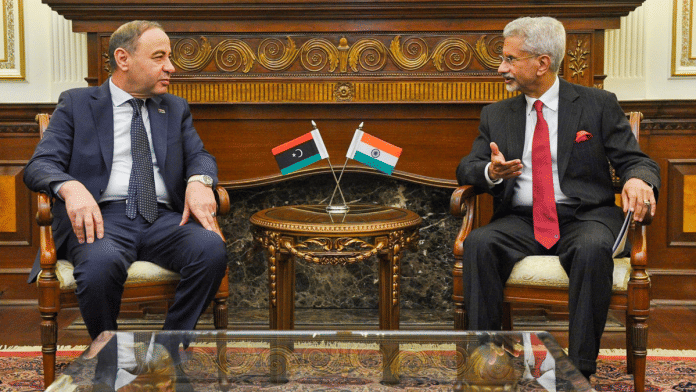



New Delhi: External Affairs Minister S. Jaishankar Saturday asserted India’s right to “defend” itself against cross-border terror attacks, while calling for “zero-tolerance for terrorism” as a universal norm during the second India-Arab Foreign Ministers’ Meeting in the national capital.
“A common threat in both our regions to these objectives is that of terrorism in all its forms and manifestations. Cross-border terrorism is particularly unacceptable because it violates the basic principles of international relations and diplomacy,” Jaishankar said.
“Societies targeted by terrorism have the right to defend themselves and will understandably exercise it. It is essential that we strengthen international cooperation to combat what is a global scourge. Zero-tolerance for terrorism must be an uncompromising universal norm,” he added.
The statement assumes significance as Pakistan has deepened ties with several Arab League countries over the past year, including a strategic mutual defence agreement with Saudi Arabia.
The meeting saw participation from all 22 member-states of the Arab League, including foreign ministers, ministers of state, vice-ministers and senior officials. This is the second such meeting since 2016 and is being hosted by India. Arab League delegations met Prime Minister Narendra Modi earlier Saturday ahead of the summit.
Jaishankar underlined the importance of closer ties with the Arab League, noting the region is home to India’s “largest expatriate communities” and serves as a “key” source for energy and trade.
India’s trade with Arab League members crossed $240 billion in the last financial year, with half of its energy imports sourced from the region. Nearly all of India’s trade passes through the Suez Canal, Red Sea and Gulf of Aden – connectivity points surrounded by member-states.
Also Read: Why India and Oman remain among the oldest strategic partners of the Indian Ocean world
“Our meeting will examine an agenda for such cooperation in 2026-28. It currently covers energy, environment, agriculture, tourism, human resource development, culture and education, among others,” Jaishankar said.
He added, “India looks forward to a more contemporary dimension of cooperation being included, such as digital, space, start-ups, innovation, etc. We will also be contemplating working together on counter-terrorism and parliamentary exchanges.”
The External Affairs Minister highlighted regional conflicts in Yemen, Sudan, Libya, Lebanon, Syria and Gaza, stating that foreign ministers would deliberate in detail on the Gaza peace plan and its prospects.
“There are a number of other situations in the region that also merit our collective attention. One is the conflict in Sudan that is exacting a deadly toll on its society. Another is that in Yemen, with the additional implication for the safety of maritime navigation. Then there is the concern about Lebanon, where India has troops committed to UNIFIL (United Nations Interim Force in Lebanon). Where Libya is concerned, all of us have an interest in advancing the national dialogue process. The direction of events in Syria is also critical for the well-being of the region,” Jaishankar said.
“Contemplating this multitude of challenges, our shared interest warrants strengthening forces of stability, peace and prosperity,” he added.
Prime Minister Modi, during his interaction with the Arab delegations earlier in the day, “reiterated India’s continued support for the people of Palestine and welcomed ongoing peace efforts, including the Gaza peace plan”.
India has been a long-term development partner for Palestine. Roughly $170 million worth of development assistance has so far been given by New Delhi. Of these, projects worth $40 million are presently under implementation. PM Modi reiterated India’s support for partnering with Palestine as development partner.
Jaishankar held bilateral meetings Friday and Saturday with foreign ministers from Oman (Badr Albusaidi), Somalia (Abdisalam Ali), Libya (Eltaher S.M. Elbaour), Sudan (Mohieldin Salim Ahmed Ibrahim), Palestine (Varsen Shahin) and Comoros (Mbae Mohamed).
Elbaour’s visit marks the first diplomatic engagement from Libya at this level since 2011, when former leader Muammar Gaddafi was removed from power. Pakistan has, in recent months, reached out to “warlord” Khalifa Haftar, who controls Eastern Libya, with negotiations ongoing for the sale of advanced aircraft. Pakistan has also sought to sell military equipment to Sudan.
Jaishankar’s meeting with Elbaour focussed on cooperation in trade, infrastructure and energy. With Palestine, the External Affairs Minister and his Palestinian counterpart exchanged views on the Gaza peace plan and agreed on initiatives to advance development cooperation with Ramallah.
(Edited by Prerna Madan)
Also Read: Swiss report should now close Op Sindoor debate. Knowing when to stop the fight is key too