





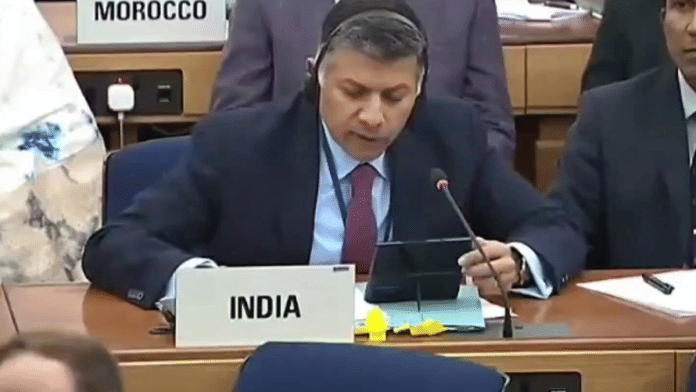



New Delhi: India Thursday called the targeting of commercial shipping and the closure of the Strait of Hormuz as “unacceptable” in its strongest criticism of the move by Tehran to disrupt the movement of ships in the vital waterway that accounts for the flow of roughly a fifth of global energy needs.
“We reiterate that targeting commercial shipping, endangering civilian crews and impeding safe and free navigation through international waterways, including the Strait of Hormuz, are unacceptable. The exercise of navigational rights and freedom by merchant and commercial vessels in accordance with international law must be respected,” Vikram Doraiswami, India’s High Commissioner to the United Kingdom and Permanent Representative to the International Maritime Organisation (IMO) said in a statement at the 36th extraordinary session of the IMO Council.
Doraiswami added: “The safety and welfare of seafarers, the security of international shipping, energy supply chains that sustain nations and humanitarian supply chains that ensure the survival and welfare of seafarers must remain paramount.”
The Indian permanent representative to the organisation Thursday highlighted that of the seven seafarers killed during the ongoing conflict in West Asia, three were from India, indicating the impact current threats to civilian maritime shipping have on Indian nationals. Around 13 per cent of global seafarers are Indian.
“At present, 24 Indian flagged vessels are operating in the Persian Gulf region, including 22 vessels west of the state of Hormuz, with 611 Indian seafarers on board, and two vessels east of the state of Hormuz, with 47 seafarers on board. All vessels and crew are being closely monitored for their safety and security. India’s energy security and trade are critically dependent on the safe and unimpeded passage through the state of Hormuz,” said Doraiswami.
India has been in touch with Iran to allow its vessels to move through the international waterway. At least two Indian vessels carrying energy resources were allowed to pass through the Strait of Hormuz earlier this week. The disruption of ship movement through the Strait of Hormuz has led to a spike in oil prices, while other energy goods such as liquefied natural gas (LNG) have also been impacted by the war.
Iran Wednesday struck the Ras Laffan Industrial City in Qatar, wiping out production of roughly 17 per cent of Qatar’s total LNG exports, worth $20 billion annually. The US has been pushing countries to join its endeavour to ensure ship movement through the Strait of Hormuz, but has found little support from its allies and the world at large.
“Any disruption, obstruction or closure of these vital waterways has direct consequences for India’s economy and for global energy and humanitarian supply chains…We note with grave concern the grave risk of marine pollution arising from attacks on commercial vessels in these waters,” said Doraiswami.
The war is now finishing its third week, and has seen further escalation with Israel launching attacks on Iran’s South Pars natural gas field Wednesday. In retaliation Iran launched strikes at energy infrastructure across Qatar, Saudi Arabia and the United Arab Emirates.
Iran’s threats and disruption to the Strait of Hormuz were condemned by the IMO at the end of the extraordinary session Thursday. The declaration tabled by the UAE and co-sponsored by over 115 member-states – the most in IMO’s history—demanded that Tehran immediately refrain from any further attacks or actions to disrupt the movement of civilian maritime vessels through the Strait of Hormuz.
The IMO also called for the establishment of a mechanism to get merchant vessels out of the region, as well safe evacuation of seafarers from the Strait of Hormuz.
(Edited by Shashank Kishan)
Also Read: Strait of Hormuz crisis shows limits of US, say Chinese. ‘India most vulnerable’