





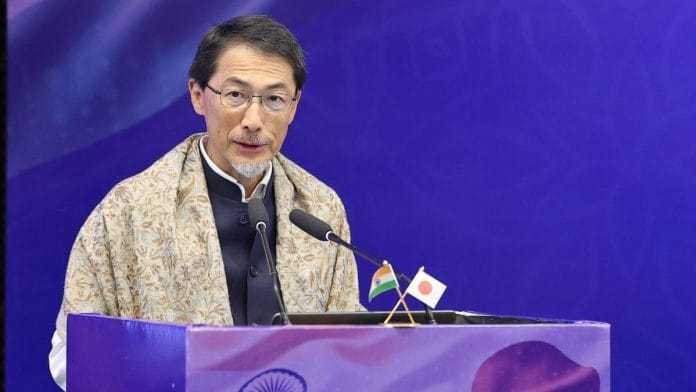



New Delhi: India and Japan will finalise the “co-production and co-development” of the UNICORN radar “soon”, as a part of the bilateral efforts to deepen defence ties, Ono Keiichi, Tokyo’s envoy in New Delhi, said Tuesday.
“Security cooperation has matured in the maritime field [between India and Japan]. Going forward, we will enhance jointness in land, sea, air and emerging dimensions, to ensure that our military can operate together across dimensions,” Ono said, speaking at the International Conference on India-Japan Cooperation in the Indo-Pacific organised by the India Foundation in the national capital.
The Japanese ambassador highlighted that over the last few years, the relationship between the two countries has developed due to a transformation across “four pillars of diplomatic and defence ties”.
The two countries signed a memorandum for co-development of UNICORN (Unified Complex Radio Antenna) masts in November 2024. India was the second Asian nation to have such an agreement with Tokyo, following the Philippines. The UNICORN mast is considered among the more technologically advanced antennas in the world, owing to its stealth technology and radio frequency functioning. The masts aid in improving stealth capabilities of naval vessels.
The foundation of the defence partnership between India and Japan was initiated in 2015, when they signed the transfer of defence equipment and technology agreement. The UNICORN mast is meant to be the marquee project to kick off this dimension of ties between the countries.
Discussions surrounding the transfer of the UNICORN technology also figured in the talks between External Affairs Minister S. Jaishankar and his Japanese counterpart Toshimitsu Motegi during the latter’s visit to New Delhi in January.
Under Prime Minister Sanae Takaichi, Japan has sought to accelerate its defence expenditure and development of technologies, said Ono. Tokyo is set to achieve its goal of spending two percent of its gross domestic product on defence by end of 2026 fiscal year, the Japanese envoy pointed out, while highlighting the efforts by the incumbent PM to “accelerate the review of three key security documents to the end of this year, one year ahead of the schedule”.
“Prime Minister Takaichi showed her commitment to deepen ties in plurilateral frameworks including Quad. The Quad remains a framework to advance our interests and for the region in an open and transparent way. Japan remains committed to Quad,” the Japanese ambassador further said, adding that India and Japan are moving forward to focusing on economic security resilience, especially in an “era of economic coercion and fragile supply chains”.
”During discussions between our foreign ministers, they achieved sufficient progress in economic security…The first B2B economic security discussions will take place day after tomorrow, which is another testament to the business dimension of the relationship,” he said.
The ambassador was clear that as Tokyo looks to strengthen its own defence capabilities, it remains aware of the challenges in the region, specifically from China and the Democratic People’s Republic of Korea (North Korea).
“With China, Japan remains steadfast on its territorial sovereignty and integrity, and reiterates that it opposes any unilateral measures to forcefully change the status quo,” he said.
The ties between Tokyo and Beijing have plunged to their lowest levels in years, after PM Takaichi suggested that Japan’s Self Defence Forces may be activated in the event of any attack by China on Taiwan.
Japan does not formally recognise Taiwan—a self-governing territory recognised by over 180 countries, including India—as a part of China. Beijing responded to Takaichi’s comments by sending warships to the region, slowing rare earth exports and moving to curb travel by Chinese tourists to Japan. Beijing went as far as reclaiming two pandas gifted to Japan.
The Japanese ambassador also highlighted the challenges of a nuclear-armed North Korea and its impact on Tokyo’s security architecture.
(Edited by Mannat Chugh)
Also Read: India-US trade deal to be signed after Trump administration decides new global ‘tariff architecture’