





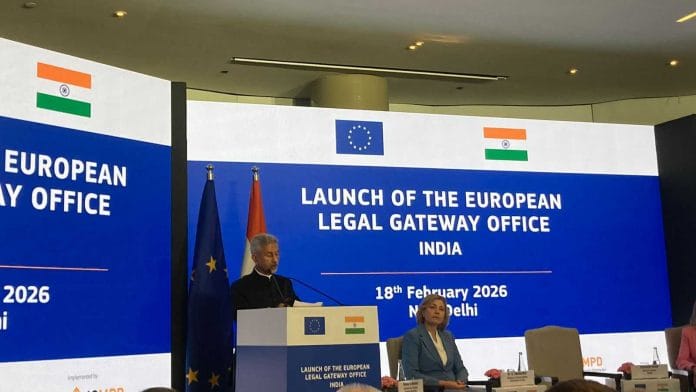



New Delhi: The growing “strategic convergence” between India and the European Union (EU) set the stage for the mobility partnership, External Affairs Minister S. Jaishankar said as the two sides launched the first deliverable from the recently concluded Joint Comprehensive Strategic Agenda with the inauguration of the European Legal Gateway Office in the national capital.
“India’s partnership with the EU is promising not just because of our shared values but because we see ourselves as natural and preferred partners and growing strategic convergence. The conclusion of negotiations for the FTA, security and defence partnership, have put forward a roadmap for our shared future,” Jaishankar said.
He added that India is “increasingly a major contributor to global talent pools”, promoting “mobility with a purpose”. Jaishankar launched the new office alongside Henna Virkkunen, the EU’s executive vice-president for Tech Sovereignty, Security and Democracy, on the margins of the Impact AI Summit.
“The adoption of the ‘Towards 2030: a Joint India–European Union Comprehensive Strategic Agenda’ at the Summit really opens up a new chapter in our ties—towards mutual prosperity, security and sustainability, and in that, we recognise the key role of talent, skills and knowledge. Now, the Comprehensive Framework for Cooperation on Mobility that was signed at the Summit, and the establishment of this Legal Gateway Office, translate our broader understanding into concrete action,” the Indian External Affairs Minister said.
Virkkunen described “talent as the true infrastructure of the digital age” calling the mobility partnership a “strategic asset” as it promotes the building of skills “fostering innovation and creation of opportunities on both sides”.
India and the EU on 27 January unveiled an ambitious joint agenda after the two sides concluded negotiations for a free trade agreement (FTA), signed a security and defence partnership and launched negotiations for an intelligence agreement, as a part of the deepening strategic ties.
The agreements came as the Western countries are facing a major reordering of the geopolitical paradigm led by US President Donald Trump, who has taken aim at free trade and global mobility since his return to the White House.
“We are living through a period of profound transformation in the global economy. De-risking is a growing priority. Supply chains are being reconfigured. Technology is reshaping work. Demographics are diverging sharply across geographies. The concept of a global workforce is an emerging reality. Countries that can connect talent flows with seizing opportunities, while ensuring legality, transparency and fairness, will be best positioned to navigate this transition,” said Jaishankar.
The gateway office will provide information to those seeking to migrate to the 27 member-states of the EU. However, migration remains the sole competence of the member-states themselves.
“The European Legal Gateway Office will serve as a one-stop hub for Indian talents in technology interested in opportunities in Europe. It will provide clear, reliable information on study and work pathways, in full alignment with Member States’ frameworks and needs,” said Virkkunen.
Indians have become one of the larger migrant communities in the EU, with a number of students choosing to study at European institutions, while technology companies and other firms have started establishing their offices across the continent. Ireland alone is home to around 100,000 people from the Indian community, accounting for two per cent of the country’s total population.
Similarly, Germany, Spain, France and a number of other EU countries have seen an increasing number of students and professionals from India. India and the EU have launched exploratory negotiations to have New Delhi join the Horizon Europe programme, which is roughly a EUR 90 billion budget for academic research.
Horizon Europe and the legal gateway office are the first in a series of deliverables highlighted in the strategic comprehensive agenda between India and the EU. The two sides are expected to sign the FTA later this year, and kick-start the respective ratification processes, while the intelligence agreement will support further cooperation in defence and security sectors.
(Edited by Gitanjali Das)
Only last year, Jaishankar was lecturing the EU! It was a poor judgement. We cannot improve our economy isolating a continent with GDP of over $20 T!!