





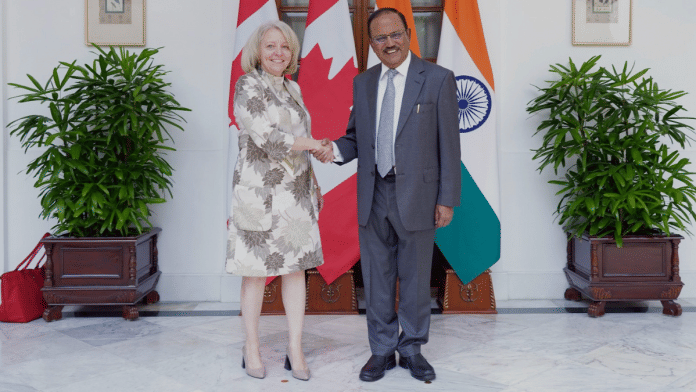



New Delhi: India and Canada Sunday agreed to establish “security and law enforcement liaison-officers,” to enable the sharing of information on issues related to transnational criminal networks and the illegal flow of drugs such as fentanyl precursors, after National Security Adviser (NSA) Ajit Doval travelled to Ottawa for a two-day visit.
Sources in the security establishment said that the “key message” from Doval’s visit to Ottawa is that “violent extremist groups do not enjoy the support of the Government of Canada.” Doval was in Canada for a two-day visit from 6 February till 7 February.
“The two sides acknowledged the progress on initiatives aimed at supporting the safety and security of their countries and citizens. They agreed to a shared work plan to guide bilateral cooperation on national security and law enforcement issues and to enable practical collaboration on respective priorities,” the statement issued by the Ministry of External Affairs said.
The statement added: “During the meeting, it was agreed that each country would establish security and law-enforcement liaison officers and that their respective agencies would build on working relationships. This important step will help streamline bilateral communications and enable timely information sharing on issues of mutual concern to Canada and India, such as the illegal flow of drugs, particularly fentanyl precursors, and transnational organized criminal networks.
Doval held meetings with his Canadian counterpart Nathalie G. Drouin, as well as engaging in discussions with Gary Anandasangaree, the Canadian Minister for Public Safety. The visit comes as India and Canada continue to strengthen their ties in security cooperation, after years of issues surrounding New Delhi’s concerns of the activity of violent extremist groups operating transnational criminal networks that included the North American nation.
“They also committed to formalizing cooperation on cybersecurity policy and information sharing on cybersecurity issues, as well as continuing discussions on cooperation related to fraud and immigration enforcement, consistent with domestic laws and international obligations,” said the statement.
Prime Minister Mark Carney of Canada shifted discussions surrounding security cooperation to the appropriate levels, which has allowed for a thaw in ties and regular meetings between the two NSAs. Ties between India and Canada cratered at the end of 2023, when then Prime Minister Justin Trudeau accused Indian officials of being linked to the killing of Hardeep Singh Nijjar.
Nijjar, a Sikh extremist and designated terrorist in India, was killed outside a gurdwara in June 2023 in Surrey, British Columbia. Ties took a nose dive in October 2024, with Canadian authorities requesting India to waive diplomatic immunity for the then Indian High Commissioner in Ottawa, Sanjay Kumar Verma.
India refused and withdrew six of its diplomats from its missions in Canada, while expelling six Canadian diplomats from its missions here. New Delhi also sought “parity” requesting Canada to remove 41 diplomats from its missions across India in October 2023, severely limiting their activities in India.
Carney’s rise to power last year, however, kick-started the rapprochement between New Delhi and Ottawa. Modi met Carney twice in 2025, once in Canada on the margins of the G7 summit last June and a second time on the margins of the G20 summit in South Africa. The meetings set forth an extensive agenda as India and Canada sought to expand economic relations with the launch of negotiations for a free trade agreement, closer civil nuclear cooperation and energy deals, including long-term contracts for the procurement of uranium.
The movement in ties came as a result of Modi and Carney sharing a good rapport, focussed on expanding the political engagement of ties. However, the lingering issues, especially transnational criminal organisations and illegal flow of drugs, has been moved to the cooperation between the security agencies.
Drouin and Deputy Foreign Minister David Morrison met with Doval in India last year, while Canadian Foreign Minister Anita Anand travelled to New Delhi and Mumbai, signalling a thaw in ties. Carney is expected to travel to India in the first week of March, as reported by ThePrint.
(Edited by Shashank Kishan)
Also Read: India-Canada have decided to resume diplomatic ties. Carney has an opportunity to rebuild trust
You have to give credit to Carney. Man literally reversed the whole India-Canada relationship which was falling into a deep pit (because of Trudeau – who is like Rahul Gandhi of Canada)