








New Delhi: India Tuesday called for an “early” end to the conflict in Iran, highlighting that it is occurring during the holy month of Ramadan, while maintaining its silence on the killing of Iranian Supreme Leader Ayatollah Ali Khamenei.
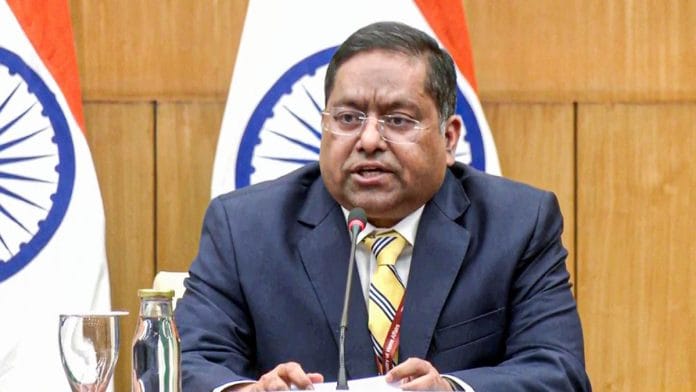
“We had expressed our deep concern at the commencement of the conflict in Iran and the Gulf region on 28 February 2026. Even at that time, India had urged all sides to exercise restraint, avoid escalation and prioritize the safety of civilians. Unfortunately, in the holy month of Ramadan, the situation in the region has deteriorated significantly and continuously,” Randhir Jaiswal, the official spokesperson for the Ministry of External Affairs said in a first clear statement of India’s position on the war.
Jaiswal added: “In recent days, we have not only witnessed an intensification of the conflict but also its spread to other nations. The destruction and deaths have mounted, even as normal life and economic activities come to a halt. As a proximate neighbour with critical stakes in the security and stability of the region, these developments evoke great anxiety.”
The Indian spokesperson highlighted that almost 10 million Indians live in West Asia, who are impacted by the war, as well as the potential consequences the conflict has on New Delhi’s energy needs. At least three Indians have been killed in strikes on maritime vessels by Iran as reported by ThePrint. Another 20 to 25 individuals are injured, with one on critical support.
“In this background, India strongly reiterates its call for dialogue and diplomacy. We raise our voice clearly in favour of an early end to the conflict. Already, many lives have been regrettably lost and we express our grief in that regard,” asserted Jaiswal.
While India’s position of dialogue and diplomacy to deescalate the conflict is similar to its position on other conflicts in the world, it has remained mum on the killing of a leader of a sovereign nation, while other countries including Bangladesh have condemned the assassination of Khamenei.
Khamenei was killed Saturday as part of the opening moves by Israel and the US. Iran has since retaliated across the region, taking aim at merchant shipping vessels, while also striking a number of installations in nearly half a dozen neighbouring countries. The US mission in Riyadh was struck by Iranian drones Tuesday.
Bahrain, Kuwait, the United Arab Emirates, Oman, Qatar and Saudi Arabia have all come under an intense barrage of missiles from Iran. The port of Duqm in Oman was also struck with Iranian drones. In the early hours of Tuesday, Israel began strikes in Lebanon in response to Hezbollah’s cross-border rocket fire. India has condemned the attacks on the UAE, Oman, Bahrain and Saudi Arabia.
Israel has begun military operations in Southern Lebanon as the war continues to expand on the fourth day. US President Donald Trump has vowed to remain as engaged as necessary to curtail the threat Tehran poses to its interests in the region.
However, US Secretary of State Marco Rubio muddied the waters of the end goal of the war, highlighting that Washington involved itself as a “pre-emptive measure” following the fact that Israel was going to go to war with Iran. Rubio Monday said the US understood that an Israeli strike would lead to retaliation against its military bases in the region by Tehran and therefore joined Tel Aviv in bombing Iran.
The Islamic Revolutionary Guard Corps (IRGC) has vowed revenge for the killing of Khamenei, while Ali Larijani, the head of Iran’s national security council announced that Iran is not keen on negotiating an end to the conflict. Larijani went further, blaming Trump’s “delusional fantasies” for engulfing the region in war.
The IRGC has vowed to enforce a closure of the Strait of Hormuz—the narrow waterway connecting the Persian Gulf and the Gulf of Oman—through which a fifth of global oil supplies travel through.
The attacks have caused a surge in the price of crude oil. Brent crude futures hit $83.79 a barrel early Tuesday morning, the highest since July 2024 when it touched $85.12, reported Reuters. The UAE is dealing with a serious fire at the Fujairah port Monday, while Iraq’s ability to export oil from its Kirkuk fields have been hampered as Türkiye’s Ceyhan port stopped loading of crude from the country, according to reports.
QatarEnergy announced Monday suspension of the manufacturing of liquified natural gas, while on Tuesday in a new statement announced that a number of downstream products have also seen its production suspended. Saudi Arabia shut down its largest refinery in Ras Tanura Monday following an Iranian drone strike.
Tehran’s policy of striking at US assets across the region have raised the costs of war for Trump. At least six American military personnel have been killed due to Tehran’s retaliation.
(Edited by Gitanjali Das)
Also Read: India has ‘40–45 days’ of crude cover, but long-term Hormuz disruption could inflate import bill
I am glad that we have changed our approach from being a neutral to actually picking a side – which is the gulf countries who were attacked by the Iranians and this also threatens our diaspora.
People in our country who are supporting Iranian because a foreign leader died – who are you loyal to ? Ayatollah is not our leader. I don’t care what your stance is about this war but if it becomes anti Indian or anti India then you need to pack your bags and move out of this country.
The UAE is a better partner for us than the Iranians ever have been. wtf have they given to us ? They were playing hard when we wanted the port and the construction of road to Afghanistan. Screw them.